Science · France, People's Republic of China
AI Method Identifies Sex Pheromone of Lily Moth
Researchers used artificial intelligence to predict olfactory receptor structures and pinpoint the sex pheromone of the lily moth, a pest with no established chemical control method, in a study published in BMC Biology.
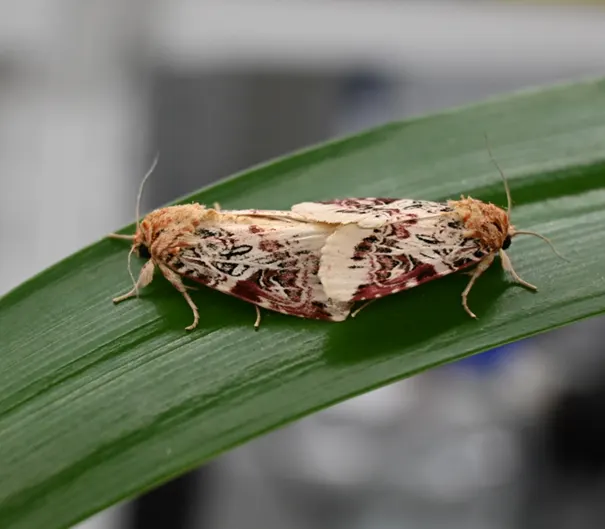
Scientists from INRAE, collaborating with Université Côte d'Azur and, according to some reports, China's Nanjing Agricultural University, applied an AI-driven technique to pinpoint the sex pheromone produced by the lily moth, a pest present in Asia and Oceania but absent from mainland France. The team began by analysing the moth's genes to select candidate olfactory receptors, then used AI to predict their structures and molecular docking to test which volatile molecules might bind to them.
Experiments confirmed that females secrete the molecule (Z,E)-9,11-tetradecadienyl acetate, which males detect and which triggers attraction and sexual behaviour. Published in BMC Biology, the work was carried out under the Invoria project, funded through France's EXPLOR'AE Programme, and researchers say the approach could speed up pheromone identification in other pest species, potentially supporting biocontrol methods.
An AI-based method identified the lily moth's sex pheromone and its receptors, offering a faster route to biocontrol tools for pest species.
- AI predicted olfactory receptor structures before lab confirmation
- Pheromone identified as (Z,E)-9,11-tetradecadienyl acetate
- Lily moth found in Asia and Oceania, not mainland France
- Study published in BMC Biology, funded via EXPLOR'AE Programme
- Approach may speed pheromone discovery in other pest species
What's new
- AI-based modelling and molecular docking predicted receptor–molecule interactions before lab testing
- Predicted pheromone confirmed by electrophysiological, chemical and behavioural experiments
- Compound (Z,E)-9,11-tetradecadienyl acetate shown to attract and elicit sexual behaviour in male lily moths
- Approach offers a faster route to identifying pheromones in other insect species
A team based at INRAE, partnering with Université Côte d'Azur and China's Nanjing Agricultural University, applied an AI-driven technique to pinpoint the sex pheromone produced by the lily moth, a pest present throughout Asia and Oceania, per research published in BMC Biology and reported in coverage appearing between 21 and 26 September 2026.1234
A reversed approach
Rather than starting from the insect that emits a chemical signal, researchers began with the receiver: the lily moth's olfactory receptors. They analysed the insect's genes and, by comparing them with related species, selected two candidate receptors likely to be involved in detecting a sex pheromone.213
Artificial intelligence was then used to predict the three-dimensional structure of these receptors, and molecular docking techniques tested a range of volatile molecules to identify those most likely to interact with them, according to the researchers.213
From prediction to confirmation
The computational analysis pointed to a candidate pheromone and its associated receptors. Experimental tests then confirmed that the selected olfactory receptors could detect the predicted volatile compounds, and physicochemical and electrophysiological methods showed that female lily moths secrete the molecule while males are able to detect it, per the researchers.21
The molecule identified is (Z,E)-9,11-tetradecadienyl acetate. Behavioural tests confirmed that it attracts male lily moths and triggers sexual behaviour in them, the researchers reported.21
The published study also reports that AI-assisted modelling and docking of two specific receptors, OR5 and OR75, predicted the principal pheromone component, which was subsequently verified through gas chromatography-mass spectrometry, antennal recordings and behavioural experiments. The paper additionally identifies three minor components of the pheromone blend and examines how the receptors evolved through gene duplication.5
A pest without an established control method
The lily moth is a non-model species not found in mainland France, according to the researchers, and its sexual communication was previously unknown. Its caterpillars feed on the plants referenced in the study, and the moth is characterized as a notable pest across numerous regions worldwide, especially in private gardens, public parks and botanical gardens, where pest-control product regulations are particularly stringent, per the dossier's sources.2134
Phys.org reports that INRAE researchers, in collaboration with Université Côte d'Azur and China's Nanjing Agricultural University, applied the AI-based technique to pinpoint both the pheromone and its associated olfactory receptors, with the outlet also noting the lily moth's status as an insect pest and identifying Nanjing Agricultural University's location in China.4
Wider implications for crop protection
Identifying a species' sex pheromone can aid population management, and certain existing biocontrol methods already exploit insect sexual signaling to mitigate crop damage, the researchers note. Insects are described as essential for ecosystem services while also causing damage to crops.21
Phys.org notes that such molecules are central to several biocontrol strategies presently employed for crop protection, especially in France, and that this newly proven technique for discovering previously unidentified molecules could pave the way for finding pheromones in additional species.4
The researchers characterize the study as demonstrating feasibility for matching receptors with pheromones in insects, stating that the method could substantially accelerate efforts to identify undiscovered sex pheromones across numerous species. They add that identifying such molecules can also offer insight into the evolutionary history of species, since pheromones function as chemical signatures that contribute to species isolation.21
Funding and next steps
This research took place under the Invoria project, backed by the EXPLOR'AE Programme that France's Ministry of Higher Education, Research and Space assigned to INRAE for fostering innovative, disruptive research with potentially major impact. Experiments building on the findings are currently under way on the lily moth, according to the researchers.214
Why it matters
Pheromone-based methods can offer targeted alternatives to chemical pesticides, which is relevant where regulations on pest control are strict, such as in public parks, private gardens and botanical gardens. A faster, AI-assisted method for identifying pheromones could extend such options to pest species whose chemical signals remain unknown.21
How the story unfolded
The story's events over time. Click a person, place or related story.
What we know
- The lily moth's sex pheromone and two associated olfactory receptors were identified using an AI-based method.
- The pheromone is (Z,E)-9,11-tetradecadienyl acetate, secreted by females and detected by males.
- Behavioural tests confirmed the pheromone attracts males and triggers sexual behaviour.
- The results were published in BMC Biology and produced under the Invoria project, funded through the EXPLOR'AE Programme.
- The lily moth is a significant pest in gardens and parks in many parts of the world but not in mainland France.
What we don't know yet
- Whether the precise contributions of Université Côte d'Azur and Nanjing Agricultural University to the collaboration are verified beyond a single source.
- Whether the lily moth is formally classified as an insect pest across all reporting.
- The extent to which the identification approach will be applied to other species going forward.
- Details of how biocontrol strategies using these molecules operate in France beyond a single-source claim.
Timeline
- 21 SeptINRAE reports development of the AI-based method that identified the lily moth's sex pheromone and receptors, carried out under the Invoria project.1
- 21 SeptBMC Biology publishes the peer-reviewed study describing AI-assisted modelling of receptors OR5 and OR75 and confirmation of the principal pheromone.5
- 22 SeptFreshPlaza states that INRAE, together with Université Côte d'Azur and Nanjing Agricultural University, created and trialed the new approach using the lily moth.3
- 24 SeptEurekAlert!/INRAE republishes details of the method, including selection of two candidate receptors and confirmation of the pheromone's effects.2
- 26 SeptPhys.org reports the results, obtained under the EXPLOR'AE program, and describes the international collaboration behind the method.4
Quotes
non-model
Invoria – Reverse chemical ecology using AI-guided high-throughput screening of insect olfactory receptors
biocontrol
Version history
- version 1 · 27 September at 07:34