World · Czech Republic
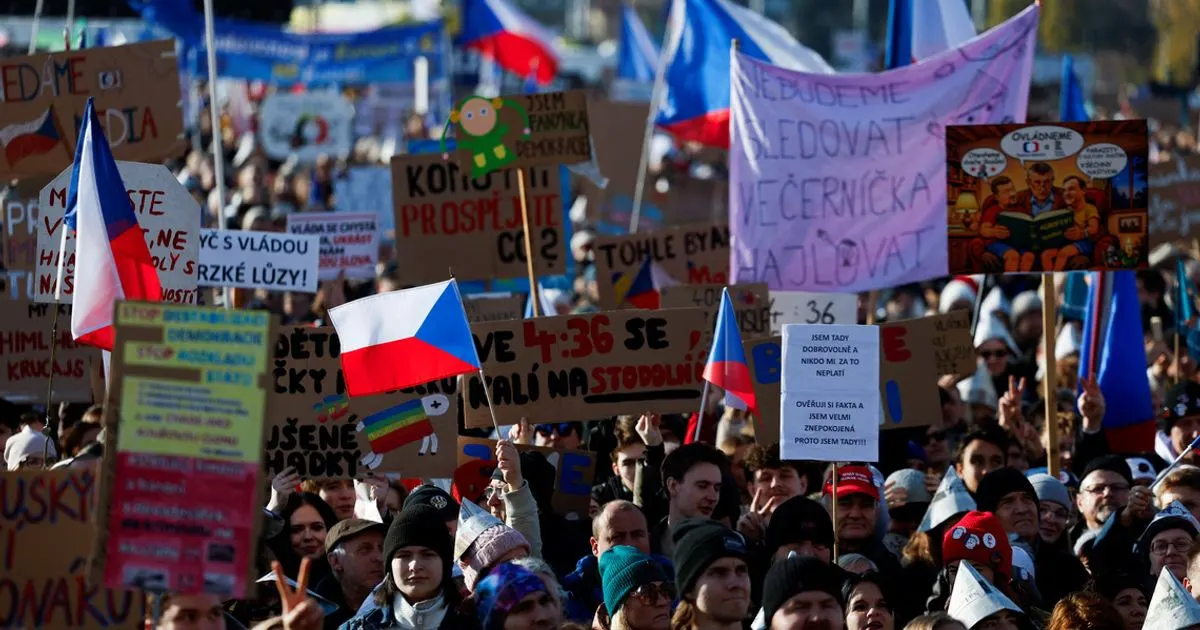
Organisers say roughly 400,000 joined Prague public-media funding protest
The BBC reports organisers’ estimate of roughly 400,000 demonstrators. Babiš says replacing licence fees with state funding would not give the government control over public media.
Listen to the story
Short version
Organisers say roughly 400,000 protested in Prague against public-media funding changes. Babiš denies seeking control over broadcasters.
- Organisers’ attendance estimate is not independently verified.
- The proposal replaces licence fees with state-budget funding.
- Broadcasters face a proposed financing cut of about 15%.
- Parliament approved the first draft in October; further debate remains.
What's new
- Million Moments for Democracy put attendance at roughly 400,000, according to the BBC.
- Babiš says the licence-fee system is outdated and denies seeking control of public broadcasters.
- The BBC reports that parliament passed the proposal’s first draft in late October; further debate remains.
Roughly 400,000 people attended the November 15 protest in Prague against plans to replace public broadcasting licence fees with state-budget funding, organisers Million Moments for Democracy said, according to the BBC. Prime Minister Andrej Babiš denies that the government wants to control public media.2
Crowds gather as legislation advances
Million Moments for Democracy said roughly 400,000 people attended, according to the BBC. Radio Prague International reported an organisers’ estimate of 350,000 to 450,000 and said crowds prompted restrictions on metro services. The Straits Times reported that the area nearest the stage filled quickly and nearby metro stations became congested.234
Million Moments for Democracy staged the rally in support of retaining compulsory household charges that fund the Czech public television and radio broadcasters. Opening the gathering, the group’s chairman, Mikuláš Minář, accused the government of seeking to move important legislation forward without adequate debate, according to Radio Prague International.14
Czech households currently pay 205 crowns a month for television and radio, according to the BBC. The broadcaster reported that lawmakers gave initial approval to the plan to eliminate the fees in late October. The measure still faces further debate, according to The Straits Times. The Guardian reported that its first reading took place during the night.123
Dispute over money and independence
Critics argue that moving the broadcasters’ financing into the state budget would weaken their connection with fee-paying audiences and leave them more exposed to political pressure, The Straits Times reported. Protesters fear that ministers would gain greater influence over newsrooms, according to The Guardian.13
The proposed changes would also reduce the broadcasters’ funding by about 15%, according to The Guardian and The Straits Times. The latter reported that the reduction would leave television’s nominal budget at its 2008 level and radio’s at its 2005 level.13
Prime Minister Andrej Babiš rejects the warnings about editorial interference. “Under no circumstances will we interfere in editorial work,” he said, according to The Guardian. He has presented the funding change as fulfilling a pledge to reduce households’ financial burden, The Straits Times reported.13
The government says editorial independence would remain intact and wants broadcasters to reduce costs, the BBC reported. Babiš described the existing funding system as outdated and argued that much of Europe was moving in the same direction. The BBC noted that France abolished its public licence fee in 2022 and funds public media partly through VAT revenue, while Norway abolished its fee in 2020 and moved public-broadcaster funding into the national budget.2
Protests extend beyond the capital
The Prague gathering followed demonstrations elsewhere and industrial action by broadcasting staff. The Guardian reported protests in 21 Czech towns and cities during November, alongside a strike at Czech Television and Czech Radio. Some television programmes were replaced by archive material during the stoppage.1
According to The Guardian, the proposal has drawn criticism from four organisations: the European Broadcasting Union, the International Press Institute, Reporters Without Borders and the European Federation of Journalists. Their criticism linked the Czech proposals to disputed media policies in Slovakia and Hungary.1
Pavol Szalai, Prague Bureau director of Reporters Without Borders, accused Babiš of making political attacks on both private and public media a recurring feature of his premiership, according to the BBC.2
Government figures dismissed the demonstration’s arguments. Foreign Minister Petr Macinka called it “an opposition event”, Radio Prague International reported. Czech Television presenter and licence-fee campaigner Daniel Stach acknowledged that some participants would also be expressing broader opposition to Babiš’s government, according to The Guardian.14
Why it matters
The dispute concerns both the resources available to Czech public broadcasters and their relationship with political decision-makers. International media organisations have connected it with concerns over broadcasting policies elsewhere in central Europe, while Babiš denies that the proposed funding system would entail editorial interference.123
Version history
- version 2 · Added the BBC’s report of organisers’ roughly 400,000 attendance estimate, expanded the government’s explanation and European funding context, and updated source references to the current dossier.
- version 1 ·