World · Pakistan
Imran Khan supporters march on Islamabad after talks stall
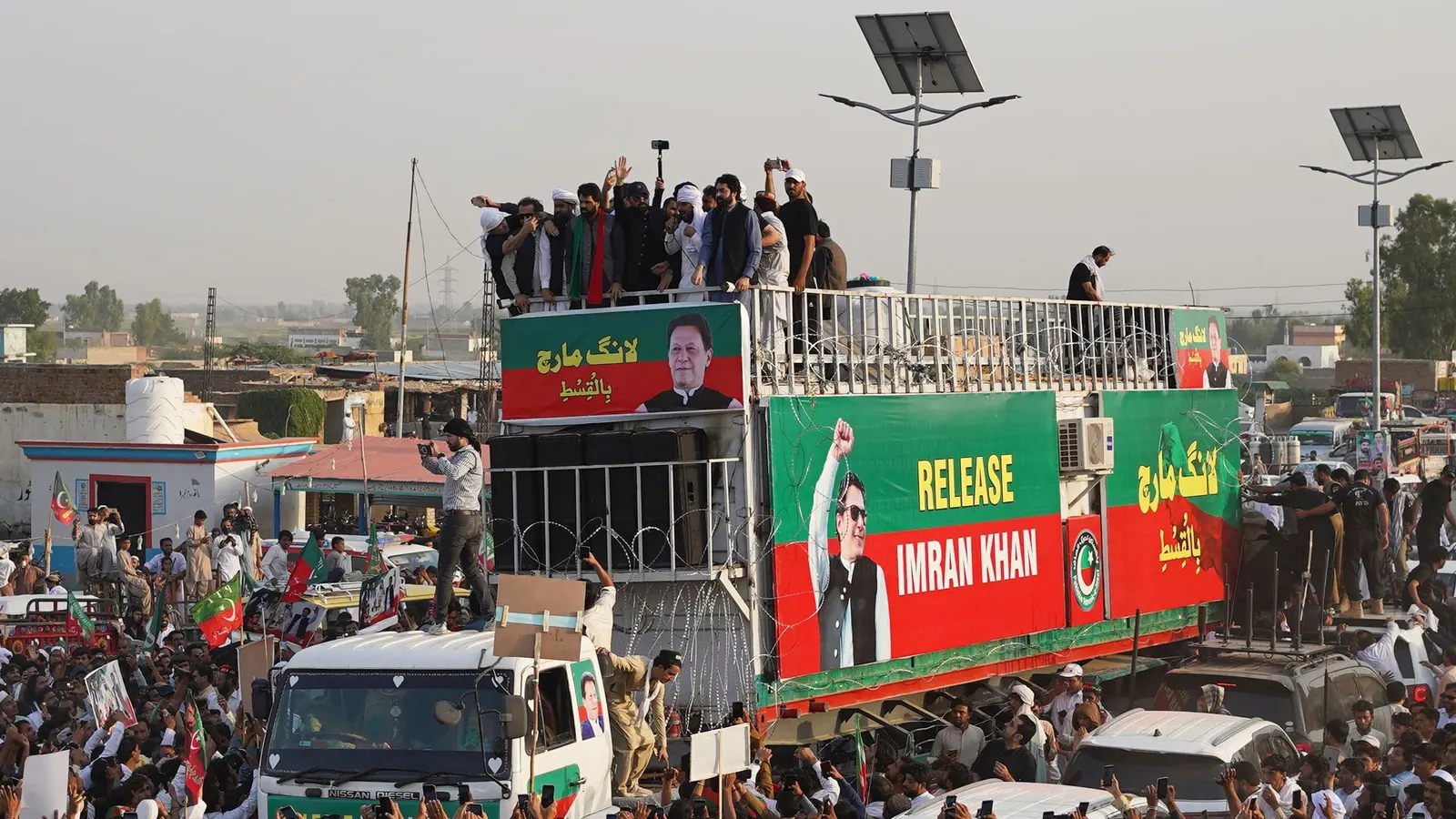
Pakistan Tehreek-e-Insaf supporters began travelling from the northwest toward the capital on October 4, demanding the jailed former prime minister’s release and medical treatment. Authorities reinforced Islamabad and blocked approach roads with shipping containers.
Imran Khan’s supporters are marching toward Islamabad after talks with Pakistan’s government failed. Authorities have reinforced the capital as PTI presses for Khan’s release and hospital treatment.
- The march began from northwestern Pakistan on October 4.
- Two rounds of talks ended without agreement.
- PTI wants Khan released and treated in hospital.
- Authorities reinforced and barricaded approaches to Islamabad.
- The government says Khan is medically fit.
What's new
- A PTI convoy began moving toward Islamabad on October 4.
- Two rounds of government-opposition talks ended without agreement.
- Additional security personnel and shipping containers were deployed around the capital.
- The march had previously been postponed from September 27.
Supporters of Pakistan’s jailed former prime minister Imran Khan began a march from northwestern Pakistan toward Islamabad on October 4 after talks between his Pakistan Tehreek-e-Insaf party and the government failed to resolve their dispute. The protesters are demanding Khan’s release and transfer to a hospital, while the authorities have reinforced and barricaded approaches to the capital.1234
Convoy heads for the capital
Deutsche Welle reported that about 5,000 people were travelling from Khyber Pakhtunkhwa in a slow-moving convoy. It said the journey covered 80 kilometres, was expected to take several days and would include rallies during overnight stops. Organisers hoped eventually to mobilise hundreds of thousands of supporters, according to the broadcaster.2
PTI had initially announced the march for September 27 but postponed it while negotiations sought a political settlement. Sohail Afridi, the PTI-affiliated chief minister of Khyber Pakhtunkhwa, said on October 4 that the demonstration would proceed. Supporters from specified districts were due to join at Gandi Chowk in Lakki Marwat, with scheduled stops near Karak, Kohat and Mattani as the caravan moved towards Peshawar.123
The federal government deployed additional security personnel and positioned shipping containers on roads into Islamabad. Rana Sanaullah, a political adviser to Prime Minister Shehbaz Sharif, said the marchers would be prevented from entering the capital. Interior Minister Mohsin Naqvi warned Afridi that he would bear responsibility for any deaths during the mobilisation, Deutsche Welle reported.12
Talks end without agreement
The first round of negotiations on October 2 concluded without an agreement, according to The Hindu. A second round began shortly before 5pm on October 3 and ended in deadlock early on October 4. PTI chairman Gohar Khan also said the two rounds had failed to break the impasse.12
PTI sought an immediate meeting with Khan and asked for him to be examined and treated in hospital by his personal doctors. The party also demanded the release of Khan’s sisters and supporters detained before the protest, a medical examination for his wife, Bushra Bibi, and hearings in their cases free from outside influence, The Hindu reported.1
The government insisted that PTI call off the protest before it would decide on a meeting with Khan, according to The Hindu. Tallal Chaudhry, the minister of state for interior, attributed the breakdown mainly to what he described as Khyber Pakhtunkhwa’s failure to promise cooperation with the federal authorities against terrorism. Deutsche Welle reported that the government had also cited a resurgence in attacks in seeking a delay.12
The government has accused PTI of sympathising with the Pakistani Taliban, an allegation the party rejects. PTI described the claims as “a baseless smear campaign”.2
Dispute over Khan’s treatment
Khan has been imprisoned since August 2023, according to Deutsche Welle. The Hindu reported that he faces more than 100 cases. His supporters also allege that the 2024 election, which returned Shehbaz Sharif to power, was rigged; the government denies that allegation.12
The Hindu reported that the Supreme Court ordered Khan on August 18 to be moved to Shifa International Hospital, a private hospital in Islamabad, for examination and treatment. Citing security reasons, the government said Khan was moved on August 20 to the state-operated Pakistan Institute of Medical Sciences, assessed as medically fit and sent back to Adiala Jail. Deutsche Welle said the government maintains that he does not require hospitalisation and receives regular visits.12
According to The Hindu, on September 16 the Supreme Court put the contempt case on hold for three weeks because the Federal Constitutional Court had called for the relevant records. The competing accounts of Khan’s medical needs and access remain central to the political negotiations and the protesters’ demands.12
Political pressure without resolution
James Dorsey, an analyst at the National University of Singapore, described Khan as the leader of a movement with broad support. He told Deutsche Welle that the mobilisation presented a challenge for the government but was not an existential threat, and said security concerns would probably encourage Islamabad to avoid escalation.2
Why it matters
For European readers following Pakistan, the march is a test of whether the government and its largest organised opposition movement can contain a prolonged political dispute without escalation. The confrontation combines disagreements over Khan’s imprisonment and medical treatment with government concerns about security and militant violence.2
Videos
Version history
- version 1 ·