Climate · Singapore
Singapore tests cooling alternatives as air conditioning reaches nearly every private home
Chilled beams and cooling driven by natural airflow are among the alternatives being used. Reported energy savings come alongside higher installation costs and questions about acceptance of warmer offices.
Singapore is testing alternatives to conventional air conditioning. Reported savings come with higher installation costs and questions about comfort preferences.
- About 99% of private residences have cooling units.
- Buildings account for one-fifth of Singapore’s emissions.
- Chilled beams and passive displacement cooling are among the alternatives.
- The Japan Times reports lower energy use at Paya Lebar Green.
What's new
- Singapore is experimenting with chilled beams and passive displacement cooling.
- The Japan Times reports energy savings of more than 30% at Paya Lebar Green.
- At least 47 buildings had adopted alternative cooling technologies by mid-2026, according to The Japan Times.
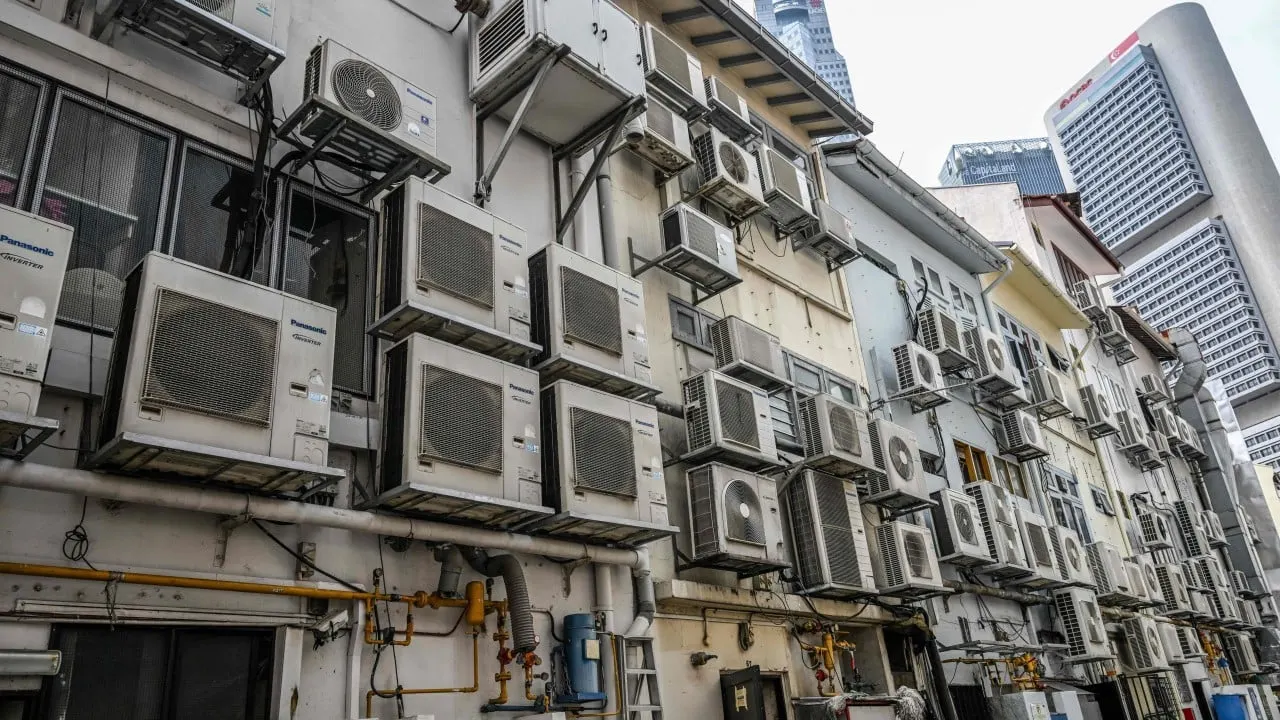
Singapore is testing alternatives to conventional air conditioning in offices and other buildings, according to reports published on November 1, 2026, as the city-state addresses cooling demand in a country where about 99% of private residences have cooling units.123
Cooling without a noticeable change
Singapore has Southeast Asia’s highest air-conditioner ownership per person, and its local building sector produces one-fifth of national emissions. The Japan Times reports that cooling represents between 40% and 60% of a building’s energy consumption, making it a focus of efforts to reduce energy use.123
At Paya Lebar Green, an eight-storey office building in eastern Singapore, an active chilled beam installation maintains offices at 24C, according to The Japan Times. According to the newspaper, the installation used less than 70% of the energy consumed by standard air-conditioning systems.1
The installation uses perforated panels mounted overhead, with coils that cool room air as it circulates, the newspaper reports. DP Architects designed the system. HR professional Renuga Shekar and her colleagues only discovered months after moving into their office that it used a different cooling technology.1
Shekar said they had paid little attention to the cooling system. No one really commented about it,” Shekar told The Japan Times. Her account describes an office where the change in equipment was not immediately apparent to the people working there.1
Other approaches, different costs
Another approach, passive displacement cooling, uses natural air movement and overhead coils to limit dependence on mechanical fans. According to The Japan Times, a Singapore ports authority maintenance building at Tuas Harbor in western Singapore uses this method.1
The newspaper also describes radiant cooling, which absorbs radiant heat through pipes or panels carrying water cooled to between 14C and 18C. Hybrid cooling combines fans with air conditioning operated at higher temperature settings.1
A government study in 2024 identified alternative cooling technologies as a key strategy and estimated potential energy savings of up to 48%, The Japan Times reports. By mid-2026, at least 33 public buildings and 14 private buildings had adopted such technologies, according to building authorities cited by the newspaper.1
The Japan Times says these technologies require a larger upfront investment than standard air conditioning, although they become cheaper to operate in the long run. Chua Zi Jun, a director at DP Architects, told the newspaper that general acceptance of offices cooled to 26C had not yet been reached.1
Limits and controls
Wan Man Pun, a cooling technology expert at Nanyang Technological University, told The Japan Times that no alternative cooling method yet exceeds vapour compression in coefficient of performance. He also called for predictive controls that change temperatures before rooms become excessively warm or cold.1
The experiments take place as climate change increases temperatures, humidity and demand for cooling in Singapore and elsewhere, according to The Japan Times. The newspaper reports that Singapore aims to reach net-zero carbon emissions by 2050.1
Why it matters
For European readers, Singapore offers a case study in efforts to reduce the energy used to keep buildings comfortable. The reported trade-offs involve installation costs, operating savings and acceptance of higher indoor temperatures; the dossier does not establish whether Singapore’s savings would be replicated in Europe.1
Version history
- version 1 ·