World · Sweden
Andersson Abandons Bid to Form Swedish Centre-Left Government
Sweden's Social Democrat leader Magdalena Andersson said she could not form a government after the Left Party withdrew support, leaving the country's fragmented parliament without a clear path to a new cabinet.
Sweden's centre-left election winner Magdalena Andersson said she cannot form a government after the Left Party's support shifted, leaving the country's next government uncertain.
- Centre-left bloc won 176 of 349 seats on Sept 13, right bloc got 173
- Andersson announced Sept 28 she could not form a government
- Left Party backed a centre-right speaker candidate instead of Andersson
- Andreas Norlén re-elected speaker with 200 votes
- Speaker has four nomination attempts before an early election is required
What's new
- Andersson handed back the task she had been given to try to put together a government on Sept 28
- Left Party backed a centre-right candidate for parliament speaker instead of Andersson
- Andreas Norlén was re-elected speaker with 200 votes
- Parliament speaker Norlén will hold new consultations with party leaders
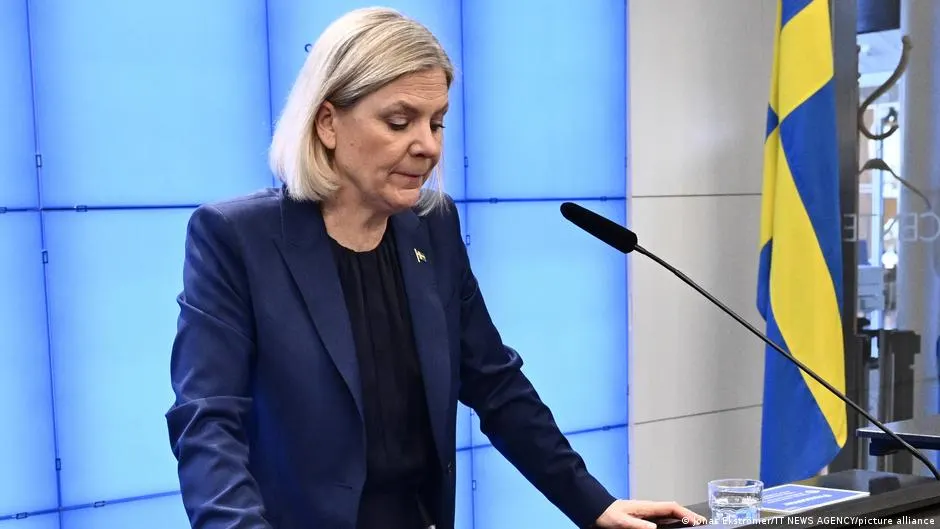
Magdalena Andersson, leader of Sweden's Social Democrats, said on September 28 that she could not form a government, two weeks after her centre-left bloc won a narrow parliamentary majority in the September 13 election.1245
Narrow win, no government
Sweden's centre-left bloc, led by the Social Democrats, won 176 of the parliament's 349 seats in the September 13 election, against 173 for the right-wing alliance that included the Moderate Party and the Sweden Democrats.153
Despite the numerical majority, Andersson said she was unable to build a government. "Based on the discussions I have had, I can conclude that, as things currently stand, it is not possible for me to form a government," she said.1
Left Party withdraws backing
The Left Party, part of the centre-left bloc, had previously said it would only support Andersson as prime minister. Instead, it chose to back a speaker candidate from the centre-right, a shift the Straits Times said weakened Andersson's chances of assembling a coalition.245
"Of course, I take the Left Party's message seriously, and based on that and the conversations I have had, I can conclude that there is currently no possibility for me to form a government," Andersson said.5
The Left Party pushed back against claims that backing the speaker nominee signaled any political partnership with the Moderate Party.3
At parliament's first session following the election, Andreas Norlén, speaker since 2018, won re-election with 200 votes, beating Social Democratic contender Johanna Haraldsson, who received 146.3
What happens next
Sweden's constitution allows the Riksdag speaker to put forward four different prime ministerial nominees; should lawmakers turn down all of them, a snap election becomes mandatory. According to reports, Norlén was meeting again with party leaders as he weighed who should get the next chance at building a government.6
Deutsche Welle reported that Ulf Kristersson, who has served as caretaker prime minister since October 2022, is expected to get the next opportunity to build a cabinet, with the outgoing right-wing bloc possibly aiming to hold onto power even after its election loss. Any centre-right government would need the support of the Center Party to secure a majority.14
Deutsche Welle reported that Center Party leader Elisabeth Thand Ringqvist would not back any government granting sway to the Sweden Democrats or the Left Party. A centre-left government could still emerge if the Left Party abandoned its push for a cabinet seat, or alternatively if the Center Party and Social Democrats agreed to let the Left Party join.16
Andersson said she remained uncertain how the situation would develop. "How things develop in the coming weeks remains to be seen," she said. She also pointed out that convention in parliament calls for the speakership to go to whichever party leads the governing coalition.9
Wider context
The impasse follows a campaign in which the Sweden Democrats lost support, a trend the Irish Times said bucked the broader European far-right pattern. Government formation after the 2018 election took Social Democrat Stefan Lofven 134 days, a comparison cited amid the current deadlock.2
Separately, police opened preliminary investigations into five election fraud complaints around Stockholm, and prosecutors opened an investigation into suspected fraud in Borlänge, where 11 parliamentary seats could be affected. More than 15,000 complaints were submitted to Sweden's Election Review Board.26
Why it matters
Sweden is a country of 10.6 million people. The standoff also illustrates how a narrow electoral majority can fail to translate into a governing coalition when partner parties disagree over influence and cabinet participation.21
Version history
- version 1 ·