Climate · Switzerland
Swiss Glaciers Lose Over 5% of Ice Volume in 2026
Monitoring group GLAMOS says a snow-poor winter and record summer heat drove one of the worst melting years on record in the Alps, with meltwater losses equal to several times Switzerland's annual drinking water use.
Listen to the story
Short version
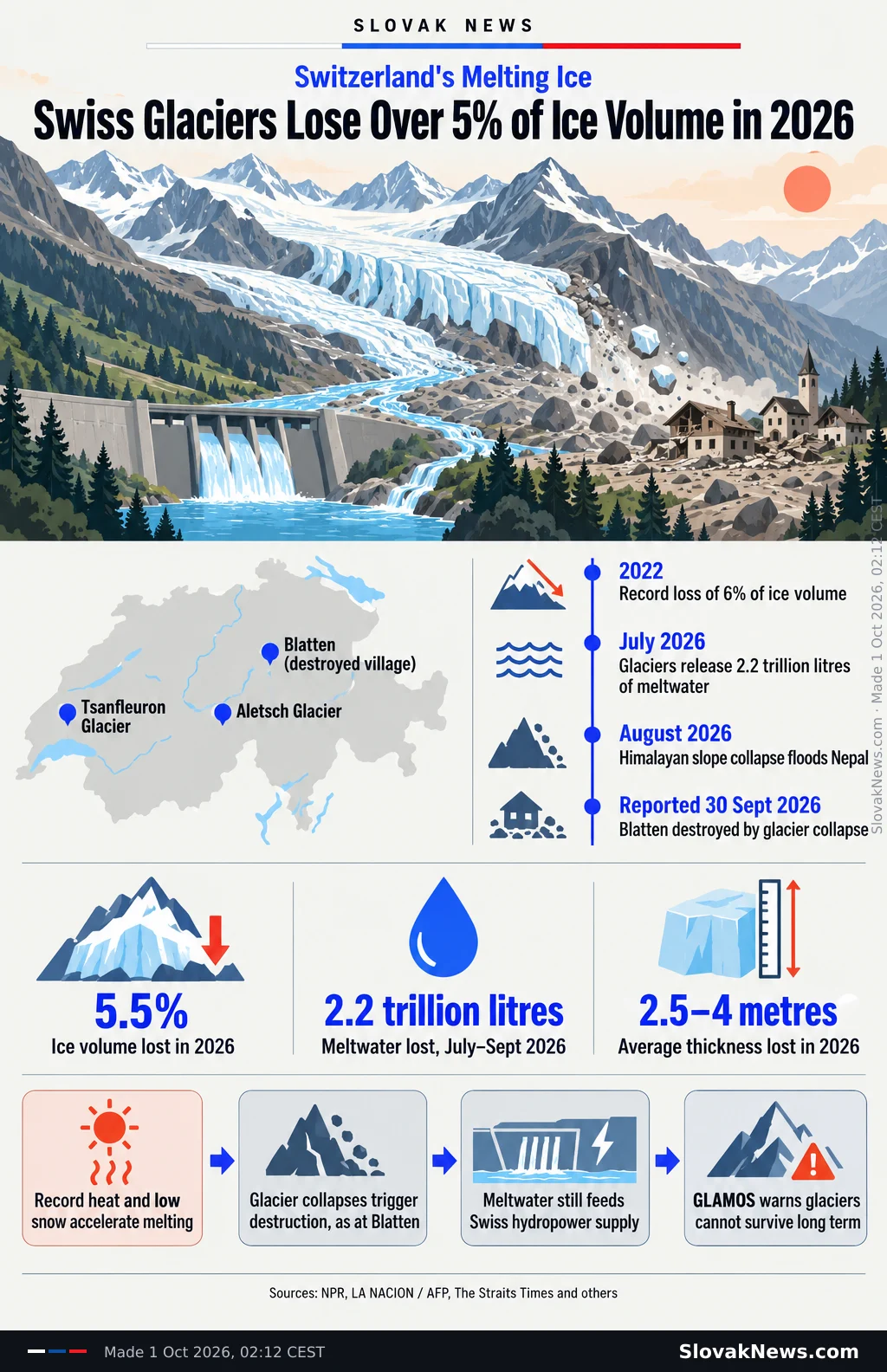
Swiss glaciers lost over 5% (reported as 5.5% by some sources) of their ice volume in 2026, the second-worst year on record after 2022, amid record heat and low snow.
- Swiss glaciers lost 5%-5.5% of ice volume in 2026, per GLAMOS
- 2022 remains the record year with 6% loss
- 2.2 trillion litres of meltwater lost July-September 2026
- Blatten destroyed and Nepal floods linked to glacier collapse
- Scientists say warming is fully human-caused
Infographic
What's new
- According to GLAMOS, Switzerland's glaciers shed in excess of 5% of their ice volume during 2026, a figure several sources put at 5.5%
- On average, ice thickness decreased somewhere between 2.5 and 4 metres, though certain glacier tongues lost as much as 10 metres
- GLAMOS and the Swiss Academy of Sciences said Alpine glaciers have no chance of surviving long term under current conditions
- Scientist Matthias Huss says current warming is attributable entirely to human-caused climate change
More than 5% of the ice volume held by Switzerland's glaciers disappeared during 2026, the monitoring network GLAMOS reported, as a low-snow winter followed by a record-breaking summer heat wave sped up melting throughout the Alps.13
Infographic
A second severe year
Several reports citing GLAMOS put the 2026 loss at 5.5% of ice volume, following a winter that brought unusually little snow and a summer of record heat that stripped glaciers of protective cover. The reduction makes 2026 the second-largest annual loss on record, behind the 6% recorded in 2022, when Saharan dust settling on the ice further accelerated melting.423
According to The Straits Times, the rate of loss in 2026 did not reach the record highs of 2022, though GLAMOS director Matthias Huss described conditions as increasingly extreme. "We are seeing extreme years almost every year now and this is really a worrying situation," he said.3
Individual glaciers including the Aletsch, Rhône, Allalin and Clariden experienced record melting in 2026. Average thickness declined by 2.5 to 4 metres across Swiss glaciers, with some glacier tongues shrinking by up to 10 metres, according to multiple reports.241
Water and power impact
In just the three months from July through September, Switzerland's glaciers shed roughly 2.2 trillion litres in water equivalent — a quantity several reports equate to more than four times the country's yearly household drinking-water use. Switzerland, whose population is about 9.1 million, draws more than half its electricity from hydropower and has been described in the reporting as the "water tower of Europe."3624
According to NPR, the summer's melting overlapped with wider disruptions across Europe, as shipping along the Rhine and Danube halted and several nuclear plants were forced offline temporarily due to diminished river levels.1
Disasters linked to melting ice
The Swiss village of Blatten was destroyed after a glacier collapse brought about 9 million cubic metres of ice, rock and mud down on the settlement; its population had been evacuated beforehand, and residents reportedly remained in temporary accommodation a year later, according to NPR.1
In Nepal, a glacier collapse near the border with Tibet triggered flooding that killed at least 1,400 people, according to NPR. Global warming is reported to have helped destabilise a Himalayan slope that collapsed in August. Huss said such events can be connected to warming conditions: "Combined with this heat, with the disappearance of the ice, with the warming of permafrost, climate change can be a triggering factor."12
Scientists' assessment
GLAMOS and the Swiss Academy of Sciences said in a joint statement that "Alpine glaciers have no chance of surviving in the long term under such conditions," according to LA NACION/AFP. Huss maintained that today's warming can be traced entirely back to human causes, stating: "The warming that we are experiencing now can be attributed 100% to anthropogenic climate change. It's as simple as that."2
Huss also stressed the protective role of winter snow cover, saying it shields bare ice from melting and helps form new ice at high elevation. NPR reported that, according to Huss, all glaciers would be gone by the end of the century if warming continues at the current rate, and that roughly 1,200 smaller glaciers have disappeared in Switzerland over the past 50 years.21
Why it matters
Switzerland's glaciers feed major European rivers including the Rhine, Danube, Po and Rhône, and the country depends heavily on glacier-fed hydropower for electricity. Continued rapid melting threatens water supplies, transport on European waterways and energy generation across the region.24
Version history
- version 1 ·