Apple Ordered to Pay $5.7 Billion in Taptic Engine Patent Case
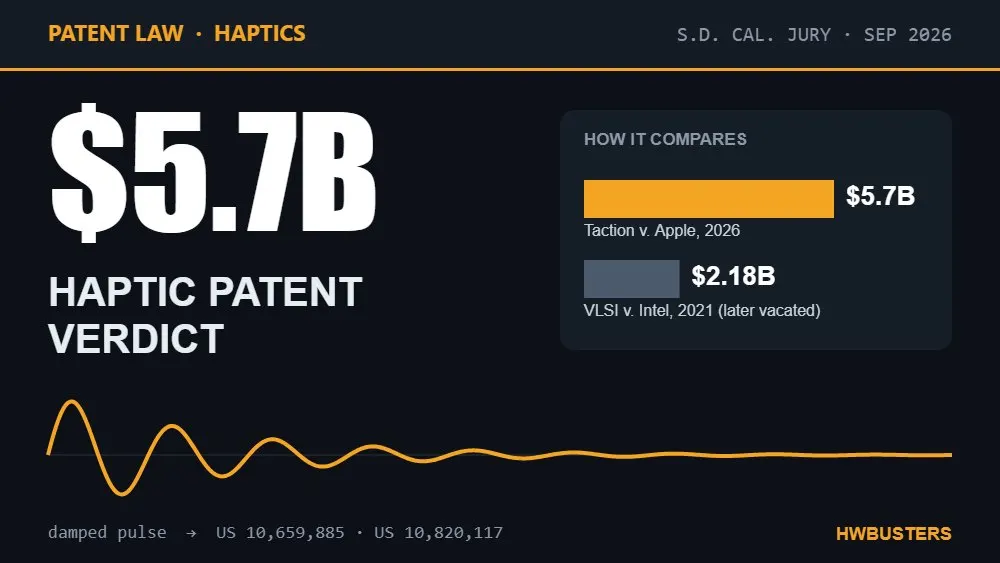
A San Diego federal jury found that Apple's Taptic Engine infringes two patents held by Taction Technology, awarding one of the largest patent verdicts in US history.
Listen to the story
Short version
A US jury ordered Apple to pay Taction Technology over $5.7 billion for infringing haptic feedback patents used in the Taptic Engine.
- Jury verdict: Apple owes Taction $5.7 billion
- Case filed 2021, dismissed 2023, revived on appeal 2025
- Infringement found not willful
- Apple to appeal, disputes using Taction's tech
- Litigation funders backed Taction's case
What's new
- A jury has directed Apple to pay Taction Technology upwards of $5.7 billion
- Verdict follows a 2025 appeals-court revival of a case dismissed in 2023
- Jurors found infringement was not willful
- Apple says it will appeal; case moves to post-trial proceedings
According to reports published Sept 27, 2026, a federal jury in San Diego has directed Apple to pay Taction Technology upwards of $5.7 billion after finding that Apple's Taptic Engine violated two of Taction's haptic feedback patents.16
The case
Taction, a San Diego company that makes headphones and gaming headsets, sued Apple in 2021 in a federal court based in Southern California, contending that Apple deployed its tactile transducer technology without permission or a license.126
The patents in dispute, U.S. Patent Nos. 10,659,885 and 10,820,117, cover a device that delivers vibrations to a wearer's skin and protect tactile transducers capable of producing low-frequency vibrations that can be felt rather than heard.52
In 2023, U.S. District Judge Todd W. Robinson granted Apple summary judgment, dismissing Taction's infringement claims before they could reach a jury. In August 2025, the federal appeals court that hears patent cases reinstated the lawsuit, finding that the lower court had improperly excluded portions of Taction's expert testimony and had misinterpreted the patent claims.123
The trial started on September 14, 2026, and a panel of seven jurors spent two days weighing the evidence before reaching a decision. Jurors found that Apple had infringed the two patents but that the infringement was not willful.123
Apple's response
Apple said it disagreed with the verdict and the size of the damages, and confirmed it plans to appeal. The company insists its Taptic Engine operates on different principles than Taction's design and does not rely on Taction's technology, adding that this view was bolstered by Taction's own trial testing of Apple's products.521
Northeast Times reports that the litigation will next enter a post-trial phase overseen by Judge Robinson, giving Apple an opportunity to contest the $5.7 billion award before proceeding with its intended appeal, which on patent matters would go back before the Federal Circuit.1
Litigation funding
Gronostaj Investments LLC and Kenosha Investments LP provided funding to Taction to pursue the case. In unrelated legal proceedings, Kenosha Investments LP has been named as an indirect affiliate of Burford Capital Ltd.21
Wider patent disputes
Taction's lead counsel, Lance Yang of Quinn Emanuel, said the company had waited five and a half years for the case to reach trial. According to Engadget, the verdict is one of the largest patent infringement payouts in the United States, said to top an ongoing Intel patent case valued at $3 billion, though this comparison has not been confirmed by other sources.54
Apple has faced other haptics-related patent disputes: Immersion previously filed a complaint accusing Apple of patent violations over haptic technology, a case the companies later settled for an undisclosed amount, according to Engadget. Separately, a federal jury ruled that Apple must pay $634 million to Masimo over blood-oxygen tracking technology, a verdict Apple also plans to appeal, per the same report.4
Why it matters
The ruling underscores the financial exposure large technology companies face over hardware-related patent litigation. Litigation funding arrangements behind the plaintiff also point to the increasing role of outside investors in shaping high-value patent disputes.21
Version history
- version 1 ·