Business · Australia
Australia’s EU trade agreement faces opposition ahead of ratification
Coalition opposition and uncertainty over Greens support have complicated the agreement’s passage. Ministers and vegetable growers are urging approval, while other agricultural groups criticise its terms.
Australia’s EU trade agreement faces an uncertain parliamentary vote, with opposition parties withholding support and agricultural groups divided.
- Canavan pledged to block the agreement, standard.net.au reported.
- Wilson said Coalition opposition was tentative.
- Greens support remains uncommitted, according to standard.net.au.
- ABC reports vegetable growers support approval while other farming groups criticise it.
What's new
- Matt Canavan pledged to block ratification, according to standard.net.au.
- Tim Wilson described Coalition opposition as tentative, saying it had not seen final legislation.
- AUSVEG renewed its support and warned against rejecting the agreement, ABC reported.
Australia’s government faced opposition to its European Union trade agreement in the Australian parliament on October 19, 2026, as Nationals leader Matt Canavan pledged to block ratification and ministers sought support from Liberal MPs or the Greens, according to ABC and standard.net.au.12
Opposition position contested
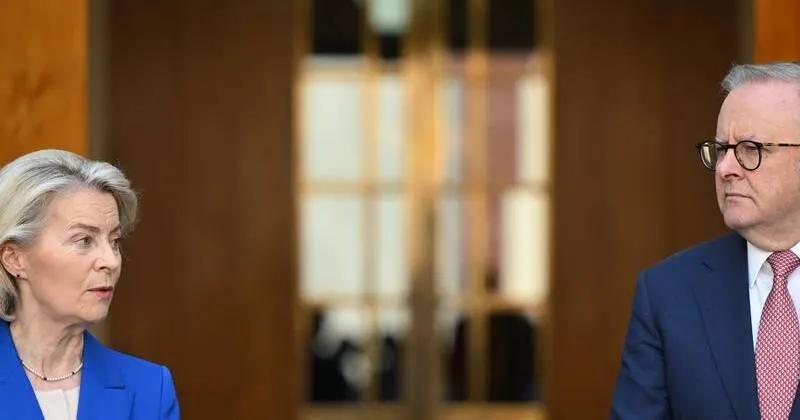
Standard.net.au reported that Anthony Albanese, Australia’s prime minister, and Ursula von der Leyen, the European Commission’s president, finalised the agreement in March following eight years of talks. It has yet to receive Australian parliamentary approval.2
Canavan said the Coalition would prevent its passage. But Liberal treasury spokesman Tim Wilson described the opposition as “tentatively opposed” and said it had not seen the final legislation, according to standard.net.au. ABC also reported Canavan’s assertion that both Coalition parties rejected the agreement.12
Assistant Trade Minister Matt Thistlethwaite offered a different account, saying some Liberal MPs had indicated support and that the Coalition was divided. The government remained confident of securing approval, ABC reported, and said the Treaties committee must examine the agreement before MPs and senators ratify it.1
Labor may need the Greens to pass the agreement through the Senate, but their backing has not been guaranteed, according to standard.net.au. Trade Minister Don Farrell urged the Liberals to support it, saying that “backing away from the agreement would be an act of economic self-harm”.2
Agricultural groups differ
The political disagreement is accompanied by contrasting positions among agricultural organisations. ABC reported strong criticism from the National Farmers’ Federation and Meat & Livestock Australia. According to standard.net.au, primary producers argued that the agreement offered insufficient access compared with the position enjoyed by subsidised European farmers.12
AUSVEG, which represents vegetable, potato and onion growers, reiterated its support. Its chief executive, Michael Coote, said implementation was particularly important for vegetable producers. ABC reported that the organisation expected benefits especially for onion growers and warned that rejecting the agreement could threaten Australian food security.1
Market access at issue
According to ABC, 98 per cent of Australia’s current sales to Europe would enter without tariffs under the agreement. OECD secretary general Mathias Cormann urged Australian politicians to approve it, pointing to Europe’s market of 450 million high-income consumers and supporting broader access to international markets.1
According to standard.net.au, European products would no longer face Australia’s five per cent import duty, while expanded access for beef, mutton and lamb would be phased in over seven to 10 years. A 50 per cent tariff on Australian steel exports to Europe would remain, the outlet said.2
The outlet estimated that the agreement could be worth as much as $30 billion in trade and said the EU ranked third among Australia’s partners for two-way trade and second among its sources of foreign investment. It reported that rejection would mark the first failure of an Australian free-trade agreement to secure ratification.2
Why it matters
For European exporters, the agreement would remove an Australian tariff of five per cent on European products, according to standard.net.au. Its fate also affects proposed increases in Australian agricultural access to the EU, with additional beef, mutton and lamb access scheduled over seven to 10 years, the outlet reported.2
Related stories
Version history
- version 1 ·