Science & Tech · France, Japan
BepiColombo enters Mercury orbit despite software problem during thruster burn
The European-Japanese mission reached Mercury after eight years. A software issue shortened its orbital-entry burn, but the spacecraft remained safe, according to the European Space Agency.
BepiColombo reached Mercury orbit after eight years despite a software issue shortening its thruster burn. ESA said the spacecraft was safe.
- BepiColombo is the second spacecraft to orbit Mercury.
- European teams are investigating the software problem.
- The Japan Times reports probe separation is planned around December 10.
- Scientific observations are expected around April 2027, according to The Japan Times.
What's new
- BepiColombo has entered orbit around Mercury after an eight-year journey.
- A software issue cut short the thruster burn used for orbital entry.
- European Space Agency teams are investigating; the agency said the spacecraft is safe.
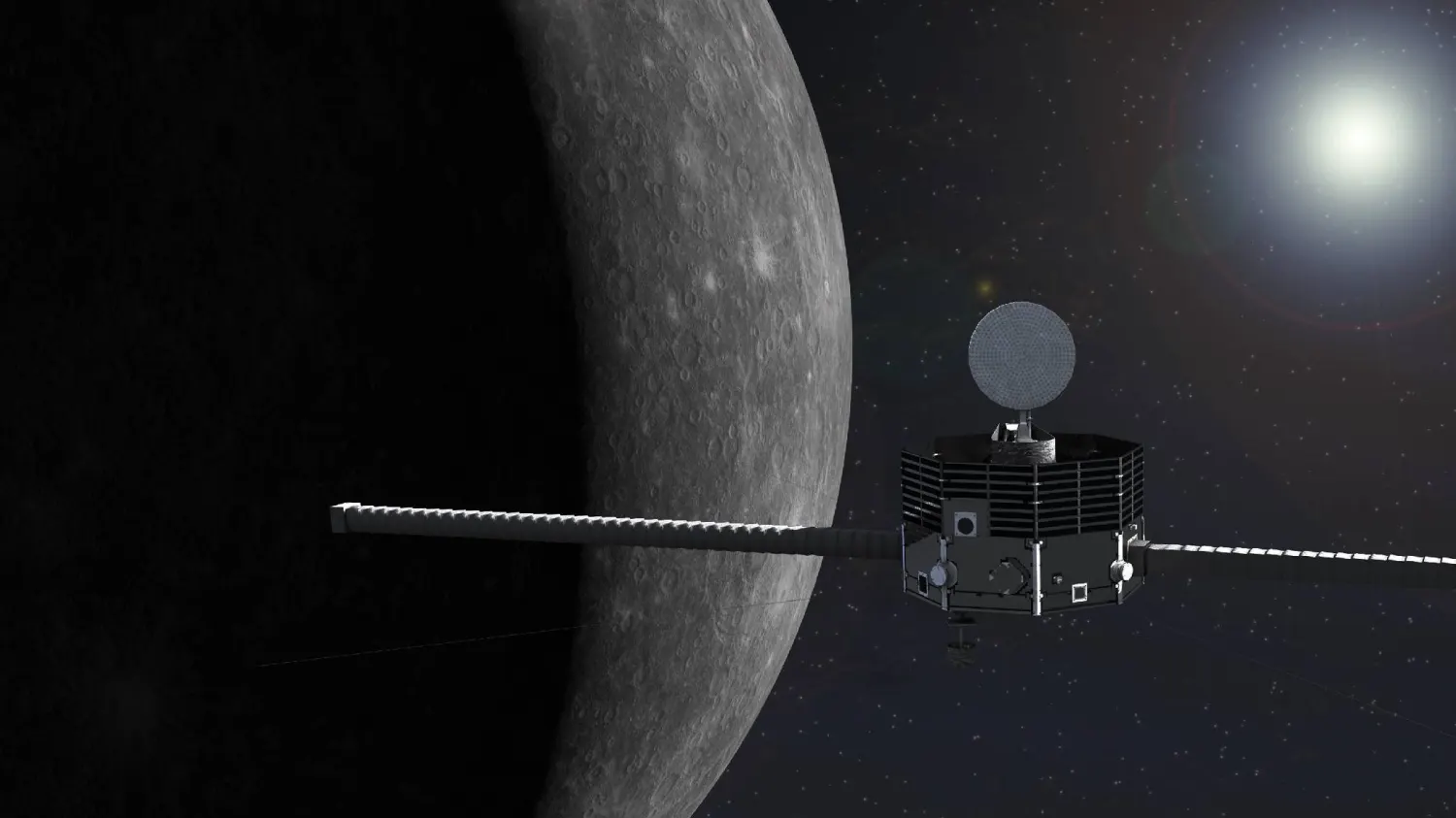
The European-Japanese BepiColombo spacecraft has begun orbiting Mercury after an eight-year journey, according to reports published on November 22, 2026, despite a software problem that shortened its orbital-entry thruster burn. The European Space Agency said the spacecraft was safe while teams investigated the incident.13
Orbital entry and investigation
BepiColombo is the third spacecraft to visit Mercury and only the second to enter orbit around it. The Japan Times reported on November 23 that Japan and Europe had successfully placed the mission’s two attached probes, Mio and MPO, into Mercury orbit.123
The software issue affected the duration of the burn intended to put BepiColombo into orbit. Reuters reported that teams at the European Space Operations Centre were examining the problem. In a statement carried by The Straits Times, ESA said: “The spacecraft is safe and teams at ESOC are working to understand what happened”.13
The arrival followed an earlier change to the mission’s timetable. According to The Japan Times, BepiColombo had originally been due to reach Mercury in December 2025, but propulsion-system problems delayed its arrival by about a year. The two probes had been attached to one another when they launched in October 2018, the newspaper reported.2
Two probes, different tasks
According to The Straits Times, BepiColombo is a collaborative project involving the European Space Agency and the Japan Aerospace Exploration Agency. Its components are Europe’s Mercury Planetary Orbiter and Japan’s Mercury Magnetospheric Orbiter. The Japan Times reported that MPO will examine surface conditions, while Mio will observe Mercury’s magnetic fields.12
The probes are scheduled to separate on December 9 and 10, according to The Straits Times; The Japan Times gives the timing as around December 10. Both reports place the start of scientific operations in April, with The Japan Times specifying April next year.12
Mercury’s surface and magnetic field
The mission will investigate Mercury’s magnetic field, ice in polar craters and hollows on its surface, according to The Straits Times. The newspaper describes Mercury as the solar system’s smallest planet and the one closest to the Sun, with a diameter of 4,880 kilometres and cliffs reaching 1.6 kilometres in height.1
The Japan Times reported that Mercury’s exposure to intense solar heat and the Sun’s strong gravity makes orbital exploration technologically demanding. It identified the US Messenger probe, which entered Mercury orbit in March 2011, as the predecessor to BepiColombo’s orbital mission.2
Why it matters
Europe’s MPO probe is now orbiting Mercury alongside Japan’s Mio, with the two assigned different scientific tasks, according to The Japan Times. Their planned observations will cover surface conditions and magnetic fields, with full-scale science expected around April 2027.2
Related stories
Version history
- version 1 ·