Business · United States of America
Treasury yields retreat as buyers return after sharp bond sell-off
US government-bond yields reversed lower as investors returned to the market and reduced expectations for an imminent Federal Reserve rate increase. Wall Street recovered, while European bond markets remained under pressure.
Listen to the story
Short version
Treasury yields fell as buyers returned and investors reduced expectations for an imminent Federal Reserve rate increase. The reversal supported US stocks, though bond-market pressure remained visible in Europe.
- The 30-year Treasury yield reached a 24-year high.
- The 10-year yield ended a seven-session run of increases.
- September payroll growth was weaker than expected, MFS reported.
- Expectations for an October Federal Reserve increase declined.
- US stocks recovered and closed slightly higher.
Infographic
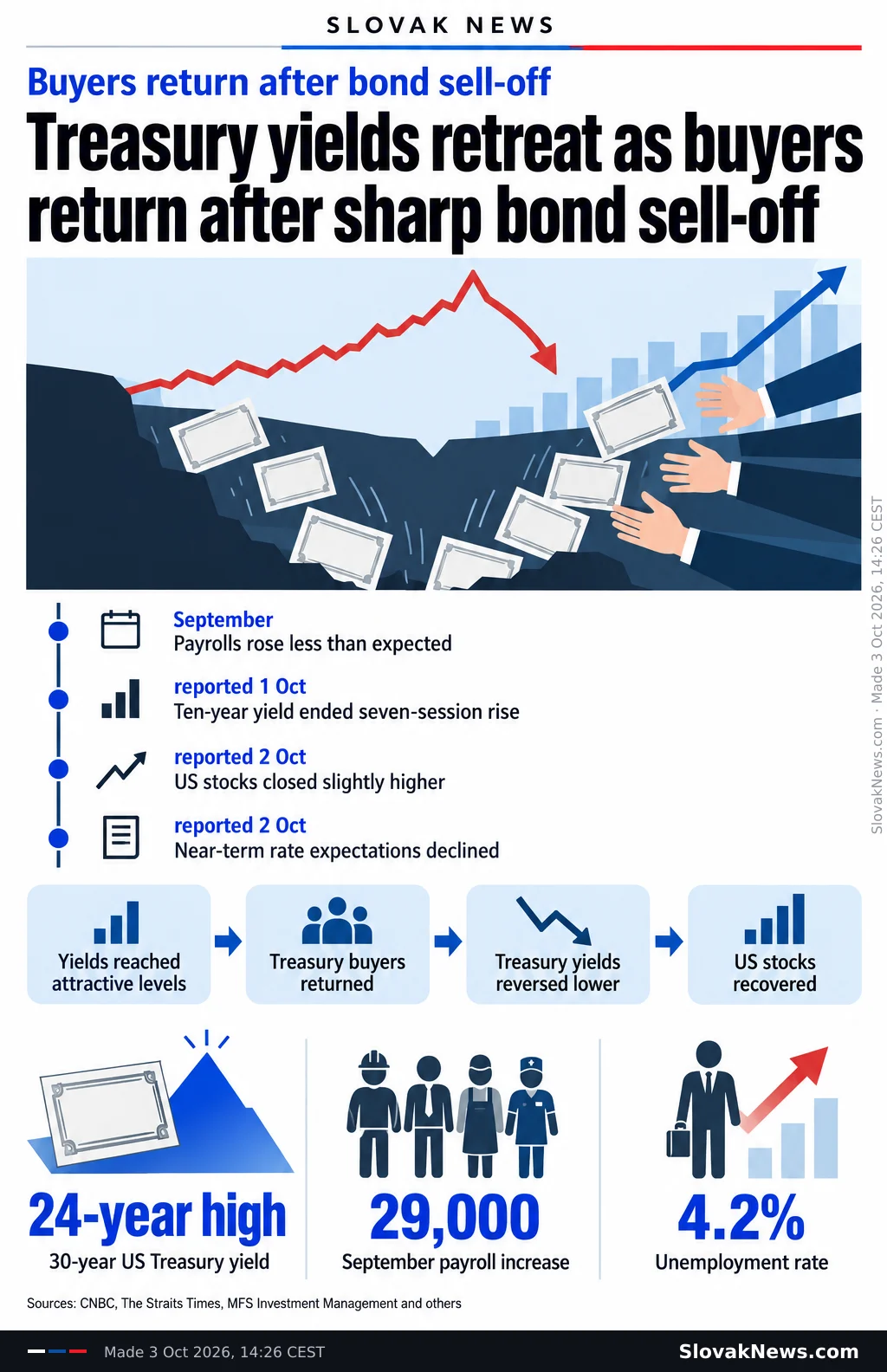

What's new
- Buyers returned after Treasury yields reached more attractive levels. [s7]
- The 10-year yield ended seven consecutive sessions of increases. [s7]
- Weak September payroll growth reduced expectations for an October rate increase. [s3]
- US equities recovered from early losses and closed slightly higher. [s2]
Buyers returned to the US Treasury market on Oct. 1, pushing yields lower after a prolonged rise and helping Wall Street recover. Reuters reported that the benchmark 10-year yield ended seven consecutive sessions of increases, while the 30-year yield had reached a 24-year high. Investors also took account of signs that the Federal Reserve might delay any further interest-rate increase.127
Infographic
Demand returns at higher yields
Reuters attributed the reversal to investors judging that yields had reached attractive levels. The retreat followed a sell-off that had carried long-term borrowing costs to multidecade highs, including a 24-year high for the 30-year Treasury yield. Reports differed over the precise historical comparison for the 10-year yield, although MFS Investment Management put it at 5.20% around midday on Friday.1237
The Straits Times reported on Oct. 2 that Treasury yields moved lower when buyers entered the market and fell further after Federal Reserve vice-chair Philip Jefferson indicated that policymakers could be patient before raising rates again. The two-year yield declined by about 10 basis points and was on course for its largest one-day fall since August 2025, according to the newspaper.2
Interest-rate expectations shifted substantially. The Straits Times said markets assigned a 28.2% probability to a Federal Reserve increase of at least 25 basis points, compared with 68.6% one week earlier. MFS said the implied probability of an October increase dropped from about 70% to below 15% after the employment figures were released.23
Employment data change the rate outlook
MFS reported that US nonfarm payrolls rose by 29,000 in September, below expectations, while unemployment increased to 4.2%. It also said revisions reduced the combined payroll figures for the previous two months by 60,000 jobs. Separately, core personal-consumption-expenditure inflation was reported at 3.0% year on year in August, below a consensus estimate of 3.3%.3
New York Fed president John Williams said another rate increase might be required late in 2026 but that there was “no need for urgency”, according to MFS. Policymakers offered differing views: The Straits Times reported that Neel Kashkari anticipated additional rate rises to curb the economy through 2027.23
Stocks recover, but volatility concerns remain
US equities recovered from early declines and finished slightly higher on Oct. 1 as the bond sell-off eased, The Straits Times reported. The Dow Jones Industrial Average, S&P 500 and Nasdaq Composite all advanced. US exchange trading totaled 17.25 billion shares, marginally exceeding the 20-session average of 17.19 billion.2
Axios identified several possible contributors to recent Treasury volatility, including mortgage-related hedging, the potential unwinding of basis trades, reduced purchases by foreign governments and greater reliance on private investors. These were presented as possible mechanisms rather than established causes of the sell-off.5
The pressure extended beyond the United States. CNBC reported that long-dated British government-bond yields reached their highest levels since 1998 and that the gap between French and German yields widened to its largest in 14 years. Those historical comparisons are based on CNBC’s reporting and have not been independently confirmed within the dossier.1
Why it matters
European readers face the same broad repricing in government-bond markets: CNBC reported multidecade highs for long-dated UK yields and a wider French-German yield spread. The US reversal shows that demand can return when yields rise sufficiently, but MarketWatch and CNBC continued to describe concern about volatility and the effects of elevated borrowing costs across markets.147
Videos
Version history
- version 1 ·