Science & Tech · United States of America
California Bars Employers From Letting AI Alone Fire Workers
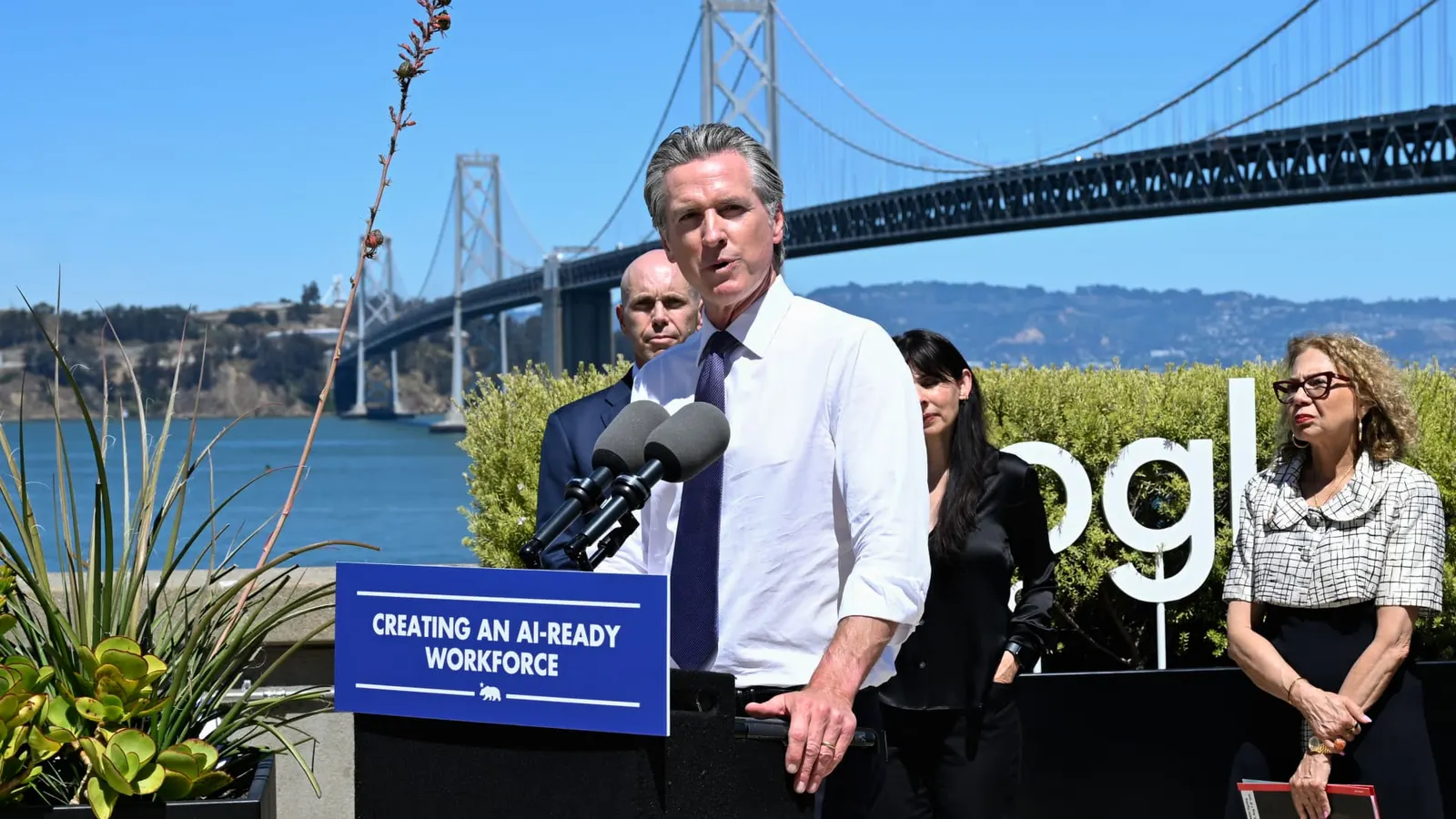
Governor Gavin Newsom put his signature on a group of measures that limit how companies in the state can deploy artificial intelligence when terminating, disciplining or monitoring staff, marking the first legislation of this kind anywhere in the country.
California became the first U.S. state to bar employers from using AI alone to fire or discipline workers, under a package Governor Newsom signed September 30, 2026.
- SB 947 bars sole reliance on AI for firing or discipline decisions
- Human review and written worker notice now required
- Package also bans AI emotion-detection and neural-data tools
- Newsom had vetoed similar bills in 2025 before this version
- Labor groups praised the law but want further health care protections
What's new
- Newsom signed SB 947, barring employers from relying solely on AI to terminate or discipline workers
- Package also includes SB 951 on AI-driven layoff notices and AB 1883 on emotion-detection bans
- Newsom put his signature on 13 bills altogether, spanning employment practices, medical care, internet content and genetic science
- Newsom reversed a veto of a predecessor bill he had rejected a year earlier
On September 30, 2026, California Governor Gavin Newsom enacted legislation prohibiting state employers from depending entirely on artificial intelligence when terminating or disciplining employees, mandating that a human reviewer weigh in on such choices and that workers be informed in writing.16
The new rules
The centerpiece measure, SB 947, prevents California employers from using automated decision-making systems as the sole basis for disciplining or terminating staff, according to CNBC. Employers who rely primarily on such systems must have a human reviewer corroborate the decision, and affected employees must receive written notice that AI played a primary role, the outlet reported.1
A related measure, SB 951, obligates companies to reveal cases where AI is a major driver behind layoffs, while AB 1883 prohibits deploying AI systems that guess at employees' feelings or gather neural information through biometric means, CryptoBriefing reported. KMPH reported that the broader package also limits workplace surveillance and sets protections against AI deepfakes and fraud, alongside a separate measure requiring gene synthesis companies to screen customers and genetic materials linked to diseases such as polio and Ebola.76
Newsom also signed an executive order directing state employees to study AI's impact on job loss and another ordering state agencies to use the term "Artificial Intelligence" rather than "super intelligence," according to CalMatters and KMPH. A further order aims to fast-track a law empowering independent organizations to verify AI claims.36
A reversed veto
The governor had vetoed a predecessor bill prohibiting the firing of workers by AI a year earlier, and in October 2025 he vetoed a broader measure, SB 7, on grounds it was overly encompassing, according to CryptoBriefing. Lawmakers this year split AI regulation into targeted bills rather than a single comprehensive measure, the outlet reported.7
Labor leaders said the package fell short of their full demands. According to CalMatters, Newsom passed over a number of AI-focused bills that unions had advocated for, including two meant to shield health care employees, even though the AFL-CIO, the California Labor Federation and labor leaders from various states had lobbied him for months earlier in the year. Lorena Gonzalez, who heads the California Federation of Labor Unions and helped champion the No Robo Bosses Act, remarked: "We're glad Governor Newsom is catching up with the overwhelming sentiment of the American people on AI and starting to lead on this issue," and continued, "We still have work to do, especially to regulate AI in healthcare and demand human oversight of these technologies."3
In a letter addressed to Newsom, AFL-CIO president Liz Shuller characterized the legislation as "a floor to protect workers from the worst abuse of AI in the workplace while allowing for adjustments as technology advances." Sandy Reding, who leads the California Nurses Association, referred to the occasion as "a historic day in California." Nicolle Pillion, a Kaiser Permanente phone operator who said an AI system meant to gauge her empathy had discriminated against her, remarked: "It's a big win for us and a step in the right direction. I just wish he'd put pen to paper on this earlier."3
Industry caution and federal gap
Robert Singleton of the Chamber of Progress, a technology industry group, said the term "primarily relies" is never defined in SB 947, according to CNBC. Newsom himself cited concern that the law would impose unfocused notification requirements on businesses using what he considered innocuous tools, the outlet reported.1
Newsom argued that California had no choice but to step in given the lack of action from Washington, telling reporters that artificial intelligence ought to create opportunity instead of hurting working families: "AI should expand opportunity – not come at the expense of workers and families." Referring to the White House, he added, "Super intelligence is clearly not coming from the White House – that's why California continues to lead."64
CNBC noted that federal legislation modeled on similar principles, introduced by Senator Ed Markey, was effectively dead on arrival in Congress, while Illinois' Public Act 103-0804, requiring employers to notify workers when AI is used for specified employment purposes, took effect in January. California's SB 947 is described as the first law of its kind to be enacted in the country.1
Public sentiment and political backdrop
Surveys cited by CalMatters found that fear of AI-driven job loss is the most significant reason Americans say they are concerned about the technology, with roughly half of Californians reporting that AI is used extensively or moderately in their own workplace and two out of three wanting government policy to protect them from job loss. CNBC separately reported that 39 percent of Americans believed AI does more harm than good as of July, up from 31 percent in 2025, and that 71 percent think AI will take people's jobs.31
The signing came alongside remarks from Newsom on national politics. He stated that the 2028 election could not be considered legitimate and fair unless Democrats regain control of the House, and said he would not seek the presidency should Kamala Harris decide to run in 2028, simply replying "No" when pressed on the matter. He also said he and Harris have not spoken since a CNN interview aired. These comments came at the same time as a debate for governor featuring Democrat Xavier Becerra and Republican Steve Hilton, the latter of whom had expressed backing for SB 947.24
Why it matters
The law arrives as California's approach may serve as a reference point for policymakers elsewhere weighing similar human-oversight requirements. California's approach, enacted in the absence of federal U.S. rules, may serve as a reference point for policymakers elsewhere weighing similar human-oversight requirements.14
Related stories
Version history
- version 1 ·