Business · France, Spain
Euro hits 17-month low as French and Spanish uncertainty grows
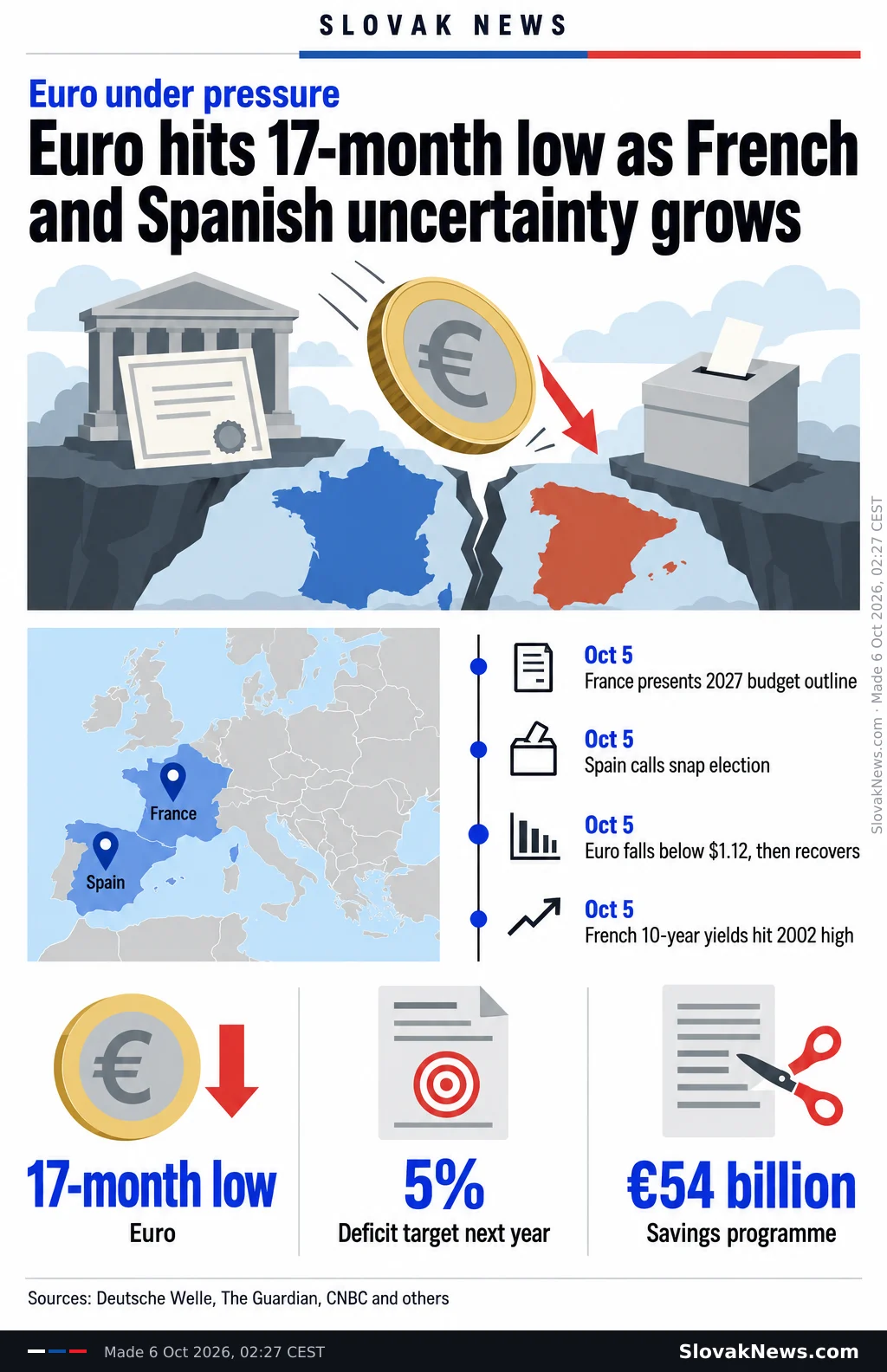
The single currency fell below $1.12 as investors focused on France’s borrowing costs and Spain’s snap election. French 10-year bond yields reached their highest level since 2002.
Listen to the story
Short version
The euro dropped to a 17-month low as markets focused on French borrowing costs and political uncertainty in France and Spain. France’s budget plans and the possibility of wider bond-market stress remain under scrutiny.
- Euro traded below $1.12 before a slight recovery
- French 10-year yields reached their highest since 2002
- France targets a 5% deficit next year
- Spain called a snap election
- A weaker euro could increase import costs
Infographic

What's new
- Euro fell below $1.12 before recovering slightly
- French 10-year bond yield reached a 24-year high
- Spain called a snap election after housing legislation failed
- France outlined savings intended to narrow next year’s deficit
On Oct., the euro sank to its weakest point against the US dollar in 17 months. 5, 2026, dropping below $1.12 as financial markets focused on France’s public finances and political uncertainty in France and Spain.1234
Infographic
French borrowing costs rise
The yield on France’s 10-year government bonds reached its highest level since 2002 before easing. Deutsche Welle reported that the yield touched 5%, while The Guardian said the difference between French and German borrowing costs widened to its largest level since 2012.12
The Guardian reported that investors linked the latest euro selling to concern about France’s rising debt costs and the possibility that stress in the French bond market could affect other euro-area countries. It also said a hung parliament and gains by National Rally could complicate efforts to reduce the budget deficit.2
According to Deutsche Welle, France’s debt is almost 118% of gross domestic product and has increased by well over €1 trillion since Emmanuel Macron became president. The outlet also reported that the annual deficit regularly exceeds 5%, compared with 3.4% when Macron took office.1
Budget plans face scrutiny
France released preliminary plans for its 2027 budget, which seek to bring the public deficit down to 5% of GDP next year. CNBC reported a starting figure of 5.4%, while The Guardian cited Prime Minister Sébastien Lecornu as putting this year’s deficit at 5.5%. Lecornu warned that without measures the shortfall could reach 6.5%.23
The Guardian reported that the government had announced a €54 billion savings programme involving reductions in pension spending and departmental funding, with defence excluded. CNBC cited an assessment that France was unlikely to meet its fiscal goals even if the plan was adopted and that the proposal would not correct the country’s underlying fiscal problems.23
Spain added another source of political uncertainty after Prime Minister Pedro Sánchez called a snap election following the defeat in parliament of emergency housing legislation. The Guardian said the election announcement contributed to concerns surrounding the eurozone.12
Currency and inflation pressures
Accounts of the euro’s daily fall differed. According to The Guardian, the currency dropped by up to 0.8% versus the dollar and then edged back up, whereas CNBC put the decline at 0.6%. The Guardian also put the currency’s monthly loss at about 1.2% and said it was roughly eight cents below its January peak; France 24 calculated a decline of nearly 7% from its late-January high.234
Ricardo Amaro of Oxford Economics attributed the broader euro decline to changing expectations of higher US Federal Reserve interest rates amid rising global bond yields, while also saying investors had prepared for greater French fiscal risk. Roberto Mialich of UniCredit said another fall could bring $1.10 into view in the near term.12
Deutsche Welle reported that a weaker euro would raise the price of imports, particularly oil and gas bought in dollars, adding to inflationary pressure expected to remain elevated into 2027. It also reported expectations of further European Central Bank interest-rate increases this year.1
Why it matters
A weaker euro can increase the local-currency cost of imported goods, particularly dollar-priced energy, while higher sovereign yields raise governments’ borrowing costs. The Guardian reported concern that French bond-market strains could spread to other euro-area countries, placing additional pressure on the European Central Bank.12
Videos
Related stories



Version history
- version 1 ·