Business · United States of America
G20 Trade Ministers Meet in Milwaukee Amid Tariff Tensions
Trade officials from the world's largest economies gathered in Wisconsin for a two-day summit dominated by disputes over U.S. tariffs, forced-labor rules and industrial overcapacity.
G20 trade ministers met in Milwaukee for two days amid disputes over U.S. tariffs, forced-labor rules and industrial overcapacity, with analysts predicting little progress.
- Meeting opened September 30 in Milwaukee, running two days
- U.S. has tariffed 60 economies over forced-labor concerns
- Washington investigating 16 partners for excess industrial capacity
- Supreme Court struck down many broader tariffs in February
- Canada reports rising trade beyond the United States
What's new
- G20 trade ministers opened two days of talks in Milwaukee on September 30
- The U.S. government is examining 16 trading partners for producing more industrial goods than needed
- New U.S. tariffs of 10-12.5% hit roughly 60 economies over forced-labor concerns
- A U.S. Supreme Court ruling in February struck down many of Trump's broader duties
Trade ministers from the Group of 20 convened in Milwaukee, Wisconsin, on September 30 for a two-day meeting overshadowed by tariff disputes tied to U.S. President Donald Trump's trade agenda, with Washington holding the G20's rotating presidency this year.16
Tariffs and investigations dominate agenda
Washington has alleged insufficient action against forced labor to justify new tariffs on 60 economies, and is separately investigating 16 trading partners over excess industrial capacity, according to multiple outlets covering the summit.134
A February ruling by the U.S. Supreme Court struck down many of Trump's country-specific duties, though sectoral tariffs on automobiles, steel and lumber remain in place, according to World Today News. Since then, officials have imposed levies ranging from 10 to 12.5 percent on about sixty nations deemed to have fallen short on forced-labor enforcement, per the outlet's reporting.5
U.S. U.S. Trade Representative Jamieson Greer justified the administration's stance during a Milwaukee roundtable, describing American policy as "not anti-trade," and World Today News reported he further characterized U.S. trade policy as "fundamentally not anti-commerce."45
Doubts over breakthroughs
Experts anticipate the summit will conclude without resolution, pointing to Trump's preference for one-on-one deals rather than multilateral G20 discussions. Josh Lipsky of the Atlantic Council said, according to World Today News, that "participants should not expect major policy pivots out of Milwaukee."135
Wendy Cutler, affiliated with the Asia Society Policy Institute, noted that certain nations perceive themselves as unjustly singled out by U.S. investigations, a concern echoed across multiple reports. She said "they are being unfairly targeted" and, separately, that "nations feeling unfairly targeted are unlikely to mince words during the proceedings."457
Poland's finance minister Andrzej Domanski said tariffs are damaging for companies and consumers, telling reporters, "Tariffs are bad for companies, are bad for customers and are increasing inflation," and adding he hoped "our US partners will stick to all settlements that were made." He also condemned Russian actions against Ukrainian agriculture exports.1
John Drew, who leads the UAW's political wing in Wisconsin, contended that current tariffs haven't undone years of manufacturing job losses, World Today News reported, as demonstrators gathered outside the summit to voice frustration over unfulfilled administration commitments.345
Canada shifts trade beyond the United States
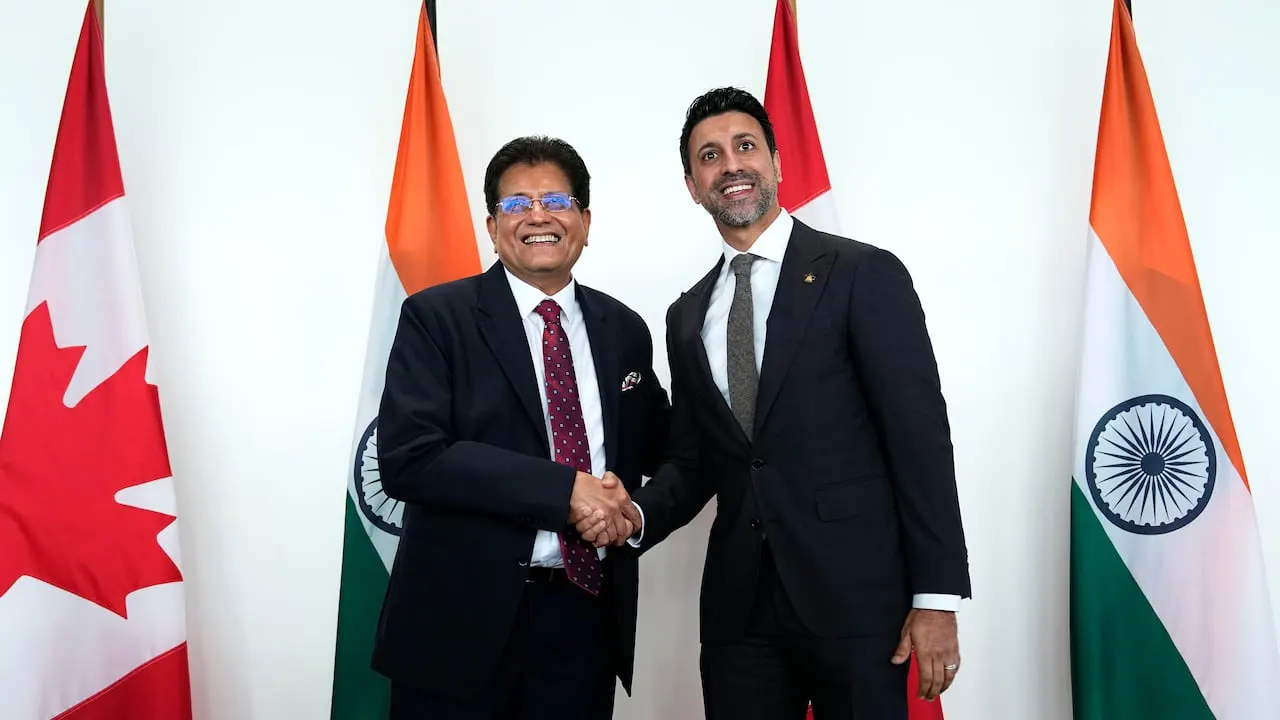
Many delegations, including Canada's, arrived prepared to discuss deals without their U.S. host, according to CBC. Maninder Sidhu, Canada's minister for international trade, emphasized his government's commitment to trade governed by established rules, while CBC reported that Canadian officials highlighted growing commercial ties with countries outside the U.S.23
CBC reported that Canada's non-U.S. trade grew by 17 percent — an increase of 33 billion dollars — over the last year, and the outlet noted that roughly a third of Canada's exports now go to markets beyond the U.S., the largest such proportion in four decades.2
The report also noted that a U.S. import ban on certain Canadian products, including most alcoholic drinks, took effect on Tuesday, and that Canada-U.S. talks stalled in August when Canada turned down the most recent American deal. Greer and Canada's LeBlanc have nonetheless spoken by phone multiple times per week since August, including as recently as last Friday, CBC reported.2
Martha Harrison said the dispute extends well beyond the two countries, stating, "It impacts, ultimately, not just the trading relationship between Canada and the U.S., but trading relationships around the world that are governed by the rules based system."2
WTO rules and wider outlook
CBC reported that the U.S. has "laid the foundation for a new global trading order," and that the Most-Favored Nation principle, meant to prevent discrimination against WTO member countries, is under strain, with changes potentially causing more uncertainty for businesses reliant on international supply chains. The WTO, whose 166 members are at different stages of development with conflicting interests, has warned that failure to reform could fragment the system and significantly reduce economic output, according to CBC.2
Beijing dismisses accusations of overcapacity and keeps denying it exports surplus production, whereas U.S. officials, per World Today News, also implicate the European Union, Japan and South Korea in distorting global prices. Ongoing U.S. investigations reach beyond China, putting the EU and other G20 economies including Japan and South Korea at risk of tariffs, according to the Bangkok Post.1357
The European Union has a separate tariff deal with the U.S. capping Trump duties at 15 percent, while India is pushing to finalize its own trade pact with Washington. Greer said of existing agreements, "We will certainly take them into account." Poland, though not a permanent G20 member, was invited this year, while South Africa has been excluded by U.S. officials, according to France 24.1
Prior to the gathering, USTR indicated the agenda would include eliminating forced labor, revising the MFN principle, condemning the use of food as a trade weapon, and tackling systemic overproduction. Ambassador Greer said, "The Trump Administration looks forward to working with our G20 partners to establish a global trading order based on fair, reciprocal, and balanced trade," adding that the tariff program is "actively rebalancing global trade, reversing decades of non-market policies and practices to protect American workers and businesses."6
Analysts and officials at the summit suggested trade policy could change in the United States after 2028, though for now Trump's tariffs have, according to critics cited by France 24 and TRT World, done nothing to bring back jobs or rebuild manufacturing.13
Why it matters
The dispute affects trading relationships governed by rules-based systems well beyond North America, and questions about reforming World Trade Organization principles could reshape supply chains that European businesses depend on. A push by G20 members, including the EU, to deepen trade ties outside the United States could alter Europe's own commercial calculations.2
Related stories
Version history
- version 1 ·