World · Germany
AfD Wins First State Parliament Speaker Post in Germany
Members of Saxony-Anhalt's state parliament chose far-right Alternative for Germany lawmaker Tobias Rausch to serve as its president, a milestone for the party, after securing backing from the left-wing BSW along with additional legislators.
Listen to the story
Short version
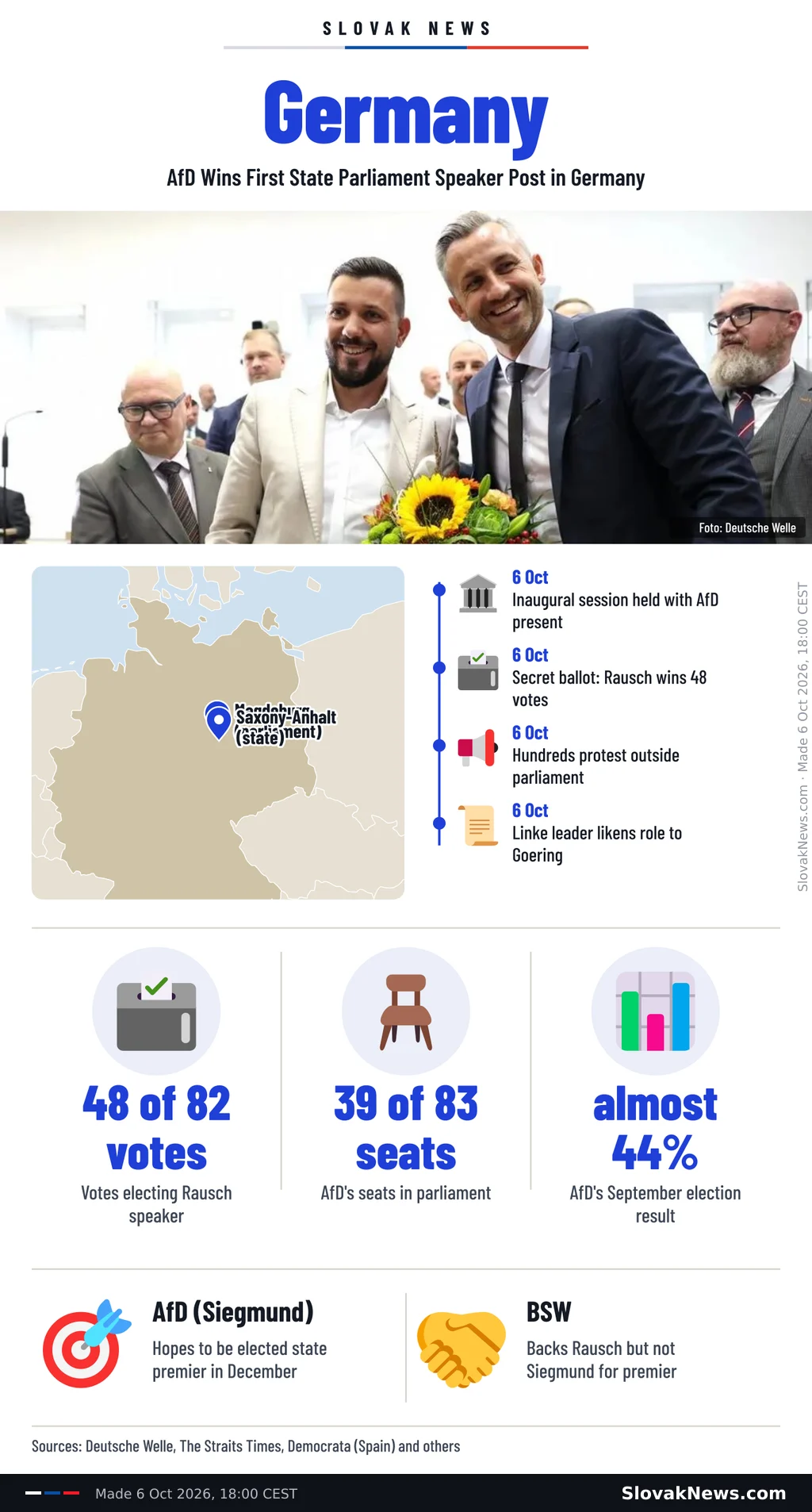
The AfD's Tobias Rausch was elected speaker of the Saxony-Anhalt state parliament, a first for the far-right party in Germany since 1945.
- Rausch won 48 of 82 votes, with 29 against and five abstentions
- BSW backed Rausch but will not support AfD's Siegmund for premier
- Hundreds protested outside the Magdeburg parliament
- Linke leader compared it to Goering's Reichstag role in the 1930s
- AfD took nearly 44% in September's Saxony-Anhalt election
Infographic

What's new
- Tobias Rausch (AfD) elected speaker of Saxony-Anhalt parliament with 48 votes
- BSW backed Rausch, breaking with other parties' refusal to cooperate with AfD
- Hundreds protested outside the parliament in Magdeburg
- Linke leader compared the moment to Hermann Goering's Reichstag role
On Tuesday, the eastern German state of Saxony-Anhalt's legislature chose Alternative for Germany (AfD) member Tobias Rausch to head its parliament as president, marking the first time since World War II's conclusion that an AfD politician has held a state legislature's top post.1245
Infographic
A narrow but decisive vote
Rausch received 48 votes in favor and 29 against, with five abstentions, out of 82 votes cast in a secret ballot, according to Deutsche Welle, Democrata and t-online.de.136
According to Deutsche Welle and Democrata, the AfD holds 39 of the state's 83 seats and the BSW holds five, meaning the two parties' combined 44 lawmakers could not alone explain the 48 votes for Rausch; both outlets say the secret ballot made it impossible to confirm the identity of the additional backers. The Local Germany reported that the AfD had narrowly missed an absolute majority with 39 seats, a claim disputed by t-online.de. Ukrainian National News referred to the election as a historic AfD victory but did not give the same seat breakdown.1356
The BSW, a left-wing party with five lawmakers, had already announced it would support Rausch, according to Deutsche Welle and The Local Germany, while saying separately it would abstain in any vote for AfD leader Ulrich Siegmund to become state premier. Democrata reported that the CDU abstained in the speaker vote while the SPD, Greens and Die Linke rejected backing Rausch.1235
Protests and political reaction
Several hundred protesters gathered outside the parliament building, some carrying signs invoking Germany's Nazi past and reading out parts of the constitution, according to the Bangkok Post and The Local Germany. The Straits Times put the number at about 400 and described the demonstration as peaceful.258
Eva von Angern, the Left Party leader in Saxony-Anhalt, drew a comparison between the AfD's new role and Hermann Goering's time as Reichstag speaker in the 1930s and his part in enabling Adolf Hitler's takeover, according to The Local Germany and NBC News. The BSW called the comparison "shameful".59
Christian Leye of the BSW defended his party's decision to back Rausch, saying: "We need a smarter way of dealing with the AfD and that means tackling the content of their programme instead of a firewall." According to The Local Germany and NBC News, Sven Schulze, the CDU's regional leader and the state's sitting premier, stated that none of his party's members had broken ranks.59
Political context
According to Deutsche Welle, The Straits Times, The Local Germany and the Bangkok Post, the AfD captured close to 44 percent of ballots cast in Saxony-Anhalt's September 6 election, outperforming the CDU. The Straits Times reported the AfD fell three seats short of an absolute majority, despite some polls predicting it would secure one. Deutsche Welle said Ulrich Siegmund, the AfD's leader in the state, won the election with 44 percent of the vote and intends to seek election as state premier in December, with the vote for speaker held separately from that for premier.1258
Per reporting from Deutsche Welle, The Straits Times, The Local Germany and t-online.de, Germany's domestic intelligence agency has designated Saxony-Anhalt's AfD chapter as a verified far-right extremist group. Chancellor Friedrich Merz entered office in 2025 vowing to curb support for the AfD, yet his governing coalition has since been beset by internal friction, and the party has now pulled decisively ahead in nationwide surveys, with The Straits Times and The Local Germany putting AfD support at 30 percent compared with 17.5 percent for Merz's CDU/CSU.25
Rausch's background
Rausch, 35, has been an AfD member of the Saxony-Anhalt parliament since 2016, according to Deutsche Welle and Democrata. Deutsche Welle reported that Rausch had given legislative office jobs to multiple acquaintances from his soccer club, while Democrata cited him saying he played no role in hiring his family members and had pledged to carry out the presidency impartially. Ukrainian National News reported that Rausch had threatened to dissolve parliament and hold new elections if his appointment as speaker failed.137
Why it matters
The vote gives the AfD institutional standing in a German state legislature for the first time since 1945, a milestone that several outlets link to the party's rising national poll numbers and strains within Chancellor Merz's coalition. Readers across Europe may watch whether other parties' long-standing refusal to cooperate with the AfD continues to erode, as it did with BSW support in this vote.25
Related stories
Version history
- version 1 ·