World · Japan
Japan Raises Permanent Residency Fee 20-Fold, Tightens Rules
A revised immigration law took effect in Japan on October 1, 2026, raising the permanent residency application fee from 10,000 to 200,000 yen and adding new income, pension and language requirements for applicants.
Japan raised its permanent residency application fee twenty-fold and added stricter income, pension and language requirements, effective October 1, 2026.
- PR fee rises from 10,000 to 200,000 yen
- New income, pension and Japanese-language rules for applicants
- Most criteria apply to applications from April 2027
- Long queues reported at Tokyo immigration bureau
- Comes amid anti-immigration political gains in Japan
What's new
- Permanent residency fee rises twenty-fold, from 10,000 to 200,000 yen
- New income, pension and Japanese-language benchmarks added to PR eligibility
- Residency renewal and status-change fees now tiered, up to 75,000 yen
- Takaichi creates new minister post for coexistence with foreign nationals
Japan's revised immigration control law took effect on October 1, 2026, raising the fee for permanent residency applications twenty-fold, from 10,000 to 200,000 yen, and introducing stricter income, pension and Japanese-language requirements for applicants, according to the BBC, Nikkei Asia and other outlets.124
New fee structure
Under the revised law, the cost of applying for permanent residency climbed twentyfold to 200,000 yen from its previous 10,000 yen level, a sum the BBC converted to roughly $1,270 or £955. Officials explained that these higher charges, coming after visa fees had already quintupled in July, were intended to account for inflation and shifts in currency exchange rates.1245
Fees for renewing residency status or changing it also shifted away from a uniform 6,000 yen charge to a sliding scale of 10,000 to 75,000 yen based on how long someone has stayed, while the law allows the cabinet to set a maximum fee as high as 300,000 yen. GaijinPot reported that a family of four renewing one-year visas would face annual costs of 132,000 yen from October 1, up from 24,000 yen, and that applications filed by September 30, 2026 retained the previous fee schedule. Discounts remain available for applicants in financial hardship, those designated as refugees, and specified family members of Japanese nationals, reducing renewal fees to 10,000 yen and PR fees to 20,000 yen.15
Stricter eligibility criteria
Beyond the fee rise, the government revised permanent residency guidelines to add explicit income, pension and Japanese-language benchmarks that had not previously been specified. Candidates must now prove their yearly earnings meet or exceed the nationwide household average—5.75 million yen in 2024 figures—along with paying into a pension and being able to carry on basic conversation in Japanese; Euronews added that applicants also need to show familiarity with social norms. According to the Japan Times, the bulk of these new standards take effect for applications submitted starting in April 2027, at which point officials will check whether a candidate's earnings have consistently stayed above the nationwide household average.1236
Japan's foreign resident population was reported to have grown 9.5% over the past year and to be more than 80% higher than a decade ago. Reports differed on the exact total at the end of 2025: the BBC, Nikkei Asia and MyJoyOnline cited 4.12 million, while GaijinPot cited 4.13 million, describing it as the highest figure in the country's history.1245
Political context
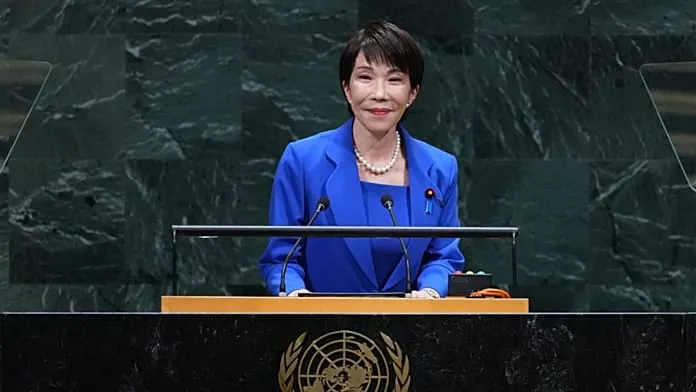
Prime Minister Sanae Takaichi, who took office in October last year, has framed the changes as part of efforts toward orderly coexistence between citizens and foreign residents. On social media she wrote, "The government recognizes that, with the increasing number of foreign residents, there are citizens who feel anxiety and a sense of unfairness," and said her administration is "addressing this by making 'foreigner policy' more 'orderly' so that both citizens and foreigners can live safely and securely." She also said, "We will ask foreign residents to bear a commensurate share of the costs."124
Takaichi established a fresh ministerial position dedicated to fostering coexistence with foreign nationals, and the ruling coalition's agreement calls for reviewing whether a cap should be placed on the number of foreign residents. Nikkei Asia reported that a panel was established in July 2026 to study future immigration trends, with the government planning to finalise basic policies on accepting foreign nationals by March 31, 2027. The measures follow gains for the nationalist Sanseito party, which campaigned on a "Japanese First" platform and rose sharply in the July 2025 upper house election, with some members using language such as "silent invasion." False claims have also circulated suggesting significant welfare payments go to foreigners or that foreign residents make Japanese streets less safe.237
Mixed reactions
At Tokyo's main immigration bureau, wait times exceeded seven hours as hundreds of applicants queued to file paperwork before the fee increase. Yujie Chono, a 22-year-old university student born in the US, reported a five-hour wait and said she recognizes that admitting too many foreigners could weaken Japan's distinctive culture, but added that given the country's low birth rate and aging population, Japan has no choice but to welcome foreign workers."1347
Micaiah Michaela-Spence, a 37-year-old foreign resident who has lived in Tokyo for ten years, said she could not compile the required documentation before the price increase. She said her first reaction was that foreign residents were being treated somewhat too conveniently, adding that they are now expected to earn more than the typical Japanese resident and pay a much steeper fee simply to work in Japan and contribute taxes. She noted that language and cultural obstacles already discourage some skilled workers from relocating to the country. and said the policy did not seem like something designed with long-term consequences in mind."4
Business leaders and experts have warned that Japan needs more foreign workers given its ageing population and labour shortages. Nikkei argued that Japan ought to move beyond treating foreign workers as a short-term labor pool and instead encourage their lasting settlement through broader Japanese-language instruction. GaijinPot observed that the new charge fundamentally alters how people think about permanent residency, saying it can no longer be treated as a minor bureaucratic step, and urged prospective applicants to review official discount and waiver provisions beforehand.357
Funding and future changes
Officials forecast that income generated from residence permit charges would total 92 billion yen for the fiscal year concluding in March 2028, funds they said would go toward handling applications, running the immigration system, and supporting Japanese-language classes and orientation programs. A pre-screening system called JESTA is planned for introduction during fiscal 2028. GaijinPot reported a surge in enrolment at Japanese-language schools and sign-ups for the Japanese-Language Proficiency Test as applicants prepared for the new requirements, and noted that many Japanese companies already cover immigration renewal fees for foreign employees, unlike formal sponsorship arrangements in the United States or United Kingdom.245
Why it matters
The overhaul signals a shift in how Japan, facing an ageing population and labour shortages, manages a growing foreign workforce while responding to rising domestic anxiety and a nationalist political challenge.23
Version history
- version 1 ·