World · Kosovo
Kosovo Lawmakers Advance Bill to Limit Hague War Crimes Court
Parliament in Pristina approved the first reading of amendments curbing the Kosovo Specialist Chambers, as protesters clashed with police and the country faced a deadline to elect a president.
Kosovo's parliament passed a first-reading bill curbing the Hague war crimes court's powers, triggering clashes between protesters and police in Pristina amid a separate deadline to elect a president.
- Parliament approved first reading of amendments to the Kosovo Specialist Chambers law
- Changes would cap sentences, allow appeals and sentences served in Kosovo
- Follows September conviction of ex-President Hashim Thaci for war crimes
- Protesters clashed with police outside parliament; injuries and arrests reported
- Kosovo faced October 6 deadline to elect president or face early elections
What's new
- Kosovo MPs passed a first reading of amendments to the law governing the Hague-based Specialist Chambers
- Protesters clashed with police outside parliament and government buildings in Pristina
- Parliament adjourned without holding the second reading vote demonstrators demanded
- The presidential election deadline passed the same day, raising the prospect of new elections
Kosovo's parliament in Pristina on October 5 and 6 approved, at first reading, amendments to the law governing the Hague-based Kosovo Specialist Chambers, as protesters clashed with police outside the legislature and government buildings over the war crimes court's powers.123
Convictions behind the dispute
The legislative effort comes after a September 16 first-instance ruling in which the Kosovo Specialist Chambers found ex-President Hashim Thaci, along with three other ex-Kosovo Liberation Army commanders, guilty of war crimes stemming from the 1998-1999 conflict and its aftermath. Thaci was found guilty of murder, torture and illegal detention and was sentenced to 25 years, with the four defendants receiving a combined 81 years; sentences for the co-defendants ranged from 13 to 25 years, according to Al Jazeera. Balkan Insight separately named the four as Thaci, Jakup Krasniqi, Kadri Veseli and Rexhep Selimi, though the outlet's reporting on individual sentences was not consistent across its own account. All four denied the charges and have appealed.123
What the amendments would do
Al Jazeera and Balkan Insight reported that under the proposed revisions, maximum prison terms would be limited to 15 years, those convicted could serve their time domestically instead of overseas, and they would gain the right to appeal before Kosovo's Supreme Court. The Straits Times reported the same cap and appeal provisions but, unlike Euronews, said the bill would also let Kosovo's President grant amnesty to convicted individuals. Balkan Insight reported that the amendments would additionally grant the President pardon powers and place the court under international monitoring, and that they would narrow the court's mandate to crimes allegedly committed from July 1, 1999 to December 31, 2000, rather than the current January 1, 1998 to December 31, 2000 period. The Democratic Party of Kosovo, founded by Thaci, sponsored the bill.123
Clashes outside parliament
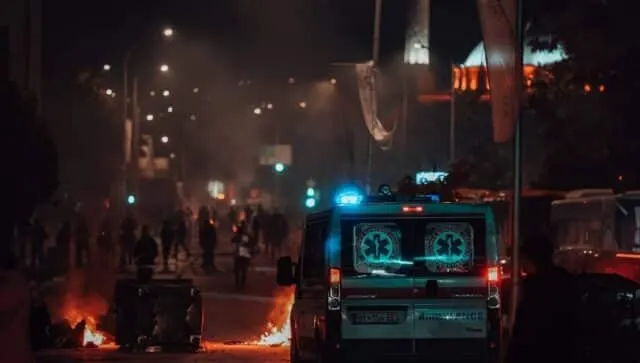
A crowd of several hundred, among them Kosovo Liberation Army veterans, assembled outside parliament and government offices in Pristina, barricading the exits so legislators could not depart and calling for the law's second reading to be voted on that very day. Police used tear gas and water cannon after demonstrators threw firecrackers, stones and fireworks, according to the Straits Times, and burned garbage bins near the government building, Balkan Insight reported. Casualty figures varied between outlets: the Straits Times reported at least 17 people injured, including six police officers, with three protesters detained, while Al Jazeera put the toll at 12 injured, mostly civilians. Naser Syla, emergency director at a Pristina hospital, said 12 people received medical assistance, a figure matched by Kosovo police, who also said six officers were hurt.123
A law tied to the presidency
Kosovo's Constitutional Court had set October 6 as the deadline to elect a president, warning that parliament would otherwise be dissolved, triggering what Balkan Insight described as the country's fourth parliamentary election in under two years. The Democratic Party of Kosovo tied its support for electing a president to passage of the court amendments, according to Al Jazeera. Prime Minister Albin Kurti said the changes were "rushed" and "insufficiently analysed and thought through," and argued that "a law regarding the Hague court is necessary, but so is a President of Kosovo," warning that "proceeding with one without the other could be highly detrimental." He added that Kosovo could not claim to defend its interests in The Hague "while allowing an institutional vacuum to develop within Kosovo." Kurti's party backed the first reading but declined to support a same-day second vote, and Speaker Albulena Haxhiu rejected holding that vote, saying "it was not on the agenda." Deputy speaker Vlora Citaku said passing the new law was "a national obligation, whereas the election of the president is a matter of agreement," and a meeting between PDK chair Bedri Hamza and Kurti failed to reach agreement.231
Why it matters
Created in 2015 after Western allies pressed Kosovo to prosecute wartime crimes, the Kosovo Specialist Chambers now serves as a gauge of how European-backed judicial bodies in the Balkans are weathering political pressure. A weakening of the court's sentencing and jurisdiction rules, alongside a stalled presidential election, carries implications for Kosovo's political stability and its relations with the European Union.32
Version history
- version 1 ·