Lake Powell and Lake Mead Fall to Record Lows in 2026
A meagre Rocky Mountain snowpack and record warmth have driven the Colorado River's two largest reservoirs to their lowest levels on record, prompting emergency water releases and new federal operating rules.
Lake Powell and Lake Mead, the Colorado River's two largest reservoirs, dropped to record-low levels in 2026 after a severe winter snow drought, prompting emergency water releases and new federal operating rules.
- Lake Powell hit 3,517.24 feet on September 10, 2026, a new record low
- Lake Mead also reached a record low in August 2026
- Combined reservoir storage is lowest since 1963
- 450,000 acre-feet released from Flaming Gorge since April
- New 2027-2036 operating guidelines finalized after failed consensus talks
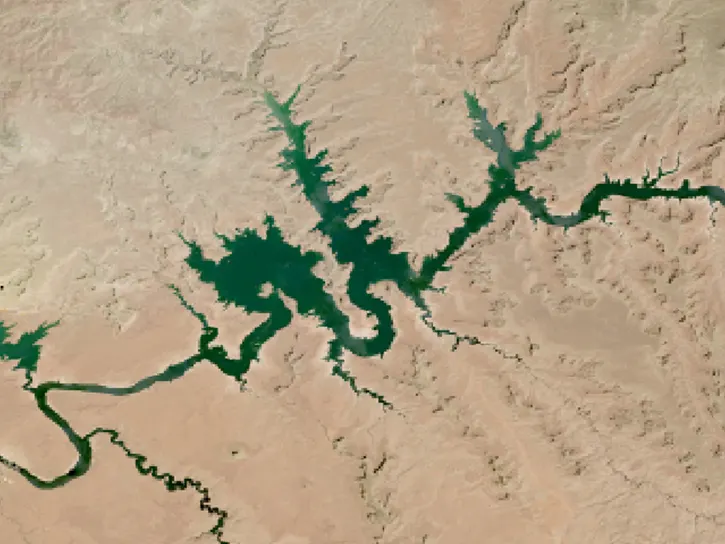
What's new
- Lake Powell's surface fell to 3,517.24 feet on September 10, 2026, below its previous record low
- Lake Mead's elevation dropped to an all-time low during August 2026, and the combined volume held by the two reservoirs sank to its weakest point since 1963
- Since April, federal water managers at the Bureau of Reclamation have discharged roughly 450,000 acre-feet from Flaming Gorge Reservoir in an effort to bolster Lake Powell's supply
- Federal officials finalized 2027-2036 operating guidelines and 2027-2028 rules after consensus talks failed to produce agreement
As the country's second-biggest reservoir, Lake Powell dropped to a historic low of 3,517.24 feet in surface elevation on September 10, 2026, eclipsing the mark it had set in April 2023, amid a punishing lack of snowfall in the Upper Colorado Basin that has left the river system severely diminished.134
Record lows across the basin
The latest measurement of 3,517.24 feet undercuts the earlier benchmark of 3,519.92 feet recorded on April 13, 2023. The reservoir now holds about 22 percent of capacity, compared with a 33 percent average, and its pool elevation stood at 3,518.79 feet above sea level on August 23.134
Further down the river, Lake Mead—the nation's biggest reservoir—likewise sank to an unprecedented low point that August. Federal water managers at the Bureau of Reclamation reported that the two reservoirs' total stored water fell to its weakest point since Lake Powell first began filling in 1963.346
Stretching roughly 1,400 miles through seven U.S. states and Mexico, the Colorado River delivers drinking water to about 40 million residents and irrigates around 5 million acres of cropland, serving urban centers such as Las Vegas, Phoenix, Los Angeles, and San Diego.134
A thin snowpack and a warming basin
The Upper Colorado Basin received unusually little snow during the winter of 2025-2026, and record warmth further sapped what snowpack there was, according to NASA. Seasonal snowmelt declined to what the agency described as a trickle, and it did little to replenish the reservoirs in spring, as it typically would. NASA noted that "much of the Colorado Basin is arid or semi-arid, so a large portion of the river's flow originates as snowmelt from higher elevations."1
KUNC reported that Colorado, located within the Upper Basin, experienced its hottest winter in recorded history during 2025-26 alongside its thinnest statewide snowpack in over four decades. According to the outlet, the state's evaporative demand climbed 5 percent from 1980 to 2022 and is expected to grow another 8 to 17 percent by mid-century, even as total rainfall across the Upper Colorado River Basin has declined about 7 percent since the turn of the millennium.2
According to researchers Brad Udall and Jonathan Overpeck, human-caused emissions are playing an ever-larger role in the river's decline; they stated, "We can say with confidence that human-caused emissions of greenhouse gases are having an increasingly negative impact on the flows of the Colorado River," adding, "This climate change impact will continue to worsen, but because humans cause it, humans can halt it." Per KUNC, rising temperatures alone explain roughly 40 to 50 percent of the diminished flows, and researcher Pedro DiNezio noted, "What's important here is that we're showing that rainfall has also been influenced by humans, in addition to just evaporation. Both contribute to drought."2
Emergency measures and new rules
The Colorado Sun reported that federal officials have discharged approximately 450,000 acre-feet from Flaming Gorge Reservoir—located across northern Utah and southern Wyoming—starting in April, aiming to shore up Lake Powell's water levels. Upper Colorado River Basin officials convened on September 15 to weigh additional emergency water releases, as Washington urged Upper Basin states to keep pursuing such steps under the newly adopted guidelines.5
Colorado communities saw water cuts affecting senior water-rights holders over the summer, and supplies across the basin were reduced by half, the Colorado Sun reported. Tanya Trujillo acknowledged that none of the officials involved were happy with the current hydrologic situation She added that she appreciated the Bureau of Reclamation's efforts and its clear communication of the results, while Becky Mitchell remarked that various parties had cooperated to get through a difficult year We've almost gotten through this year. Mitchell added that while she hoped conditions would improve next year, that outcome could not be guaranteed.5
On August 28, the Department of the Interior issued a Record of Decision for Colorado River operating guidelines covering 2027 to 2036, after consensus-based talks begun in 2022 with Basin states and tribes failed to produce agreement. The department also finalized separate 2027-2028 operating guidelines the same day. A biological opinion on water releases from Glen Canyon Dam, above Lake Powell, was issued on August 13, and new two-year operating guidelines under the department's 10-year framework are due to take effect on October 1, 2026.6
Outlook
Federal projections cited by Newsweek suggest Lake Powell could rise by about 40 feet over the next two years, reaching 3,558.44 feet by June 2028 under the most probable scenario, while Lake Mead could fall to 998.40 feet by August 2028. Without further intervention, the Bureau of Reclamation had deemed it possible that Lake Powell could drop below the elevation needed for hydropower production at Glen Canyon Dam.134
Sarah Porter cautioned that any recovery may be limited, saying, "The reservoir will likely recover at least a little this winter, and with very heavy snowpack it could recover a lot, but levels at both Lake Mead and Lake Powell have ratcheted down over the last quarter century and one good winter won't be enough to stabilize the system over the long term."4
Why it matters
The Colorado River basin illustrates how a warming climate is reshaping water availability well beyond the American Southwest. Scientists cited in the dossier link the decline directly to human-caused greenhouse gas emissions, underscoring the shared stakes of climate policy across continents.2
Version history
- version 1 ·