World · United Kingdom
Northern Ireland Court Clears Protestant March Through Catholic Area
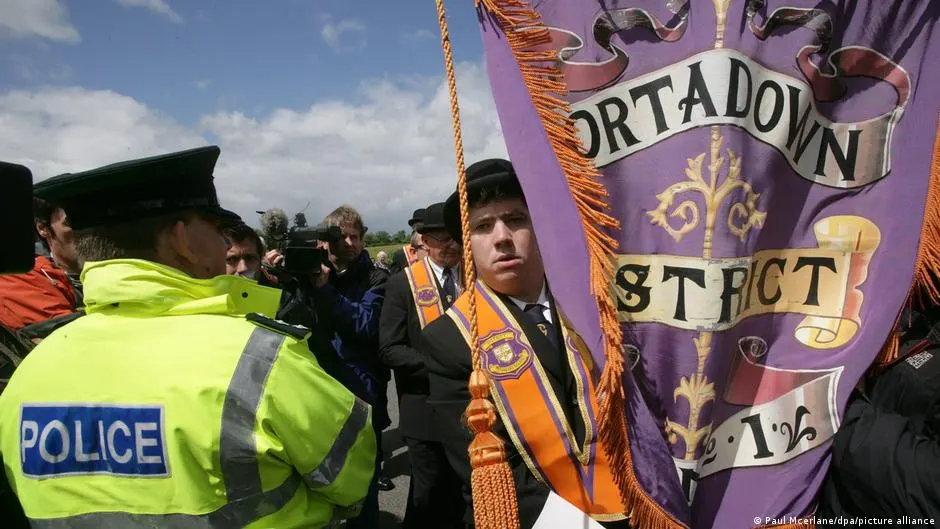
A High Court and Court of Appeal ruling allowed a restricted Orange Order parade along Garvaghy Road in Portadown, the first time the route has been used since the mid-1990s, prompting protests and political warnings.
Listen to the story
Short version
Northern Ireland's courts allowed a restricted Orange Order parade through the Catholic Garvaghy Road area, the first such march in nearly 30 years, drawing large protests and political tension.
- Court of Appeal overturned an injunction blocking the march
- Parades Commission limited it to 35 marchers, no bands
- About 2,000 people protested on Garvaghy Road
- UK PM Andy Burnham urged calm from all sides
- Route was a major Troubles-era flashpoint before 1998
What's new
- Court of Appeal overturned a temporary injunction blocking the march
- Parades Commission approved a 35-person, band-free march with strict timing
- Thousands of counter-protesters blocked the route on Garvaghy Road
- UK Prime Minister Andy Burnham appealed to both communities to stay peaceful
According to multiple outlets, Northern Ireland's High Court and Court of Appeal cleared the way for a limited Orange Order parade down Garvaghy Road in Portadown on Sunday, September 27, marking the first time in almost 30 years that a Protestant march has been allowed to pass through the Catholic neighborhood.123
The ruling
The High Court quashed the Parades Commission's earlier ban on the march in August, citing a procedural error, and the Court of Appeal subsequently overturned a temporary injunction that had blocked the parade.32116
The Parades Commission approved the procession under strict conditions: 35 Orange Order members were permitted to march silently, without bands or supporters, beginning at 8 a.m. and required to finish by 9:30 a.m.369
Outlets differed on how long the route had been closed to such marches. Deutsche Welle reported it was the first time since 1997, while The Straits Times and France 24 described it as almost 30 years. Al Jazeera reported the gap as 28 years, a figure disputed by other outlets.2346
A flashpoint from the Troubles
Garvaghy Road, described as a Catholic enclave within the largely Protestant town of Portadown, was a notorious flashpoint between the two communities before the 1998 Good Friday Agreement, which largely ended three decades of conflict in Northern Ireland known as the Troubles.3473
The Drumcree parade standoff began in the mid-1990s, when repeated Orange Order attempts to march down the road sparked protests, rioting and roadblocks, turning it into one of the fiercest marching disputes of the Troubles. The Troubles killed roughly 3,600 people and wounded about 50,000 before the 1998 agreement.4657
The 1998 Drumcree standoff ended with the killing of three Catholic children by the Ulster Volunteer Force, according to The Irish News.11
Protests and political reaction
About 2,000 people gathered on Garvaghy Road on Sunday morning to block the route, according to Deutsche Welle and France 24. First Minister Michelle O'Neill addressed the crowd, saying the march decision brought into question how the peace process works and that progress of the past 28 years had been undermined.2457
Sinn Féin president Mary Lou McDonald condemned the court decision, saying: "This is madness." She argued that subjecting any community to such treatment in 2026 was regressive and unacceptable, and insisted it would not be allowed to stand, adding that the community remained "dignified and united" and determined not to be dragged back into the past.6
DUP figures pushed back. MP Carla Lockhart said the rule of law had to be upheld, while DUP leader Gavin Robinson said O'Neill was breaking the law by standing with protesters. Deputy First Minister Emma Little-Pengelly said no one in Northern Ireland wanted violence or disorder.16
UK Prime Minister Andy Burnham called for restraint from everyone involved, arguing that Northern Ireland had achieved substantial progress that should not be reversed. Jon Boutcher, who leads the Police Service of Northern Ireland, said the protest had passed without any indication of violence or unrest.2695
Northern Ireland Secretary Chris Bryant met the five main political parties separately on Sunday evening. He said no solution had yet been reached but that a resolution was important, adding that nobody wanted to relitigate the past 28 years or dismantle the Good Friday Agreement.1
On the ground
Orange Order members attempted to begin their walk at 8 a.m. on Sunday but were refused permission by the PSNI beyond 100 yards on public safety grounds, before the Court of Appeal later permitted 35 members of the Portadown Orange Lodge to proceed. Schools in Portadown announced they would close on Monday because of the escalating situation.1
By Monday, a further legal challenge was thrown out by a High Court judge, and the Parades Commission again gave consent for 35 members to march through Garvaghy Road, with local residents and supporters from across Ireland organising separate protest groups along the route.11
Why it matters
The decision touches one of the most sensitive symbols of Northern Ireland's post-conflict order, testing whether institutions built after the Good Friday Agreement can manage a dispute that once threatened the peace process. For European readers, it underscores how unresolved sectarian tensions can still resurface within the United Kingdom nearly three decades after the 1998 settlement.29
Videos
Version history
- version 1 ·