World · United Kingdom
Portadown March Standoff Threatens Northern Ireland Power-Sharing
A court-approved Orange Order parade on Garvaghy Road was blocked by thousands of residents, reviving a decades-old sectarian dispute and straining the Stormont government.
Thousands blocked a court-approved Orange Order march in Portadown, Northern Ireland, reviving a 28-year-old sectarian dispute and straining the power-sharing government.
- Court permitted a 35-person Orange Order march on Garvaghy Road for first time since 1997
- About 2,000 protesters blockaded the route on September 27
- Judge's injunction blocking march was later ruled an error in law
- Taoiseach and NI Secretary responded amid concerns for Stormont's stability
What's new
- High Court upheld a Parades Commission decision allowing 35 Orange Order members to march on Garvaghy Road for the first time since 1997
- About 2,000 protesters blockaded the route on September 27, preventing the 8am parade start
- A judge briefly halted the march citing escalation risk, before the Lady Chief Justice said the ruling had erred in law
- Northern Ireland's Secretary of State appealed for calm as the power-sharing executive came under strain
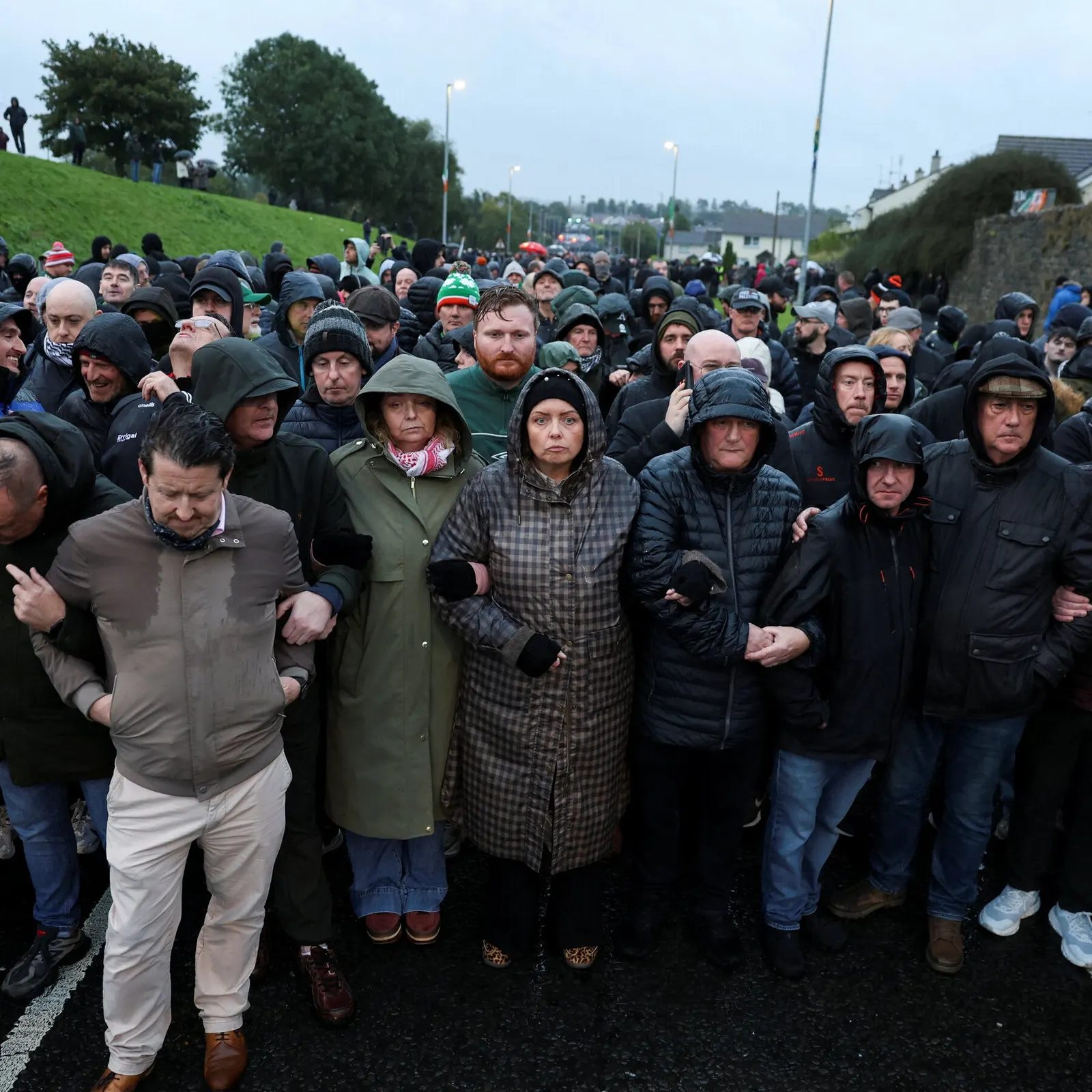
Thousands of nationalist residents blockaded the Garvaghy Road in Portadown, Northern Ireland, on September 27, 2026, preventing an Orange Order march from proceeding for the first time in 28 years, after a High Court ruling permitted the parade to pass through the mainly Catholic area.357
A dispute rooted in the Troubles
The Garvaghy Road, a thoroughfare in a predominantly nationalist part of Portadown, has been the site of Northern Ireland's longest-running parading dispute, according to the Irish Times. The Royal Ulster Constabulary rerouted the Orange Order's march away from the road in 1995, and the Orange Order has not marched there since 1997.4
According to the Irish Times, the standoff traces back to a string of sectarian killings tied to the dispute, among them the 1996 loyalist murder of Michael McGoldrick and the deaths of the Quinn brothers, who were killed when their house was firebombed on July 12, 1998. At the peak of the crisis in the late 1990s, security forces sent upwards of 2,000 soldiers and officers into the Garvaghy Road area, home to roughly 4,500 residents.4
The Guardian reported that Britain's government created the Parades Commission in 1998 to rule on disputed marches, forming it specifically in reaction to the Drumcree crisis. It banned the Drumcree parade every year from its creation until this year, a restriction the Orange Order and unionist parties opposed, according to Inkl.18
Court rulings reverse the ban
The High Court ruled in August that the Parades Commission had erred by not following its own rules and procedures, a decision that was upheld again on September 27.158
Justice Patricia Smyth subsequently granted an injunction halting the march, warning that the entrenched conflict could spiral into wider unrest throughout Northern Ireland.158
Northern Ireland's Lady Chief Justice, Siobhan Keegan, said Smyth's ruling had "unfortunately erred in law," and the High Court subsequently ruled that the original Parades Commission decision permitting the march had to be respected.158
Politico Europe reported that since the ban was imposed in 1998 in the wake of the violence the march had sparked, the Parades Commission had turned down over 1,300 separate Orange Order bids to finish the route.2
Blockade on the day
Euronews reported that the scaled-back procession, made up of just 35 Orange Order members marching without bands or supporters, was set to begin at 8am and wrap up by 9:30am. Roughly 2,000 people turned out in heavy rain to obstruct the route, while officers capped the number of marchers allowed on the hill at 35, as required by the Parades Commission's conditions.36
The demonstrators blocking the road did not have formal approval from the Parades Commission, according to Politico Europe, which noted that the law requires those protesting a parade to lodge an application with the commission. Politico Europe also reported that the policing operation had helped prevent violence or disorder during the standoff.2
First Minister Michelle O'Neill, of Sinn Féin, urged protesters to maintain the blockade. Sinn Féin president Mary Lou McDonald also addressed the crowd in support of the blockade.16
Political fallout
Taoiseach Micheál Martin described the High Court ruling permitting the march as "incomprehensible and wrong," according to the Irish News. The commentator Tom Kelly said the ruling highlighted "the fragility of our peace process" and warned that the standoff would have "no winner."168
Chief Constable Jon Boutcher urged a peaceful, collective resolution to the standoff, and Chris Bryant, who serves as the UK's Northern Ireland Secretary, called for calm and stressed that compromise was necessary.56
The standoff comes as Northern Ireland's cross-community government faces strain. Both the Guardian and Inkl pointed out that unionists no longer hold a majority in the region, and that Sinn Féin, the party of First Minister Michelle O'Neill, has become Northern Ireland's biggest political force. Politico Europe reported that Brexit's sea border arrangements have left many unionists feeling uneasy, and that the power-sharing executive at Stormont was revived two years ago after a lengthy breakdown over Brexit rules.128
Why it matters
The standoff highlights how unresolved sectarian tensions can still destabilise Northern Ireland's power-sharing settlement, a cornerstone of the post-Troubles peace process. For European readers, it underscores how Brexit-era arrangements, including the sea border, continue to affect political stability on the island of Ireland.12
Videos
Related stories
Version history
- version 1 ·