Business · Russian Federation, United States of America, EU
Russia Extends Diesel Export Ban as US Ban Threat Rattles Europe
Moscow is preparing to prolong its producer-level diesel export ban through October after drone strikes hit refineries, while a separate US ban under consideration by President Trump has stoked fears of a fuel price spike in Europe.
Listen to the story
Short version
Russia is extending its diesel export ban through October while a possible US diesel export ban stokes concern in Europe over prices and supply.
- Russia to extend diesel export ban to October 31, 2026
- Drone attacks disrupted major Russian refineries in September
- Trump reportedly weighing a US diesel export ban
- EU urges energy conservation amid supply concerns
- US supplies about a third of EU's extra-EU diesel imports
What's new
- Russia is preparing to extend its diesel export ban beyond September 30 to October 31, 2026
- Three of Russia's six largest diesel refineries halted or cut output after drone attacks in September
- Donald Trump is reportedly considering a US diesel export ban, described by a Russian expert as a bargaining chip
- The EU energy commissioner has urged all 27 member states to cut gas and electricity use "for as long as necessary"
According to reports dated September 21 and September 28, Moscow plans to stretch its producer-level diesel export ban—originally put in place on July 8 following drone attacks on refineries—out to October 31, 2026. The extension comes as European governments separately voice alarm over a possible US diesel export ban under consideration by President Donald Trump, which officials and analysts say could push up prices and strain supplies already tightened by the war in Ukraine and the region's shift away from Russian energy.3612
Russia prolongs its own export curbs
Russia first imposed a producer-level ban on diesel exports on July 8, 2026, and extended it through August and then through September 30 as supplies and prices at home came under pressure, with reports of long queues at filling stations earlier in the year, according to Roic News.3
Deputy Prime Minister Alexander Novak chaired a meeting on September 14 to decide on a further extension. The report indicated that as of September 21, officials intended to carry the ban forward to October 31, even though a formal government decree confirming the extension had not yet been issued. Bloomingbit separately reported on September 28 that Russia was pursuing the extension, though specific details on scope had not been disclosed.36
Under the measure, manufacturers are prohibited from shipping diesel, marine fuel and gasoil abroad, except for deliveries tied to intergovernmental agreements or humanitarian aid. The dossier noted that traders and other non-manufacturer exporters are subject to their own diesel export restrictions running through January 31, 2027, with gasoline exports also banned until that date and jet-fuel export limits kept in place through November 2026. "The move aims to rebuild domestic inventories ahead of winter," the report said.3
Roic News linked the renewed curbs to Ukrainian drone strikes that in September knocked out or severely cut production at three of the country's six top diesel refineries, among them Rosneft's Syzran and Saratov facilities. Before the ban took hold, Russia ranked as the globe's number-two diesel exporter behind the United States, with Turkey and Brazil serving as its main customers. According to the Russian Energy Ministry, the restrictions could be revised once domestic supply and inventory levels settle down.3
A separate threat from Washington
Meanwhile, TASS reported that Donald Trump is giving serious thought to banning US diesel exports, citing commentary from Oleg Nikolayev, an economist affiliated with the Stolypin Institute for the Economy of Growth. Nikolayev said, "The ban on diesel exports from the US will have a severely negative impact on Europe as the share of American diesel currently accounts for up to half of European consumption." He noted that no final decision had been made, framing the idea as a potential leverage point: "That's exactly why it remains under review rather than enacted." In Nikolayev's view, Trump sees the option as leverage in economic talks with a onetime geopolitical partner. He added that such a ban "offers no benefit to America, except perhaps to plug the gap in the domestic market, which would not have arisen under other circumstances," and warned it could strain Washington's ties with other nations.4
Euronews reported that the EU, having turned away from Russian energy, now relies heavily on American diesel—the US accounts for roughly 180,000 barrels daily out of the bloc's approximately 580,000 b/d in diesel imports from outside the EU this year, and about 200,000 b/d of the 350,000 b/d flowing into North-West Europe. The outlet reported that France imported roughly 63,000 b/d of US diesel, about 36% of its diesel imports, while Italy's dependence was around 4% and Spain's around 19%, though the precision of the French and Italian figures was flagged as uncertain within the same report.1
Euronews quoted Kpler analyst Zameer Yusof observing that Europe's most immediate consequence would be rising prices. He explained that buyers in North-West Europe would need to offer higher prices to secure substitute shipments. The outlet added that a US ban wouldn't instantly drain gas stations, given diesel is one of Europe's most stockpiled fuels, though regional refineries lack the capacity to quickly churn out hundreds of thousands of additional barrels—and a 30% reduction in US supply wouldn't automatically cause a matching 30% jump in prices. US diesel prices were reported at nearly $7 a gallon.1
Euronews described India as the sole viable backup source, though its overall exports fell from about 582,000 b/d last year to 352,000 b/d this year, with shipments specifically to Europe dropping from roughly 163,000 b/d to around 50,000 b/d. China's shipments to Europe were reported at roughly 1,000 b/d and South Korea's at about 2,000 b/d, volumes described as unable to close the gap. The report also noted that the war in Iran had already disrupted Middle East fuel supplies to Europe.1
European response
French President Emmanuel Macron called the proposed US ban "catastrophic" and asked the European Commission to temporarily relax fuel specifications, according to Euronews. US Energy Secretary Chris Wright reportedly reached out to refiners to gauge interest in a voluntary export cutback, while the Energy Policy Research Foundation contended the ban would likely prove counterproductive: "Cut off from export markets, Gulf Coast refiners would see storage fill and margins fall, and many would reduce runs."1
A European Commission spokesperson said Brussels was "monitoring reports of a potential US diesel export ban, warning that a disruption of flows could adversely affect both the US and Europe," with ongoing high-level EU-US communications on the issue, according to Arabic Trader. On September 29, the EU's energy commissioner sent a letter to all 27 member states recommending cuts to gas and electricity consumption "for as long as necessary," the Washington Post reported.52
Why it matters
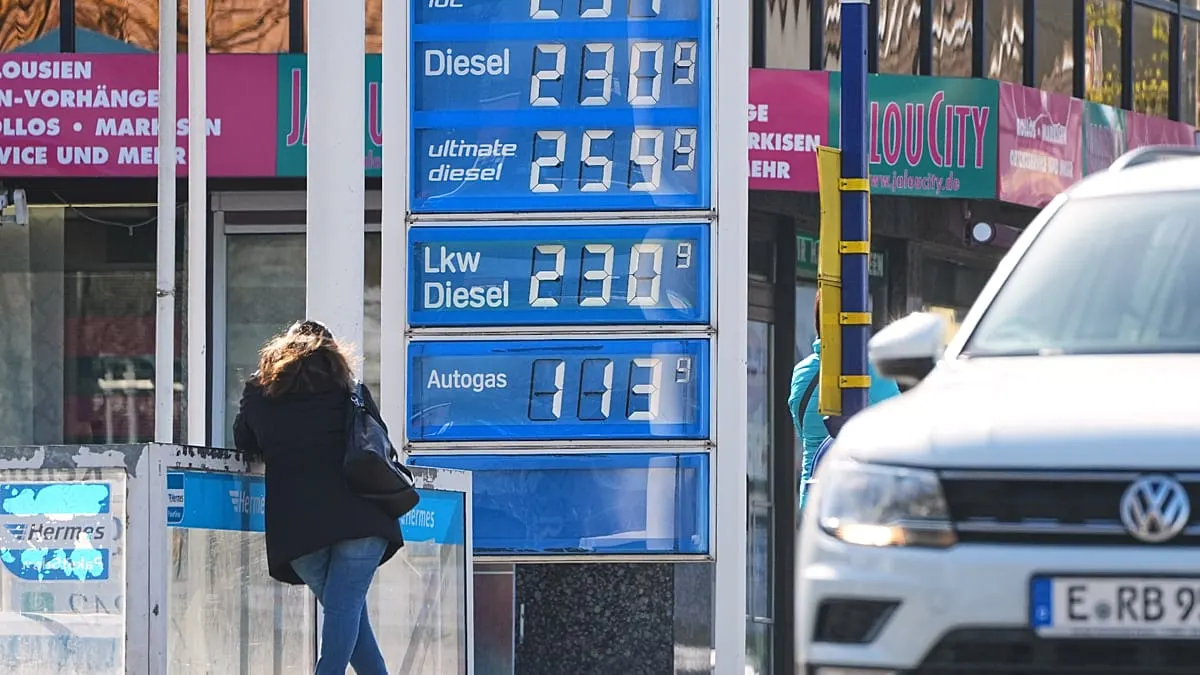
European diesel prices have already more than doubled since the start of the year, and the region has few quick alternatives to US and Russian supply. A US export ban, combined with Russia's extended restrictions and reduced refinery output, could further squeeze fuel availability and raise costs for consumers and industry across Europe.123
Version history
- version 1 ·