ViralAnecdotal
A rose-coloured Sahara meteorite reveals a piece of ancient Mars
Teghaza 001 belongs among the oldest Martian meteorites found on Earth. Its minerals also preserve evidence of interaction with water billions of years ago.
An anecdotal column: what is spreading online right now. The moment itself is verified in independent sources, but this is not news reporting and the rules of the news sections (several independent outlets) do not apply.
Teghaza 001 is an ancient Martian meteorite found in the Sahara. Its minerals preserve evidence of water, but its exact Martian origin remains unresolved.
- The rock dates back no less than 4.1 billion years.
- Its minerals show ancient interaction with Martian water.
- Researchers have proposed possible origins, not identified a source crater.
- The post behind the search spike has not been established.
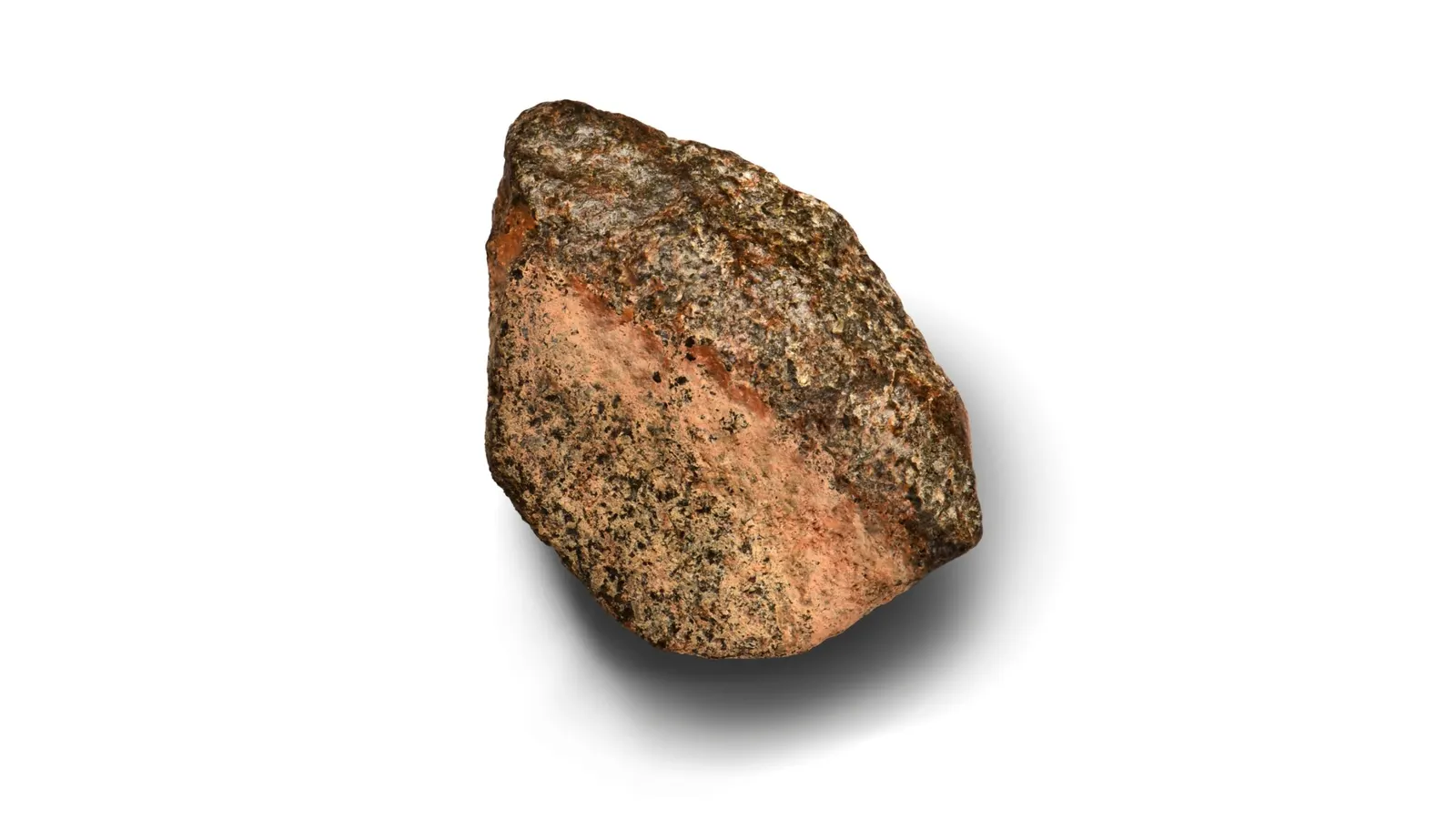
A rose-coloured stone found in the Sahara has a history stretching back at least 4.1 billion years. NASA reported on October 29, 2026 that Teghaza 001, discovered in Mali in 2022, is an exceptionally ancient piece of Mars–not simply a desert rock with an unusual colour.12
What happened
According to the University of Maine, Sahrawi meteorite hunters found the specimen in the Sahara. It weighs roughly 800 grams and takes its name from the salt plain in Mali where it was discovered. The discovery came in 2022; the recent news concerns the scientific work establishing its remarkable age and history.312
Researchers at the University of New Mexico identified its Martian origin using oxygen isotopes, NASA reports. Further examination uncovered tiny zircon crystals. The university’s account describes how Yang Liu used uranium-lead analysis of those crystals to investigate the meteorite’s age. The initial research was published in Science.24
The result places Teghaza 001 among the oldest Martian meteorites ever recovered. Its minerals also bear evidence of alteration by Martian water around 4.1 billion years ago. Those are related but distinct findings: the specimen records both ancient rock formation and a subsequent encounter with water.124
Why it spread
The coverage brings together three readily grasped details: a rosy stone, a discovery in the Sahara and an age measured in billions of years. CBS News and Smithsonian Magazine both foregrounded the meteorite’s colour and antiquity, while NASA highlighted its standing among the oldest known Martian meteorites.125
There is a scientific story behind that striking appearance, too. CBS describes the specimen as a rare view of Mars’s early crust, with evidence that rock formed from cooling magma and was later changed by water. The attention is therefore attached to more than an unusual-looking find.1
What is true
The evidence shows that Teghaza 001 came from Mars, dates back no less than 4.1 billion years and retains traces of early contact between water and rock. NASA, CBS and the University of New Mexico support its exceptional antiquity. Calling it one of the oldest Martian meteorites is more precise than declaring it the oldest without qualification.214
Its exact departure point on Mars remains unknown. NASA reports 13 locations with matching mineralogical and chemical characteristics; the University of New Mexico places several candidates in the ancient southern highlands. These are possible origins, not an identified source crater. Smithsonian also makes clear that the findings do not directly establish whether Mars ever hosted life.245
Related stories
same actors

Version history
- version 1 ·
Editors' commentary
The editors' view, not news reporting.
The colour offers a welcoming way into a complicated scientific story. The more interesting part is what the minerals can tell us after the photograph has caught our attention. There is room to enjoy an ancient visitor without giving it a precise Martian address–or a claim about life–that the evidence cannot supply.