World · United Kingdom, Germany, Russian Federation
UK and Germany deepen security partnership during Berlin talks
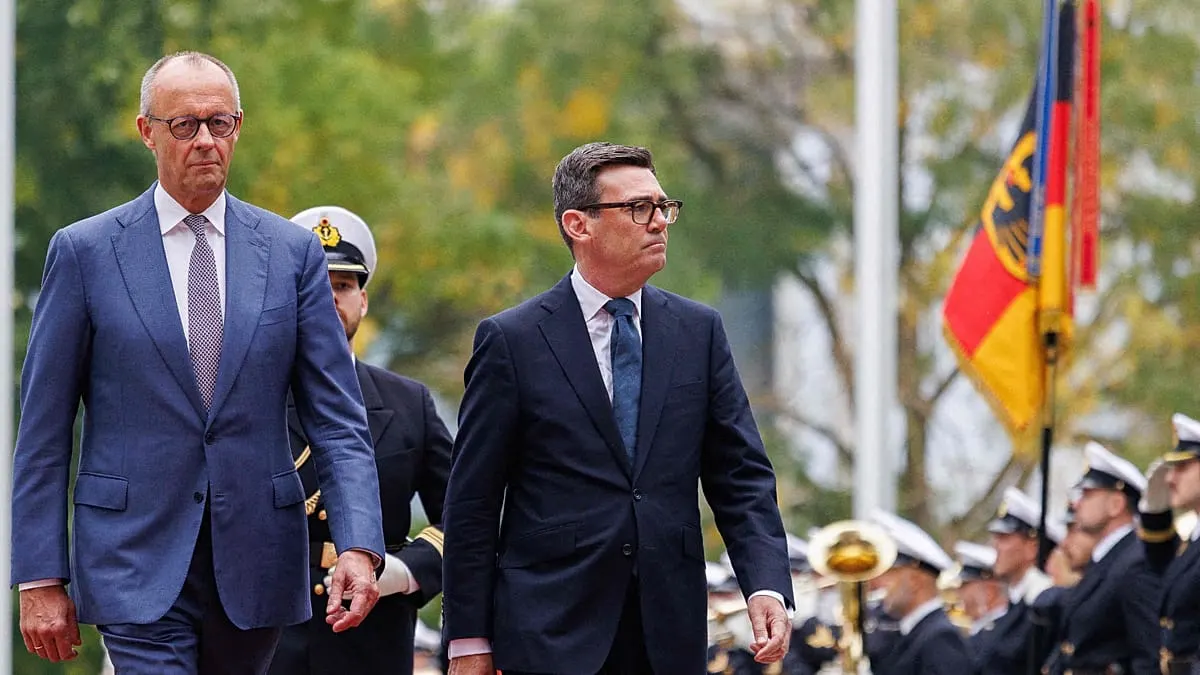
Prime Minister Andy Burnham and Chancellor Friedrich Merz met in Berlin on 8 October 2026, with hybrid threats, economic cooperation and the UK’s EU relationship on the agenda.
Burnham and Merz met in Berlin, ratified a UK-Germany treaty and announced closer action against hybrid threats.
- Kensington Treaty was formally ratified in Berlin.
- Security cooperation covers cyber attacks and sabotage.
- Burnham promised closer cooperation with the European Union.
- Space and quantum technology projects are also planned.
What's new
- UK and Germany formally ratified the Kensington Treaty.
- They launched a partnership against sabotage and cyber threats.
- Burnham pledged deeper cooperation with the European Union.
- The countries outlined further space and quantum technology cooperation.
On 8 October 2026, Prime Minister Andy Burnham held discussions in Berlin with Germany’s Chancellor Friedrich Merz on European security, economic growth and UK-EU relations. The meeting, Burnham’s first official visit to Germany, included the formal ratification of the Kensington Treaty and an agreement to deepen cooperation against cyber attacks, sabotage and other hybrid threats.34
Security partnership
The UK and German governments said their new counter-hybrid threat partnership would establish joint work to identify and disrupt hostile activity, alongside closer coordination to monitor, deter and respond to threats. The Kensington Treaty, signed in London in July 2025, commits the two countries to wider collaboration on science, technology, defence, security and growth.14
Burnham said Britain and Germany were “joining forces to find, expose and disrupt” threats. The UK government said hostile activity, particularly from Russia, posed a risk to collective security across Europe and beyond, while European leaders had warned that the threat of hybrid attacks had increased in recent weeks.134
The security discussions took place after Berlin accused Russia of organising an August drone attack on Leipzig/Halle airport, according to Euronews. According to the BBC, the British government called in a senior Russian diplomat to protest what it characterised as a grave and irresponsible assault on Leipzig airport; Moscow rejected any responsibility.13
Sir Mark Lyall Grant, a former UK national security adviser, said Russia had long been active in hybrid warfare and that the threat had intensified after European countries supported Ukraine following Russia’s invasion. He also said Russia had posed a threat to Britain since Vladimir Putin became president in 2001.1
EU ties and economic links
Alongside security, Burnham used the Germany visit to promise closer UK-EU ties on security, youth mobility and immigration, according to the Guardian. He described this as a “commitment to deeper EU co-operation”, while senior European officials welcomed the direction of travel, the newspaper reported.2
The Guardian reported that the French finance minister invited the UK “to come all the way back” to the EU. The paper also reported shifting public polling on Brexit. Euronews separately reported that Burnham argued Brexit’s negative effects outweighed its benefits and said Britain required a stable, long-term approach to its EU relationship.23
Burnham and Merz also convened British and German chief executives at a Regional Growth Forum focused on investment and industrial partnerships. The governments said an Industrial Tech Corridor would initially concentrate on artificial intelligence and high-value industrial applications.4
Future cooperation is also planned in space and quantum technologies. Stephen Doughty, the Foreign Office minister, said partnerships would be developed between German space companies and a spaceport in Scotland. The two countries aim to work towards a space-cooperation memorandum of understanding in 2027, while quantum research backing is set to rise to 19.5 million euros, according to the UK government.14
Why it matters
The Berlin meeting links two issues with consequences across Europe: protection against cyber attacks and sabotage, and the future shape of UK-EU cooperation. Britain’s pledge of closer engagement on security, mobility and immigration signals that its relationship with EU countries remains under active discussion, according to the Guardian.24
Videos
Related stories
background

same actors
Version history
- version 1 ·