World · United Kingdom, EU
UK PM Burnham Faces Internal Pressure to Commit to EU Rejoin Amid Mandate Questions
Andy Burnham, who became prime minister without a general election, is being pushed by Labour colleagues and campaigners to pledge outright EU rejoin rather than just weigh options, as critics challenge both his mandate and the economic case against Brexit.
Listen to the story
Short version
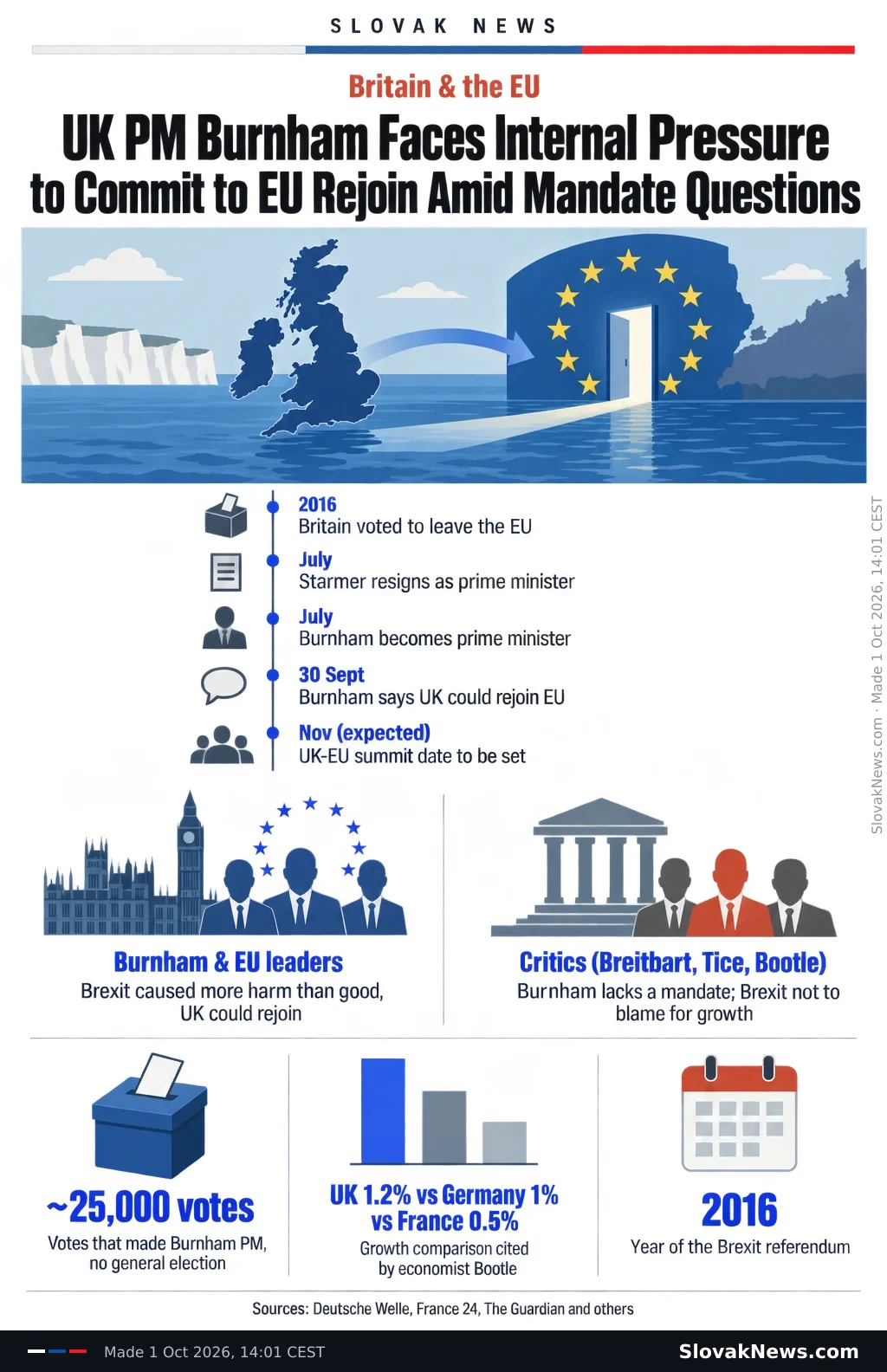
UK PM Andy Burnham faces mounting pressure to commit to rejoining the EU, as critics question his mandate and the economic case against Brexit.
- Burnham says Brexit caused more harm than good
- Labour minister and Best for Britain urge firm rejoin pledge
- Macron, Sanchez welcome possible UK return to EU
- Breitbart notes Burnham won ~25,000 votes, no general election
- Economist Bootle disputes Brexit as cause of slow growth
Infographic
What's new
- Breitbart notes Burnham became PM without a general election, winning just over 25,000 party votes
- Economist Roger Bootle disputes that Brexit is to blame for UK's slow growth, citing weaker growth in Germany and France
- Burnham says next Labour manifesto could include a rejoin pledge or a promise to hold another vote
Andy Burnham, who took over as British prime minister in July after Labour MPs ousted Keir Starmer, is under mounting pressure from inside his own party to pledge full EU membership instead of merely presenting a range of choices. Critics, including economist Roger Bootle and the outlet Breitbart, have challenged both the economic case for blaming Brexit for weak growth and Burnham's democratic mandate, noting he was chosen by roughly 25,000 Labour members rather than in a general election. This follows remarks Burnham made at Labour's conference arguing that leaving the EU has left Britain worse off, and a BBC interview in which he suggested options ranging from the status quo to a customs union, single market access, or full EU membership–an idea that drew a positive response from French President Emmanuel Macron and Spanish Prime Minister Pedro Sanchez.16213
Infographic
Reopening the debate
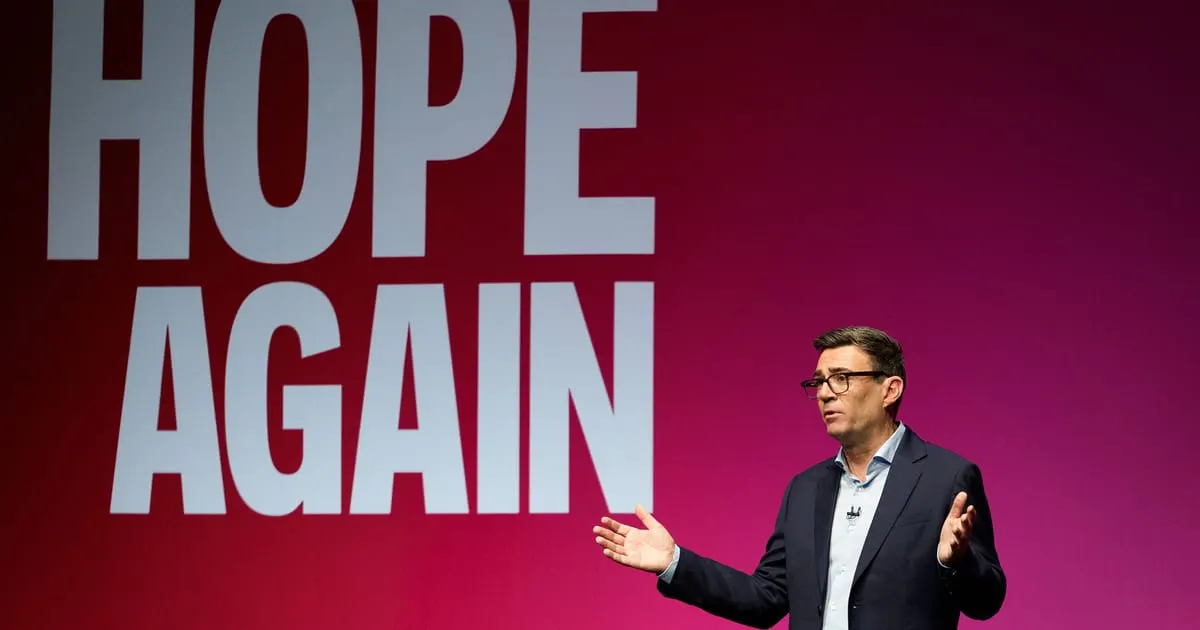
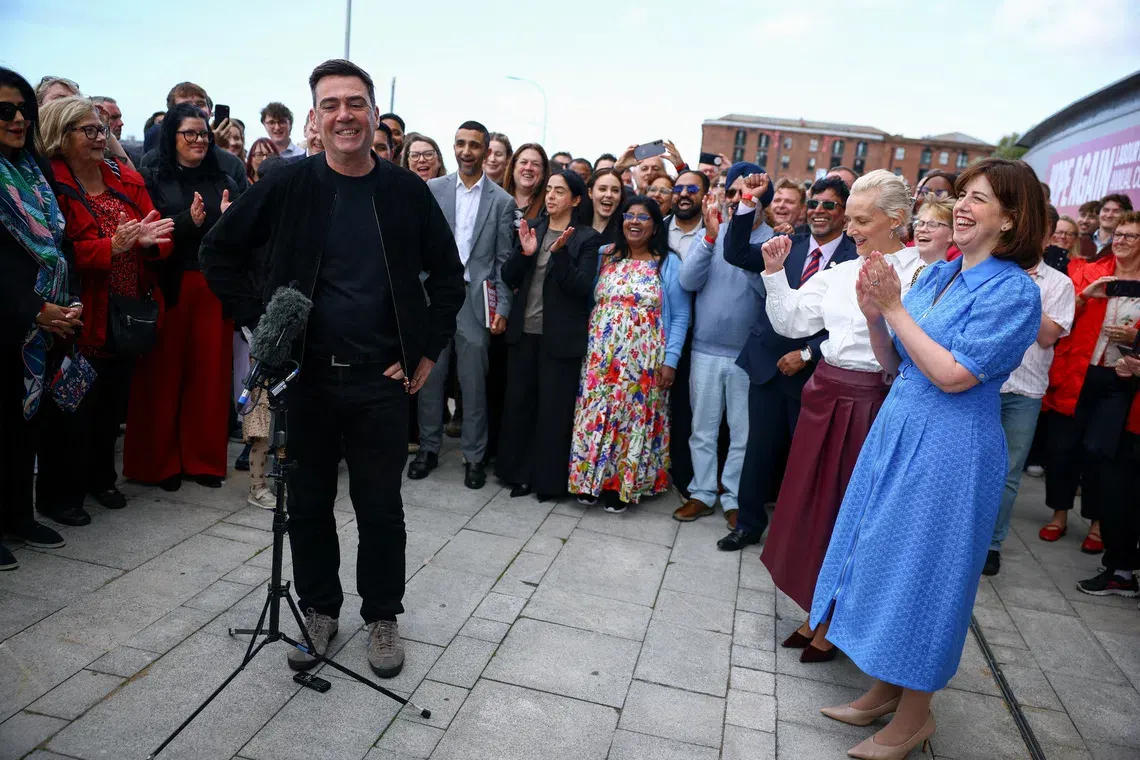
Speaking at the Labour Party conference in Liverpool on Tuesday, Burnham said bluntly that Brexit had failed to deliver for Britain. "I am very clear, and I will say this bluntly: Brexit has caused more harm than good," he said.7
The following day, on the BBC Radio 4 Today programme, Burnham set out a range of possible paths for the UK's relationship with the EU. "We could stay as we are. he said the UK could examine George Osborne's proposal for a customs union, consider the Liberal Democrats' suggestion of single market access, or go further still.325
According to Bloomberg, Burnham outlined three specific options for the future UK-EU relationship that would be discussed at a summit later this year.4
Burnham also acknowledged earlier remarks in which he said he hoped to see Britain rejoin the bloc during his lifetime. "I have said it, there's no point me denying it, I've said in the book I would like to see Britain rejoin in my lifetime," he said, adding, "I want to look at the options."5
International reaction
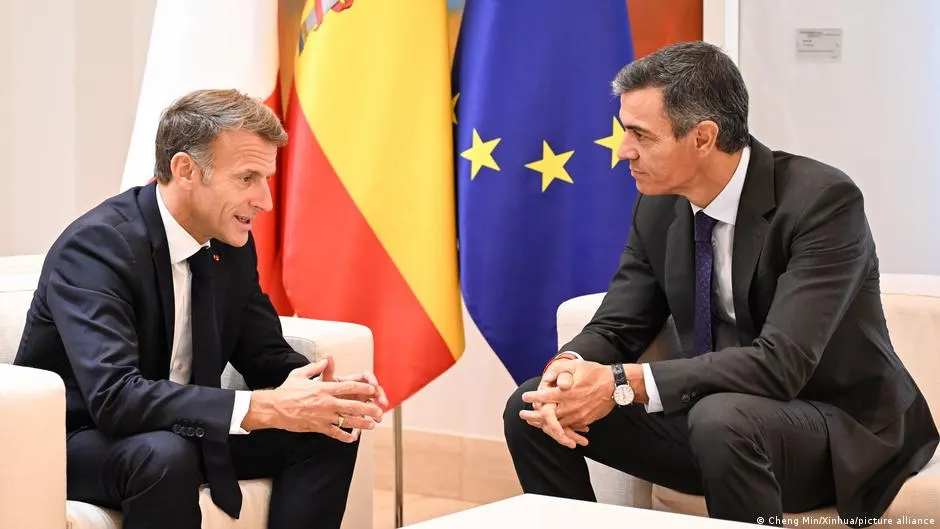
French President Emmanuel Macron, addressing reporters in Madrid alongside Spanish Prime Minister Pedro Sanchez, said Britain's return would be "very good news" but cautioned that the UK could not pick and choose which membership terms to accept. "You cannot pick and choose among the Union's freedoms, nor can you decide to take only what suits you," he said. He separately described Brexit as "the biggest lie of the last 30 years."731
According to The Straits Times, Macron called the prospect of Britain's return excellent news and a good decision, saying Britain had been useful in helping simplify matters when part of the EU, though also a demanding partner. Spanish Prime Minister Pedro Sanchez said that if the UK asked to rejoin, Spain would applaud and open its arms.61
According to The Guardian, EU officials have informed their UK counterparts that Britain remains free to join a customs union or the single market through the European Economic Area, with a summit date in late November anticipated soon. Sandro Gozi, an EU affairs official, said Burnham had "swept away" the red lines that previously constrained the Britain-Europe debate, though sources cautioned that a dispute over the EU's 'Made in Europe' industrial plans, opposed most strongly by France, would not be settled at the summit.3
A European Commission spokesperson said the UK remained "a close and valued partner" of the bloc, adding that the EU was open to engaging with London on the various options Burnham had raised, from a customs union to full membership.14
Reaction at home
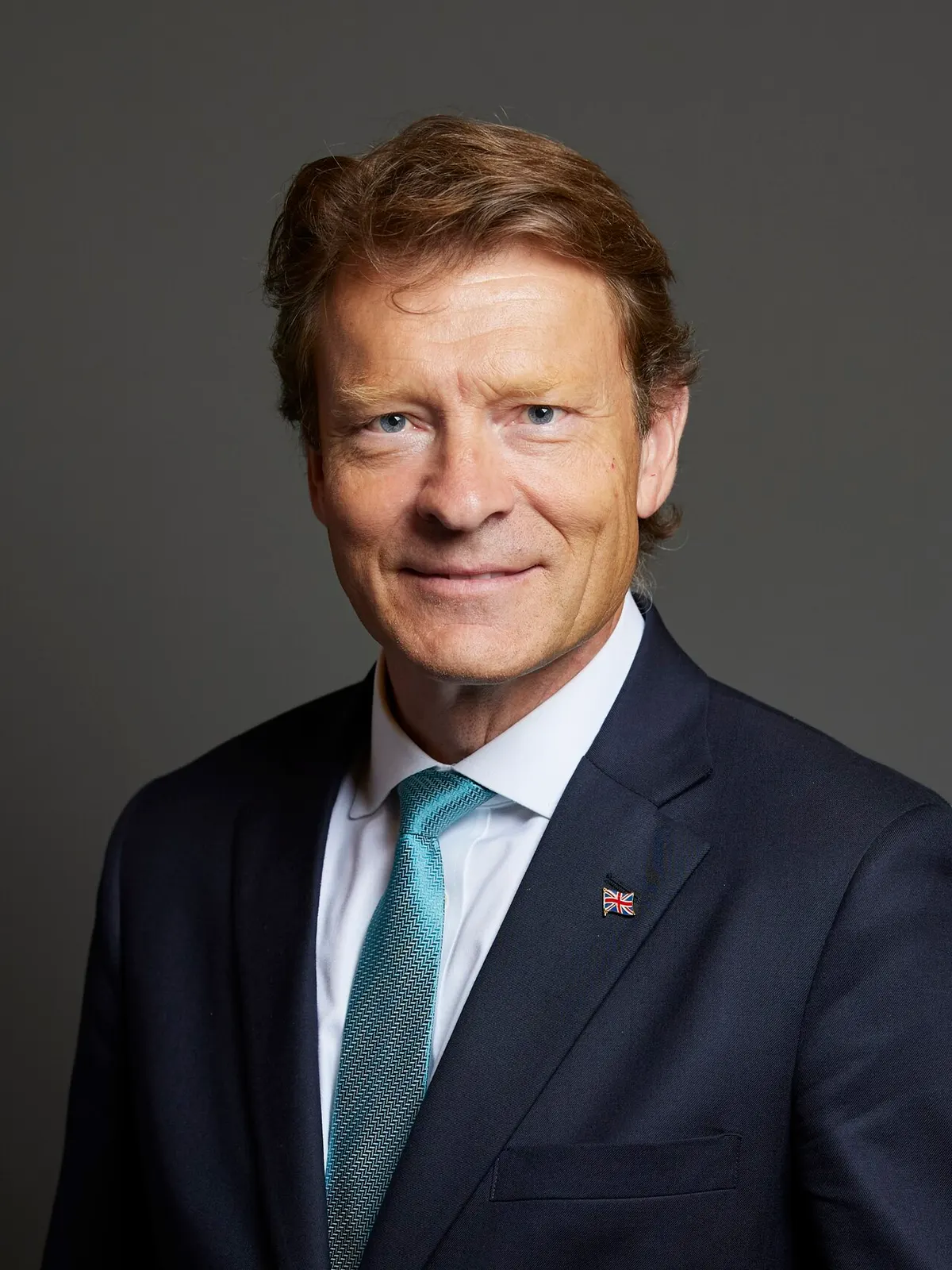
Reform UK deputy leader Richard Tice condemned the remarks, saying, "Andy Burnham has barely been prime minister five minutes and he's already trying to sneak us back into Brussels." Conservative MP Kevin Hollinrake said, "You cannot trust a word Andy Burnham says."75
Catherine Barnard, who teaches European law at Cambridge, said Burnham's remarks signalled that being outside the EU had proven difficult and that alternatives were now being seriously weighed in London.2
According to The Japan Times, Burnham said he intended to stick with Labour's existing manifesto for the rest of this parliament but might campaign for EU membership at the next general election, which the outlet said would occur in 2029, a date not confirmed by other sources in the dossier. The Japan Times also reported this would be the first time since the 2016 referendum that a UK prime minister has suggested rejoining the bloc.8
Not all Labour figures were critical: MP Stella Creasy welcomed Burnham's remarks, saying it showed colleagues across Europe that Britain's red lines had finally been removed. Analysts were more cautious about how far the shift would go. David Henig said Burnham was "recognising the widespread view in the country that Brexit has failed, and in the Labour Party that closer ties are needed," while Anand Menon of UK in a Changing Europe noted that Burnham had so far only promised "a conversation," and that some in his cabinet would be reluctant to see him spend much time and effort on Europe.1014
Reform UK also sought to link Britain's sluggish economy to the governing Labour Party rather than to Brexit itself, blaming the government for years of low growth even as Burnham argued that leaving the EU had weakened the country economically and on immigration.915
Public opinion
Polling cited across the coverage points to growing public support for rejoining. A YouGov survey found 56% of British voters would back rejoining, while a Survation poll in June found 55% would opt to rejoin in a referendum. An earlier YouGov poll in June showed 55% support and 34% opposition.317
Gary Knowles, 64, who works as a cleaner and hairdresser in Barking, east London, said his views had shifted since he voted to leave. "I voted 'out' because I thought it would be better, but no, it's not really," he said, adding, "I reckon 'In'." Roy Taylor, a 59-year-old actuary in central London, was described as more cautious about the debate.7
A postponed summit
An EU-UK summit originally scheduled for July 22 was postponed after Keir Starmer announced his resignation in June, a cancellation that Euronews reported also stalled plans for deals on agri-food trade and youth exchanges. Burnham replaced Starmer as prime minister in July, after Labour MPs removed him, according to The Straits Times.376
An EU official said the bloc was looking to hold the rescheduled summit in November, with negotiators hoping to present deals on food standards, youth mobility and emissions trading, though talks have stalled over British concerns about EU industrial plans. Politico reported that European officials have warned Britain would face a high-risk situation if the summit were delayed further, and that Burnham intends to move further and faster than his predecessor on resetting relations with the bloc.19
Mandate and economic pushback
Breitbart highlighted that Burnham became prime minister in July without standing in a general election, replacing Keir Starmer after Labour MPs removed him, and noted he received just over 25,000 votes within the party, compared with the 9 million votes Labour won in 2024 and the 17.4 million that backed leaving the EU in 2016.16
Economist Roger Bootle, writing in the Daily Telegraph, argued that Britain's economic troubles were not necessarily the result of Brexit, pointing out that Germany grew by 1 percent and France by 0.5 percent over the past year compared with the UK's 1.2 percent.16
Burnham told conference supporters he would try to build consensus on Britain's EU position: "I will see if we can find consensus around one which will give us clarity about our position, and the future of the continent we live in," he said. Breitbart noted that rejoining the EU would require Britain to accept the bloc's migration rules, including sharing the burden of irregular immigration, and would mean giving up independently negotiated trade deals, including with the United States.16
Pressure to go further
Pressure for a firmer commitment is also building from within Labour. According to Breitbart, pressure is building from within Labour for Burnham to commit explicitly to rejoining the EU rather than simply laying out a menu of options for voters to consider.16
Why it matters
The EU is described as the UK's largest trading partner, and any shift toward closer alignment or membership would have significant implications for trade and politics across Europe. EU officials say the bloc remains open to discussing customs union or single-market options via the European Economic Area, though a dispute over the EU's 'Made in Europe' industrial plans, opposed especially by France, could complicate a rescheduled summit. The debate is further complicated by questions over Burnham's mandate, since he took office without a general election, and by disagreement over whether Brexit or domestic policy is responsible for Britain's sluggish growth.1236
Videos
Related stories
Version history
- version 4 · Added details on internal Labour pressure to commit to rejoining, Breitbart's mandate critique of Burnham, and economist Roger Bootle's dispute of the Brexit growth narrative.
- version 3 · Added European Commission's 'close and valued partner' statement, fuller Sanchez and Tice quotes, Catherine Barnard's analysis, and Reform UK's economic attack on Labour.
- version 2 · Added detail on Macron and Sanchez's joint Madrid remarks, EU officials' openness to a customs union or single market via the EEA, and domestic reaction including Labour's Stella Creasy and analyst skepticism.
- version 1 ·