Science & Tech · Switzerland
UN conference considers binding rules for lethal autonomous weapons
Countries meeting in Geneva are considering a treaty requiring human control over lethal autonomous weapons. The United States and Russia oppose binding restrictions, both outlets report.
Listen to the story
Short version
Geneva talks are considering binding restrictions on lethal autonomous weapons, with US and Russian opposition.
- Delegates from 128 states attended, The New York Times reported.
- At least 50 countries seek a firm timetable, NPR reported.
- Washington proposed voluntary guidelines over five years, according to NPR.
- Humanitarian groups want lethal decisions kept under human control.
Infographic

What's new
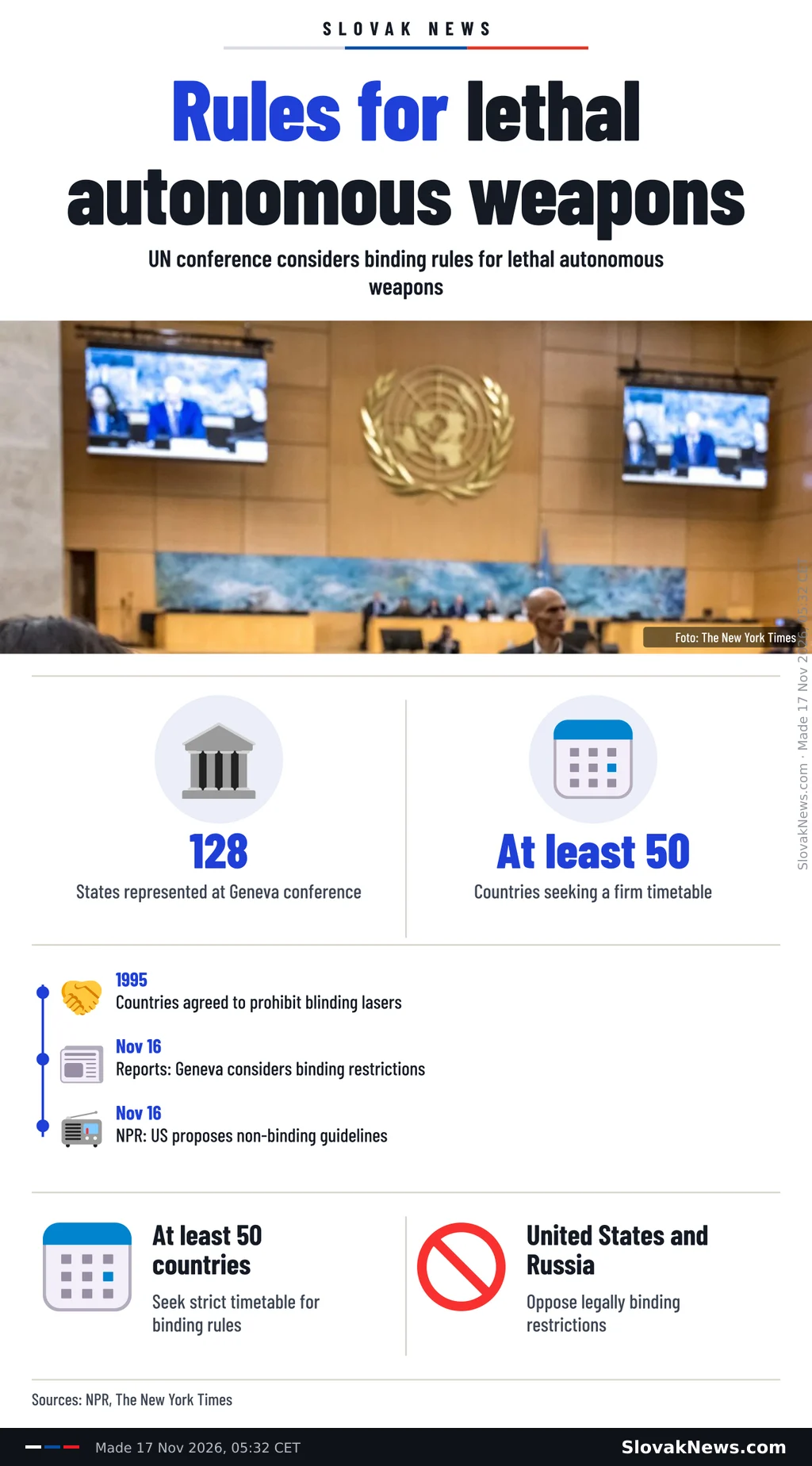
- Delegates from 128 states gathered for a weeklong Geneva conference, according to The New York Times.
- At least 50 countries want a firm timetable for binding rules, NPR reports.
- Washington proposed five years of work on voluntary guidelines instead, according to NPR.
Delegates from 128 states were meeting at the United Nations in Geneva for a weeklong conference, The New York Times reported on November 16, 2026, to decide whether to negotiate a treaty banning lethal autonomous weapons and requiring meaningful human control. The United States and Russia oppose binding restrictions, both outlets reported.12
Infographic
Disagreement over the rules
NPR reported that a group of at least 50 nations supports a fixed schedule for adopting legally binding rules; France, Brazil, Ireland, Germany, Mexico and Italy are among them. NPR also reported that Israel, alongside the United States and Russia, had indicated opposition to that approach.1
The United States instead proposed a five-year period to develop non-binding guidelines, NPR reported. Diplomats were also considering negotiations with a longer deadline or no fixed endpoint, under which countries could choose whether to treat the resulting rules as binding.1
NPR described the Certain Conventional Weapons conference as a meeting held once every five years and said UN negotiations restricting particular weapons are intended to proceed by consensus. It cited the 1995 agreement banning blinding lasers as an example of restrictions achieved through that process.1
Human control and battlefield use
Humanitarian organizations argue that humans must retain both the decision to kill and responsibility for it, NPR reported. The Red Cross says autonomous weapons cannot fully comply with existing rules of war. One concern described by NPR is whether such weapons can distinguish a soldier fighting from one who is wounded or surrendering.1
The two reports describe battlefield autonomy differently. NPR said AI-assisted weapons used against targets in Ukraine and Gaza remained under remote human control, while some experts warned that systems independently selecting targets and deciding to kill could emerge within months. The New York Times reported that Russia and Ukraine had already used fully autonomous drones in attacks.12
Those accounts do not establish a shared assessment of how much autonomy deployed weapons already possess. They distinguish between human-controlled weapons assisted by artificial intelligence and systems described as capable of carrying out attacks autonomously.12
Warnings about wider access
Human rights groups cited by NPR say AI-assisted weapons are becoming less expensive and easier to operate. They warn that military adoption could increase the risk of their spread to terrorist groups or repressive law-enforcement agencies. The New York Times also described concerns about access by nonstate armed groups and organized crime.12
UN human rights chief Volker Türk urged governments to establish safeguards before further delay made that task harder, The New York Times reported. Pope Leo XIV called for concrete steps toward a ban and insisted that decisions involving human life and force remain under informed, responsible human oversight.2
Antonio Guterres warned that permitting fully autonomous weapons to kill would mean “crossing a moral red line,” according to NPR. The reports describe calls for binding measures but do not establish whether the Geneva conference will agree to negotiate them.12
Why it matters
For European readers, the negotiations concern rules backed by several European governments, including France, Germany, Ireland and Italy, according to NPR. Reports of weapons using artificial intelligence in Ukraine also place the question of human control within a conflict already cited by both outlets.12
Videos
Related stories


Version history
- version 1 ·