Business · United States of America, People's Republic of China
US and China agree $30bn tariff cuts and AI dialogue
The agreements cover non-sensitive goods in both directions and establish talks on AI risks and benefits. The two governments also announced understandings on trade mechanisms, international waterways and Iran.
During a three-day Washington summit, the United States and China committed to pursuing lower tariffs on non-sensitive trade worth $30 billion flowing in either direction. The package covers categories of US exports and imports, while the two sides will establish a trade council and continue arrangements from earlier talks in Kuala Lumpur.
They also launched a dialogue on AI risks and benefits, scheduled the next exchange for November 2026 and agreed to create a channel for AI-related incidents. Other understandings addressed Iran’s commitment not to develop nuclear weapons, transit tolls on international waterways, support for APEC and G20 gatherings, and military crisis communication. Reports conflict over the precise timing and status of a proposed two-month trade-truce extension.
Washington and Beijing created a bilateral AI dialogue and reached a tariff-relief agreement encompassing $30 billion worth of non-sensitive trade flowing either way. The summit also produced understandings on trade mechanisms, Iran, waterways and crisis communication.
- Tariff recommendations cover $30bn of goods in each direction.
- The next bilateral AI exchange is planned for November 2026.
- A communication channel will handle AI-related incidents.
- Reports conflict over the trade truce’s precise extension.
- Military officials plan a crisis-communication memorandum.
What's new
- Tariff relief is planned for $30bn of non-sensitive goods in each direction. [s3, s4]
- A bilateral AI dialogue and incident-communication channel will be established. [s2, s3]
- The next exchange on AI risks and benefits is scheduled for November. [s3, s4]
- The countries will establish a trade council and continue earlier Kuala Lumpur arrangements. [s3, s4]
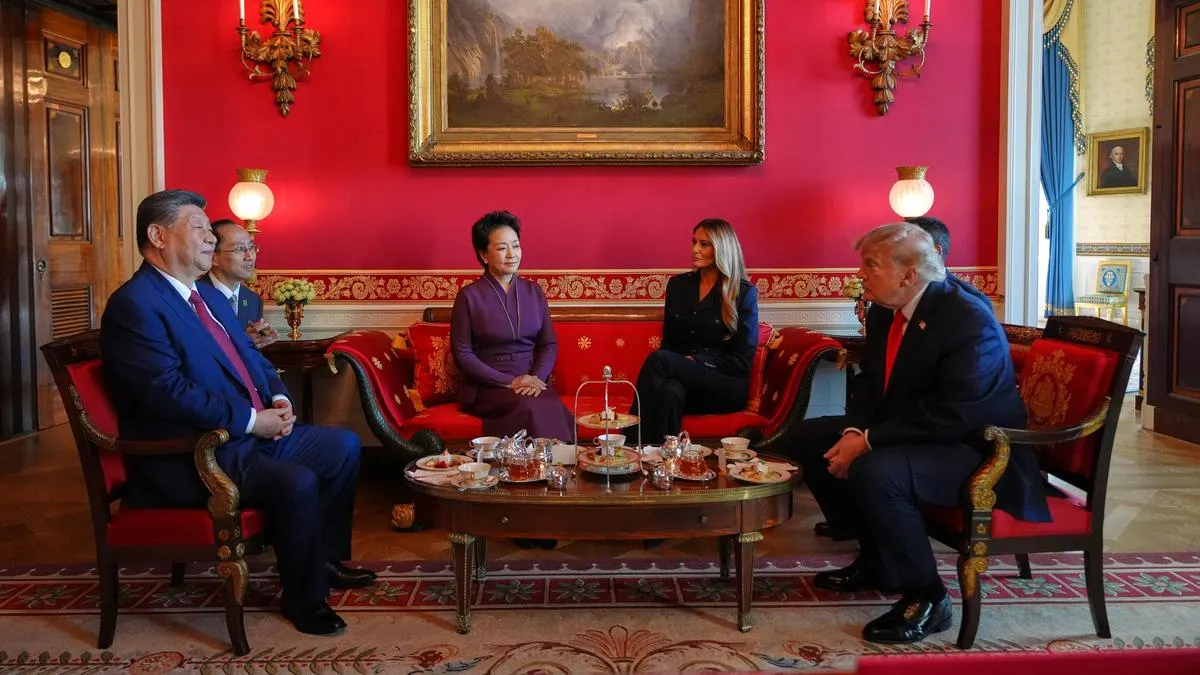
At a three-day Washington summit that ended on Friday, September 25, President Donald Trump and Chinese President Xi Jinping committed the United States and China to seeking lower tariffs on $30 billion worth of non-sensitive trade flowing each way and beginning talks on artificial intelligence.2347
Tariff relief in both directions
The White House said the tariff recommendations would cover selected American exports and imports. Agricultural products, wood and cosmetics were listed among the US exports, while small appliances, toys and decorations were among the imports. The announcements did not specify tariff rates for individual products.3456
The countries further decided to create a trade council and build on the results of previous economic and trade talks held in Kuala Lumpur, Malaysia. US Treasury Secretary Scott Bessent said continuing the truce would provide more time to pursue a potentially broader trade agreement.3456
Reports differ over the precise status and timing of the trade truce. One account said the countries had moved to extend it by two months beyond its November 10 expiry, while other coverage disputed that formulation. China’s official account endorsed the trade teams’ work and an extension of the Kuala Lumpur outcomes but did not give a timetable.1345
Additional economic measures reported after the summit included a working group on agricultural market-access barriers and a Board of Investment intended to discuss opportunities and investment obstacles. The countries also agreed to continue addressing US supply-chain concerns involving rare earths and other critical minerals.1
Dialogue on emerging technology
Washington and Beijing established a bilateral dialogue to exchange views on the risks and benefits of AI, with the next exchange scheduled for November 2026. They also agreed to create a communication channel for incidents involving the technology.2345
The White House said the leaders agreed to use the term “super intelligence” in place of “artificial intelligence” for the relevant emerging technologies. China’s Foreign Ministry said Beijing valued the US position and respected its terminology. One Chinese account described the mechanism as the China-US AI Dialogue, while a US description called it the US-China Super Intelligence Dialogue.1236
The governments said that continued technological advances made greater exchanges and efforts to reach common ground necessary. The announced channel for AI-related incidents adds a separate means of bilateral communication alongside the planned policy discussions.2345
Other summit understandings
Trump and Xi said Iran must honour its pledge to refrain from developing nuclear weapons. They further stated that transit through international waterways must not be subject to tolls levied by any country, organisation or other entity.1234
Each country committed to backing the other’s hosting of the Asia-Pacific Economic Cooperation leaders’ meeting and the Group of 20 summit, with Trump and Xi each planning to attend the event held by the other country. The Chinese and US armed forces further committed to finalising, at the earliest opportunity, a memorandum covering crisis prevention and communications.1235
China’s official account said the two militaries would continue cooperating in searches for the remains of missing US service members in China. It also said counter-narcotics and law-enforcement cooperation had produced results, including joint work on cases involving new psychoactive substances and precursor chemicals; those details were reported only by the Chinese source.2
Xi returned to Beijing after the summit, according to China’s state news agency Xinhua. Chinese Foreign Minister Wang Yi characterised the visit as strengthening a constructive and stable bilateral relationship, while western reports emphasised the tariff package, the AI terminology and the role of direct diplomacy.3456
Why it matters
For European readers, the agreements concern tariff treatment across two major trading economies, access to international waterways and supply-chain discussions involving rare earths and critical minerals. The AI dialogue, Iran commitment and planned military crisis contacts also address issues with consequences beyond the bilateral relationship.1234
How the story unfolded
The story's events over time. Click a person, place or related story.
What we know
- Tariff recommendations cover $30bn of non-sensitive goods in each direction. [s3, s4, s5, s6]
- The countries will open an AI dialogue and establish an incident-communication channel. [s2, s3, s4]
- The next AI exchange is planned for November 2026. [s2, s3, s4]
- The leaders reached understandings concerning Iran and tolls on international waterways. [s1, s2, s3, s4]
What we don't know yet
- The precise status and timetable of the reported two-month trade-truce extension remain disputed. [s1, s3, s4, s5, s6]
- China’s official trade readout did not provide a timeline for tariff relief. [s1]
- The claim that the summit produced exactly eight deliverables comes from one Chinese source. [s2]
Timeline
- Sep 23-25, 2026Xi Jinping made a state visit to the United States, according to China’s official account.2
- Sep 25, 2026The three-day Trump-Xi summit in Washington ended, and Xi later returned to Beijing.234
- Sep 27The tariff recommendations, trade mechanisms and wider summit understandings were reported.1456
- November 2026The next bilateral exchange on AI risks and benefits is scheduled.1234
Quotes
The two countries reached consensus on recommendations for more favorable tariff treatment for $30 billion of non-sensitive goods in each direction
U.S.-China Super Intelligence (SI) Dialogue to exchange views on risks and benefits
We didn’t spend a lot of time talking about Taiwan. He understands very much how I feel.
Related stories
Version history
- version 1 · 27 September at 06:10