World · Yemen
Yemen's Al-Alimi Calls General Mobilization Against Houthi Rebels
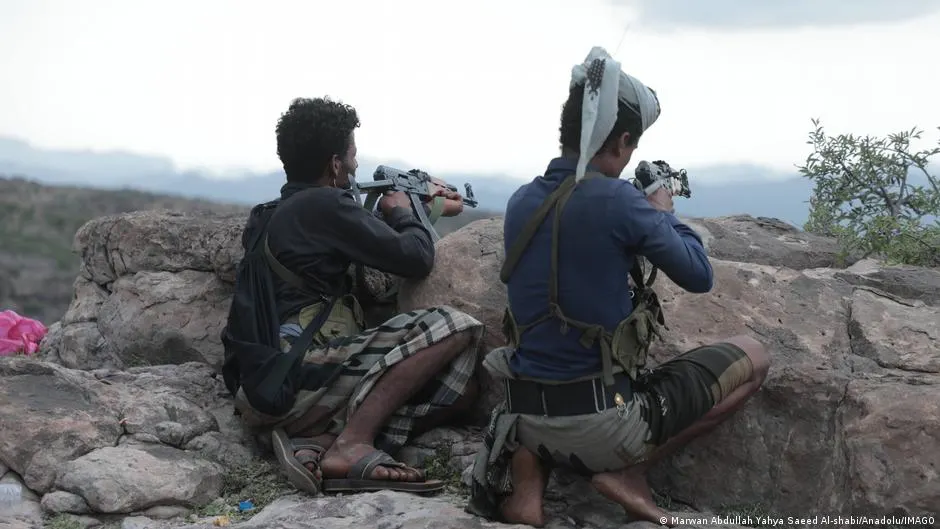
Rashad al-Alimi, who leads Yemen's Presidential Leadership Council backed by Saudi Arabia, called on Yemenis to take up arms against Houthi forces amid escalating fighting and the rebels' tightening grip on the Red Sea coast.
Rashad al-Alimi, who leads Yemen's Presidential Leadership Council backed by Saudi Arabia, called on Friday for a general mobilization against Houthi rebels, urging Yemenis to join government forces and offering an amnesty to anyone who defects. The appeal came after the Houthis reportedly took full control of Yemen's Red Sea coastline and the strategic Bab al-Mandab Strait, according to Deutsche Welle, and struck Riyadh for the first time in years.
The call follows a collapsed 2022 truce and Houthi advances in western Yemen, including the capture of Mocha and Mayyun Island, according to Al Jazeera. A senior Saudi cleric called the fight against the Houthis a religious duty, while Saudi Arabia, Turkiye and Pakistan announced an emergency military meeting. A senior Houthi official had previously cautioned other nations against siding with Saudi Arabia in the conflict.
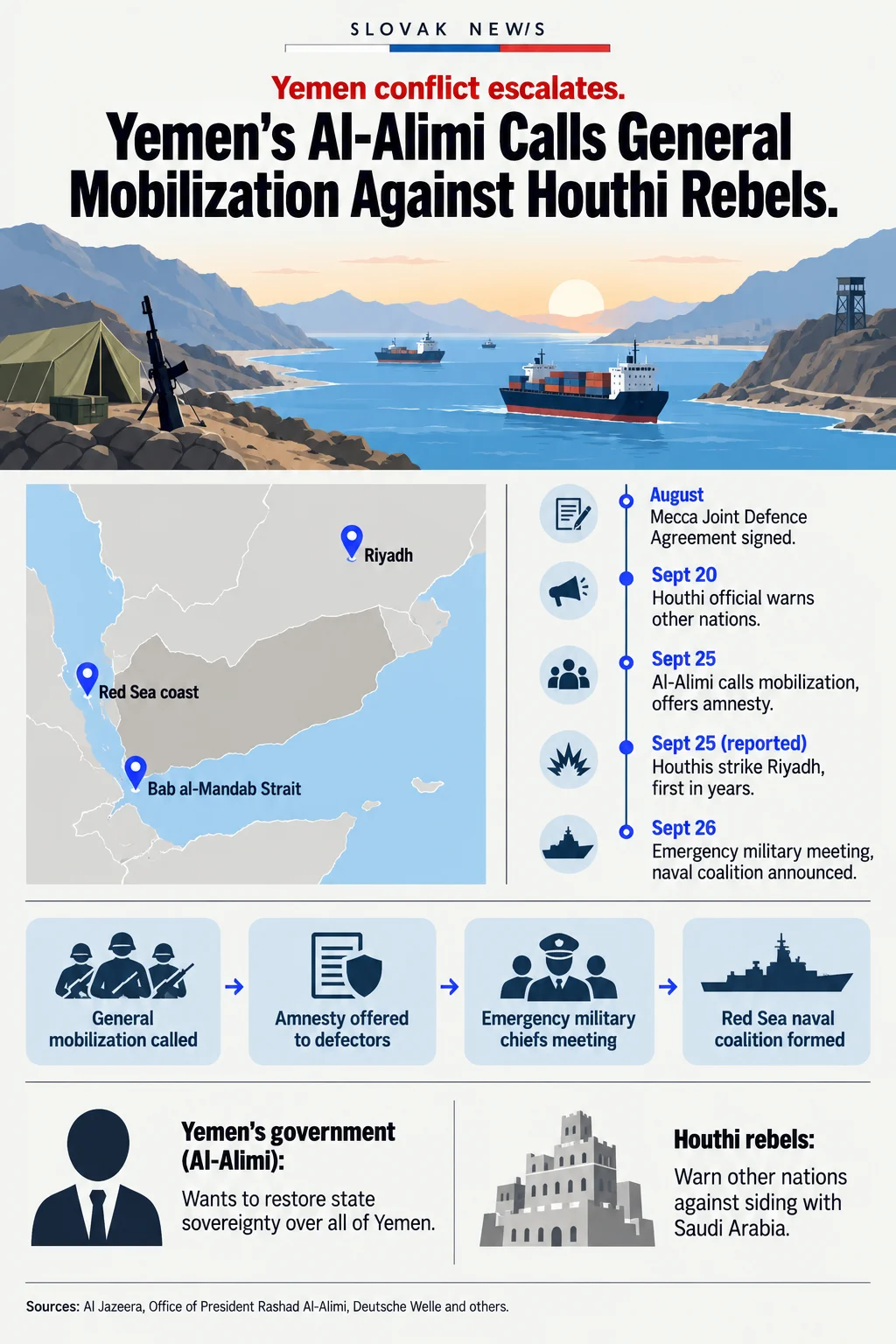
Infographic text
Yemen's president called for general mobilization against Houthi rebels after they reportedly seized the Red Sea coast and attacked Riyadh.
- Al-Alimi called for mobilization and offered amnesty to defectors
- Houthis reportedly control Yemen's Red Sea coast and Bab al-Mandab Strait
- Houthis attacked Riyadh for first time in years
- Saudi Arabia, Turkiye, Pakistan planned emergency military meeting
- A 2022 truce recently collapsed after years of paused fighting
Listen to the story
Short version · read by a synthetic voice
What's new
- Al-Alimi called for general and national mobilization on Sept. 25
- He offered amnesty to Houthi fighters who defect immediately
- Houthis reportedly seized Yemen's entire Red Sea coast and Bab al-Mandab Strait
- Houthis struck Riyadh for the first time in years
Rashad al-Alimi, who leads Yemen's Presidential Leadership Council backed by Saudi Arabia, called on Yemenis on Friday to join a general mobilization against Houthi rebel forces, as the government seeks to restore state institutions and extend sovereignty over the entire country, including the Houthi-held capital Sanaa.312
A call to arms
In a televised address marking the 64th anniversary of the September 26 Revolution, al-Alimi—who Deutsche Welle said also serves as Supreme Commander of the Yemeni Armed Forces—urged compatriots to join government forces after what the outlet described as a major setback dealt by the Iran-backed Houthis. He said, "I call upon the sons of our great people to engage in general mobilization and national mobilization, to rally around their armed and security forces."3
Al-Alimi framed the objective as restoring state institutions and sovereignty over Yemen's whole territory. He said the goal was "to restore state institutions and extend state sovereignty over the entirety of our national territory, all the way to Sana'a," a reference to the capital that has been under Houthi control since 2014, according to Deutsche Welle.23
He also announced an amnesty for anyone who defects from the Houthis, framing former fighters as compatriots rather than adversaries. "The state does not view you as a party to the conflict but as its people and partners," he said, according to Deutsche Welle. Anadolu Agency and EFE reported the amnesty would apply to anyone who stops working or fighting for the Houthis from that day, with EFE noting it would include regularised military status for defectors joining the government side.378
Al-Alimi also urged residents of Houthi-controlled areas not to send their children to fight alongside the group, according to Deutsche Welle. His office said he reaffirmed commitment to the outcome of the Saudi-sponsored South-South dialogue and described the state's measures as aimed at protecting civilians and preserving social peace following what he characterized as Houthi escalation.32
Houthi advances and rising tension
The appeal follows what Al Jazeera described as dramatic Houthi advances in western Yemen during September, including the capture of Mocha and Mayyun Island, after a 2022 truce that had paused twelve years of fighting recently collapsed. Deutsche Welle reported that government forces collapsed as the Houthis swept through and took control of the entirety of Yemen's Red Sea coastline in a swift offensive, gaining full command of the Bab al-Mandab Strait, a chokepoint Al Jazeera described as one of the world's busiest shipping routes linking the Red Sea to the Indian Ocean and of crucial economic and strategic importance to Saudi Arabia, which backs Yemen's internationally recognised government.13
Deutsche Welle reported that Houthi control of Bab al-Mandab had ignited global fears about shipping through the strait, and that the group had intensified missile and drone attacks on Saudi Arabia in recent weeks, declaring a maritime blockade and striking Saudi targets it said were intended to stifle Saudi oil exports. The Houthis have accused Saudi Arabia of besieging Yemeni areas under their control. Over the weekend, the Houthis struck Riyadh for the first time in years, an event Deutsche Welle characterized as a major escalation.3
Al Jazeera reported that most analysts view the government's position as rarely weaker, and that the 2022 truce recently collapsed after pausing years of conflict.1
Regional response
Days before al-Alimi's speech, a senior Houthi official, Mohammed al-Bukhaiti, warned other countries against joining Saudi Arabia in what the Associated Press described as the revived war, claiming the Houthis had reassured the United States they would not attack U.S. vessels. The AP report came out before al-Alimi's mobilisation address, offering background from the Houthi side rather than a reaction to his call.4
The New York Times reported that a top Saudi cleric, described as the grand mufti, called the fight against the Houthis a religious duty and called on Saudi-led forces to stay continuously prepared, a statement the paper said suggested Saudi Arabia might expand its campaign in Yemen. Al Jazeera also reported that Saudi Arabia, Turkiye and Pakistan announced an emergency meeting of military chiefs to address the threat, following a Mecca Joint Defence Agreement the three signed in August, and that Saudi Arabia unveiled a new naval coalition to patrol the Red Sea. Separately, Abdullah Abdulkader Al Alimi-Bawzer told the UN General Assembly that Houthi militias could not be trusted, arguing that their exploitation of navigation safety for blackmail endangers not just Yemen but effectively holds the entire global economy hostage.61
Baraa Shiban, a researcher at the Royal United Services Institute, questioned how any foreign military presence would be received, saying, "I really can't imagine Yemeni citizens reacting all that well to the sight of armed Turkish, Pakistani and Saudi forces on their soil." He added he would be surprised if Turkish and Pakistani involvement extended beyond technical support and intelligence sharing.1
Why it matters
The Houthis' reported control of the Bab al-Mandab Strait raises concerns for global shipping routes that connect the Red Sea to the Indian Ocean, a corridor of direct relevance to European trade and energy supply chains. Escalating attacks on Saudi Arabia and the prospect of foreign military involvement also raise the risk of wider regional instability.13
How the story unfolded
The story's events over time. Click a person, place or related story.
What we know
- Al-Alimi called for general mobilization on Sept. 25, aiming to restore state sovereignty over Yemen.
- He announced an amnesty for Houthi defectors, effective immediately.
- The Houthis made significant territorial gains in western Yemen in September, including Mocha and Mayyun Island.
- A 2022 truce that had paused years of fighting recently collapsed.
- A senior Saudi cleric called the fight against the Houthis a religious duty.
What we don't know yet
- Whether Al-Alimi's claim of being Supreme Commander of the Armed Forces is independently confirmed.
- Whether the Houthis fully control the Red Sea coast and Bab al-Mandab Strait beyond single-source reporting.
- Whether foreign forces from Saudi Arabia, Turkiye or Pakistan will intervene directly on the ground.
- How the Houthis will respond to the amnesty offer and mobilization call.
Timeline
- AugustSaudi Arabia, Turkiye and Pakistan signed the Mecca Joint Defence Agreement.1
- Sep 20A senior Houthi official, Mohammed al-Bukhaiti, cautioned other nations against siding with Saudi Arabia in the conflict and said the group had assured Washington its vessels would not be targeted.4
- Sep 25Rashad al-Alimi called for general mobilization and announced an amnesty for Houthi defectors in a televised address.3278
- Sep 25A top Saudi cleric called the fight against the Houthis a religious duty and urged Saudi-led forces to remain ready.6
- reported Sep 25The Houthis struck Riyadh for the first time in years, an escalation described as significant.3
- Sep 26Saudi Arabia, Turkiye and Pakistan announced an emergency meeting of military chiefs; Saudi Arabia announced a Red Sea naval coalition.1
- reported Sep 26Abdullah Abdulkader Al Alimi-Bawzer addressed the UN General Assembly, saying the Houthis could not be trusted.1
Quotes
I call upon the sons of our great people to engage in general mobilization and national mobilization, to rally around their armed and security forces
The state does not view you as a party to the conflict but as its people and partners
to restore state institutions and extend state sovereignty over the entirety of our national territory, all the way to Sana'a.
I really can't imagine Yemeni citizens reacting all that well to the sight of armed Turkish, Pakistani and Saudi forces on their soil,
Videos
Related stories

Version history
- version 1 · 27 September at 11:10