Latest Israel count leaves Netanyahu ahead but no bloc able to govern alone
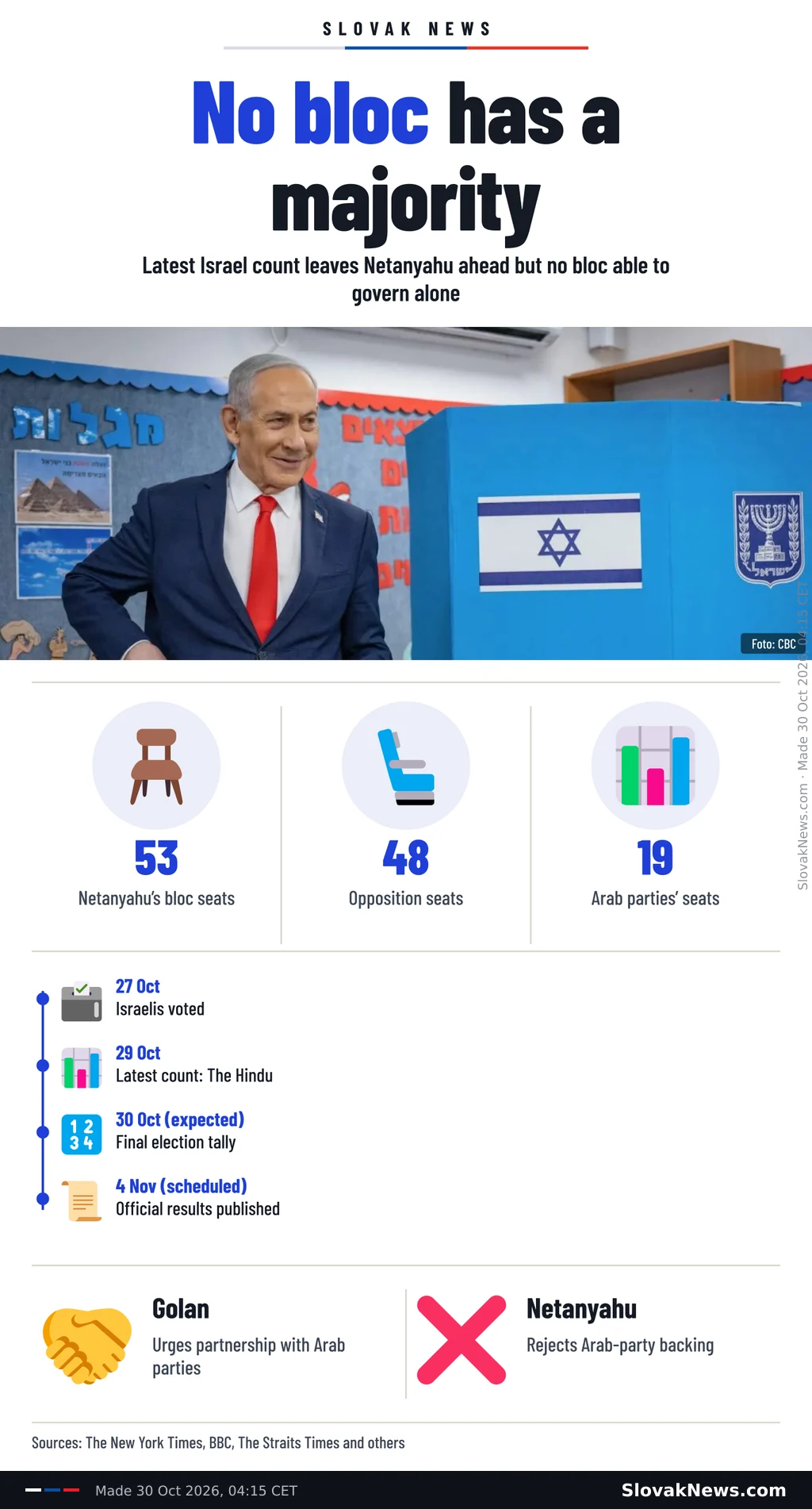
The Hindu reports 53 seats for Netanyahu’s bloc, 48 for the opposition and 19 for Arab parties. Herzog is preparing coalition talks as Golan urges cooperation with Arab parties.
Listen to the story
Short version
The latest reported count leaves three blocs without a majority. Netanyahu is expected to get the first chance to form a government.
- Netanyahu’s bloc has 53 seats; the opposition has 48, The Hindu reports.
- Arab parties hold 19 seats; a governing majority requires 61.
- Golan urges cooperation with Arab parties, but other opposition leaders resist.
- Herzog wants to avoid another election; coalition negotiations remain unresolved.
Infographic
What's new
- The Hindu’s October 29 report puts Netanyahu’s bloc at 53 seats, the opposition at 48 and Arab parties at 19; none has a majority.
- Likud has 26 seats, down from 32 four years earlier, according to The Hindu.
- Herzog is preparing coalition negotiations and has urged parties to avoid another election, the BBC reports.
- Yair Golan has called for an opposition partnership with Arab parties, according to the BBC.
- Reports differ on the government-formation deadline: The Hindu says 24 days, while Middle East Eye says 28 days with a possible 14-day extension.
Israel’s latest reported count leaves Benjamin Netanyahu’s bloc with 53 seats, the opposition with 48 and Arab parties with 19, The Hindu reported on October 29. None can govern alone in the 120-seat parliament. Netanyahu is expected to receive the first chance to form a government, while President Isaac Herzog is preparing coalition negotiations and urging parties to avoid another election.42
Infographic
Coalition options remain uncertain
The latest count reported by The Hindu on October 29 gives Netanyahu’s bloc 53 seats, the opposition 48 and Arab parties 19. None reaches the 61-seat majority threshold. Likud still leads all parties, securing 26 seats compared with 32 four years ago. The dossier does not establish a final certified allocation.4
The latest figures follow shifting early indications. The New York Times initially reported exit polls showing a narrow opposition-bloc lead. Middle East Eye subsequently reported a Netanyahu-bloc lead with 85 percent counted. Exit polls and partial counts are not final certified results.15
The New York Times reports turnout of 77.7 percent, the highest since 1999. Middle East Eye describes the most voters since 2001, while the BBC reports record participation among Jews and Arabs; the dossier does not reconcile those descriptions. Middle East Eye also reports that around 67,000 Israelis returned from abroad to vote and that Palestinian citizens voted at a higher rate than in 2022.152
President Isaac Herzog is preparing coalition negotiations, the BBC reports, and Netanyahu is expected to receive the first opportunity to form a government. Reports differ on the deadline: The Hindu says Netanyahu would have 24 days to demonstrate a majority, while Middle East Eye says candidates receive 28 days with a possible 14-day extension. The dossier does not resolve that discrepancy. The Hindu reports that failure by Netanyahu would pass the mandate to Eisenkot. Netanyahu remains in office while government formation is unresolved.245
Eisenkot opposes Netanyahu’s far-right partners, Itamar Ben-Gvir and Bezalel Smotrich, The Straits Times reports. It says some Western countries have sanctioned the two men, accusing them of encouraging violence against Palestinians. Associated Press separately reported that Ben-Gvir called on Netanyahu to continue the wars.36
Arab parties’ 19 seats could be pivotal. The Hindu reports 12 seats for Joint List and seven for United Arab List, also known as Raam; Raam alone would bring the opposition’s 48 seats to only 55. Gadi Eisenkot cannot reach 61 seats without the Arab parties, while Yair Golan has urged the opposition bloc to partner with Arab parties. No such agreement is established.45
Golan has urged the opposition to form a partnership with Arab parties, the BBC reports, challenging Netanyahu’s distinction between Jewish and Arab votes. His appeal highlights the disagreement within the opposition over how to secure enough parliamentary support to govern.25
Middle East Eye reports that Herzog and Donald Trump preferred a unity government. Analyst Assaf David, of Israel’s Vanleer Institute, told the outlet that a final Netanyahu-bloc lead could prompt some opposition parties to consider joining a Netanyahu government without Smotrich and Ben-Gvir. That is David’s assessment of a possible coalition, not an agreement among the parties.5
War and accountability shape the vote
According to The Straits Times, the October 7, 2023 assault by militants led by Hamas left 1,200 people dead and 251 others captive. Israel’s subsequent military assault in Gaza was accompanied by deep divisions at home, according to the newspaper. It cites Gaza health authorities as saying Israeli attacks killed 74,000 people.3
Iran is also part of the electoral debate. The Straits Times reports that Donald Trump endorsed Netanyahu and joined Israel in war against Iran. Netanyahu said Trump was willing to act again against the Iranian threat if he remained in office, according to the newspaper. That account is Netanyahu’s statement about Trump’s intentions.3
Eisenkot, a former military chief of staff, says the next Israeli government must stop Iran from acquiring a military nuclear capability, The Straits Times reports. His opposition to Netanyahu’s coalition partners therefore sits alongside a stated security objective concerning Iran.3
During voting, Eisenkot’s party complained that ballot slips were damaged or missing, Associated Press reported. The complaint is an allegation by the party; the dossier provides no finding establishing its extent or any effect on the election result.6
Opposition leaders pledged to improve Israel’s standing abroad and crack down on extremist violence against Palestinians in the West Bank, according to The New York Times. The newspaper also reports that Netanyahu has resisted an independent commission investigating the October 7 attacks and has vowed to continue overhauling the judicial system.1
Opposition claims victory, but government formation remains open
Eisenkot said the exit polls showed that voters no longer trusted Netanyahu or his administration, adding that he would seek to oust the government if the projected outcome was confirmed. The New York Times reports that Yair Golan said the opposition camp had won and urged the formation of a government committed to change. Gideon Saar cautioned that celebrations were premature.1
Eisenkot promised to establish an administration built around national unity, Associated Press reports. The New York Times reports that because neither his bloc nor Netanyahu’s commands a parliamentary majority, either could still assemble a government.61
Earlier opposition declarations of victory have not established a transfer of power. The New York Times reports that neither Netanyahu nor Eisenkot won a parliamentary majority and that both retain a chance to form a government. The BBC warns that negotiations could last months or end in another election.12
Herzog praised participation in the election and urged parties to avoid another vote, according to the BBC. The broadcaster reports that forming a government could take months or prove impossible; The Hindu says failure by both blocs to secure a majority would send Israel back to the polls within months.24
Why it matters
Coalition negotiations could take months or end in another election, the BBC reports. Arab parties could be pivotal, but cooperation with them divides the opposition. The outcome could also shape policies toward Palestinians: opposition leaders have pledged to improve Israel’s international standing and curb extremist violence against Palestinians in the West Bank, according to The New York Times.215
Videos
Related stories
same event
same place

Version history
- version 8 · This update leads with the latest reported count, adds Golan’s appeal for Arab-party cooperation and Herzog’s push to avoid another election, and identifies conflicting formation deadlines.
- version 7 · This update replaces the projection-led account with the reported 85-percent count, explains the emerging coalition options and corrects affected source references.
- version 6 · This update leads with revised broadcaster projections showing no majority, adds the counting timetable and Netanyahu’s continuing paths to power, and corrects source references affected by the expanded dossier.
- version 5 · This update leads with Netanyahu’s reported morning advance, adds the continuing absence of a majority and Eisenkot’s unity pledge, and explains the scheduled results and coalition-formation process.
- version 4 · This update leads with Netanyahu’s pledge to form a right-wing government, adds both rivals’ positions on Arab-party support, and updates citations to the current dossier.
- version 3 · This version adds attributed seat projections for both blocs and the Arab parties, while noting their unresolved arithmetic discrepancy and continued coalition uncertainty.
- version 2 · Voting has closed and exit polls show a narrow opposition-bloc lead, while counting continues and no governing coalition is established.
- version 1 ·