World · Israel
Palestinian parties win record 19 seats as Israel’s election results leave both blocs short
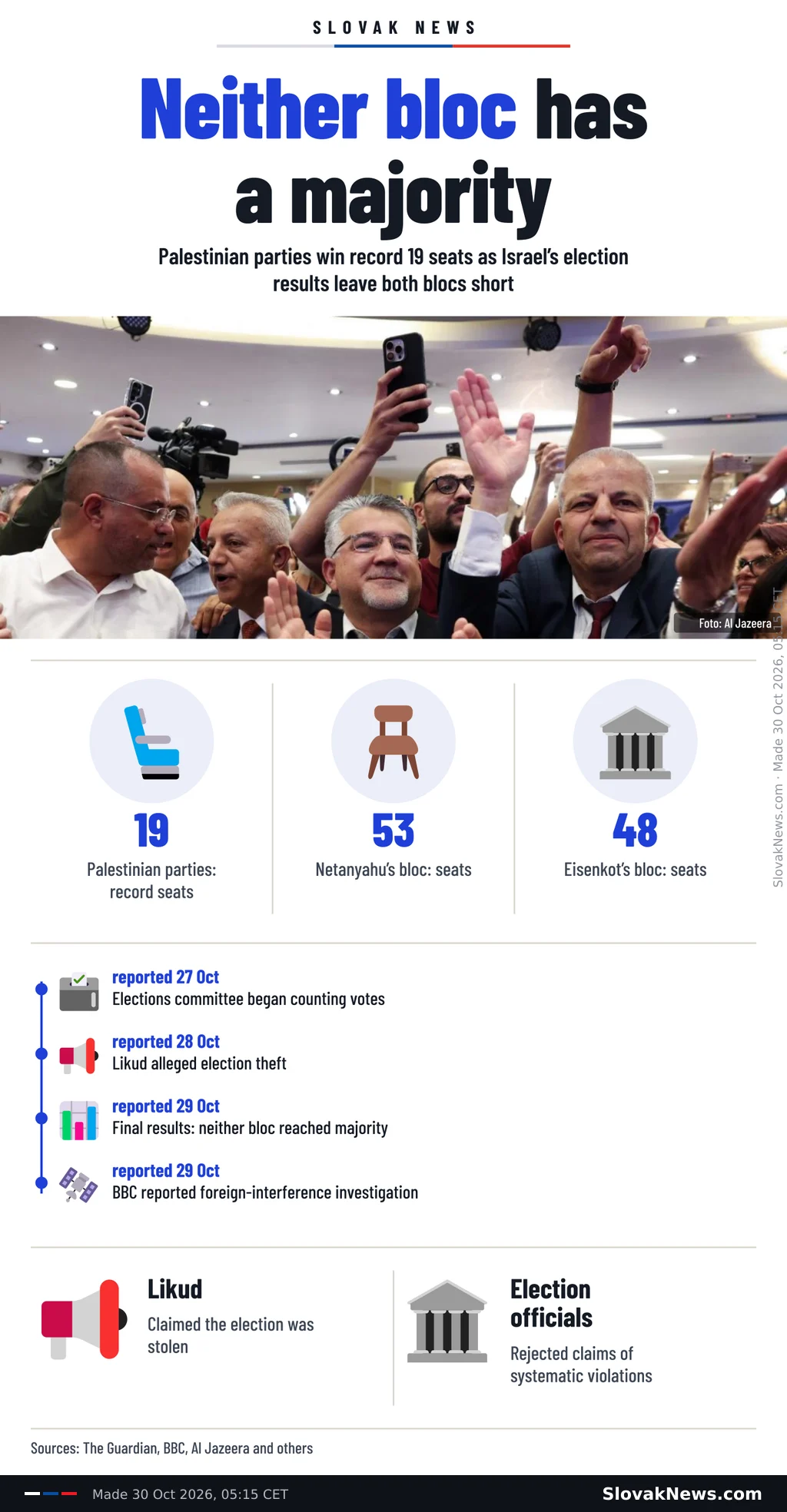
Final results give Netanyahu’s bloc 53 seats and Eisenkot’s 48. Election officials reject claims of systematic violations as Shin Bet investigates suspected foreign interference.
Listen to the story
Short version
Final results left both main blocs short of a majority, with Palestinian parties winning 19 seats. Election officials rejected systematic-violation allegations while a foreign-interference investigation proceeds.
- Palestinian parties achieved their best-ever result, securing 19 of the Knesset’s 120 seats.
- Netanyahu’s bloc won 53 seats; Eisenkot’s won 48.
- Likud alleged election theft; election officials rejected claims of systematic violations.
- Shin Bet is investigating suspected foreign interference at the elections committee’s request.
Infographic
What's new
- The BBC reported that the final count awarded 19 of the Knesset’s 120 seats to the two Palestinian party lists, their highest total ever.
- Netanyahu’s bloc won 53 seats and Eisenkot’s bloc 48, leaving both below the 61-seat majority threshold.
- The elections committee requested a foreign-interference investigation, but its acting director general said allegations of systematic election-integrity violations had no basis.
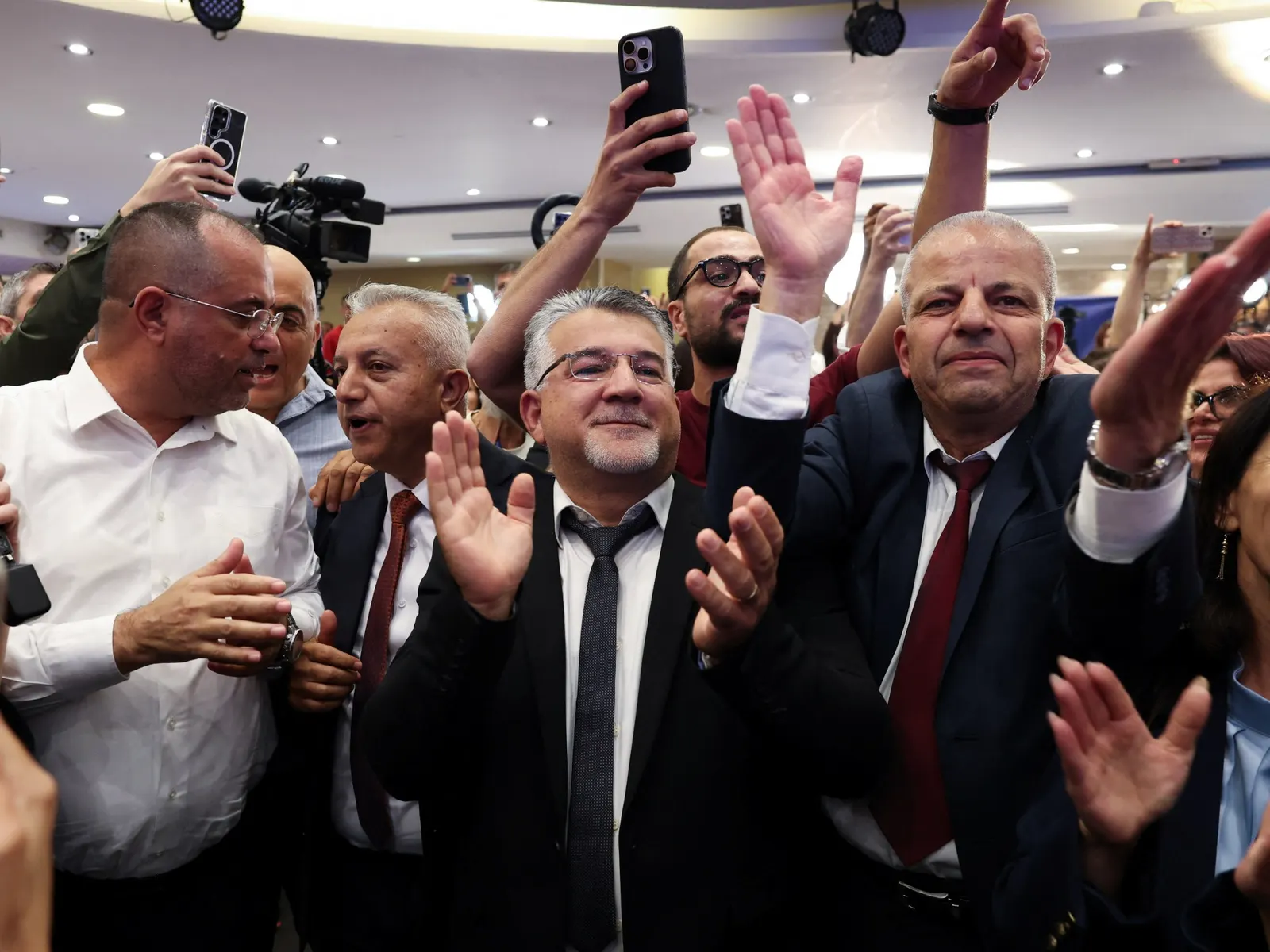
Palestinian parties won a record 19 seats in Israel’s parliament, with final results reported on October 29, 2026 leaving Benjamin Netanyahu’s bloc on 53 seats and Gadi Eisenkot’s opposition bloc on 48. Neither secured a majority in the 120-seat Knesset, the BBC reported. Likud claimed Arab-led parties had stolen the election, but the elections committee’s acting chief said claims of widespread irregularities were unfounded.2
Infographic
Projections await final results
Final results reported by the BBC on October 29 gave the Joint List and Ra’am a record combined 19 seats in the 120-seat Knesset. That exceeded the earlier projections of 17 to 18 seats.25
Netanyahu’s governing bloc won 53 seats and Eisenkot’s opposition bloc won 48, according to the BBC. Neither reached the 61 seats required for a majority.2
Overall participation reached 77.7 percent, the highest since 1999, according to Al Jazeera. Its election coverage estimated participation among Israel’s Palestinian electorate at roughly 80 percent.3
Conditions for cooperation
Speaking while counting was still incomplete, he stressed that the opposition needed 61 seats and said: “With the numbers we have now, there is no government”.3
According to The Guardian, Eisenkot set conditions for talks with the Joint List: recognition of Israel as Jewish and democratic, acceptance of stated declaration values and conscription, and denunciation of Hamas. Amjad Shbita rejected Eisenkot’s authority to dictate terms for negotiations.1
The Joint List has offered parliamentary support to someone who removes Netanyahu from office. Its representative Yousef Jabareen said its electoral showing meant it “can’t be ignored under any political scenario”. The Guardian also reported that Yair Golan urged Eisenkot to negotiate with both the Joint List and Ra’am.1
The route to a government
Netanyahu said a government dependent on Palestinian parties should not be formed, while Eisenkot said voters had rejected Netanyahu continuing as prime minister. Netanyahu also maintained that official results would establish Likud as the largest party, according to The Guardian.1
The Guardian reported that President Isaac Herzog would choose a party leader to attempt to assemble a government once counting was complete. That candidate would have six weeks before the task passed to another option. Netanyahu would remain in a caretaker role until a new majority was formed, the newspaper said.1
The BBC identified an Eisenkot-led government supported by Palestinian parties as one possible outcome. A Hebrew University snap poll found that the most popular option among the opposition bloc was an Eisenkot minority government including Ra’am, with outside support from the Joint List. The poll did not establish a governing agreement.2
Election allegations and investigation
Likud alleged that Arab-led parties stole the election through prohibited voter-mobilisation software, bribery, threats, violence and forgery. Middle East Eye reported that Likud submitted material it described as evidence to Shin Bet and the Central Elections Committee. These remain allegations, not established findings.4
The Central Elections Committee asked Shin Bet to investigate suspected foreign interference, the BBC reported. Dean Livne, the committee’s acting director general, said claims of systematic breaches of election integrity were unfounded. Shin Bet said its investigation did not implicate an entire community that had voted legally.2
Qatar denied allegations that it funded efforts to increase turnout in Arab communities. Joint List member and Balad chairman Sami Abu Shehadeh dismissed Likud’s accusations as an attempt to overturn the results. Eisenkot accused Netanyahu of an organised effort to delegitimise the election, while saying it was too early to determine whether anything had happened.2
Why it matters
The final seat totals leave government formation dependent on agreements beyond either main bloc. An Eisenkot-led government supported by Palestinian parties is one reported option, but no governing agreement has been established. The foreign-interference investigation does not itself establish Likud’s allegations of election theft.2
Videos
Related stories
same place

Version history
- version 2 · Final results replace projections with 19 seats for Palestinian parties and no majority for either main bloc, while new reporting details Likud’s allegations, officials’ rejection of systematic violations and a foreign-interference investigation.
- version 1 ·