Business · France, Germany
France and Germany seek faster EU response to trade threats
Berlin and Paris want the European Commission to respond within days to severe market distortions. Their proposal includes expedited restrictions on access to the European single market.
Listen to the story
Short version
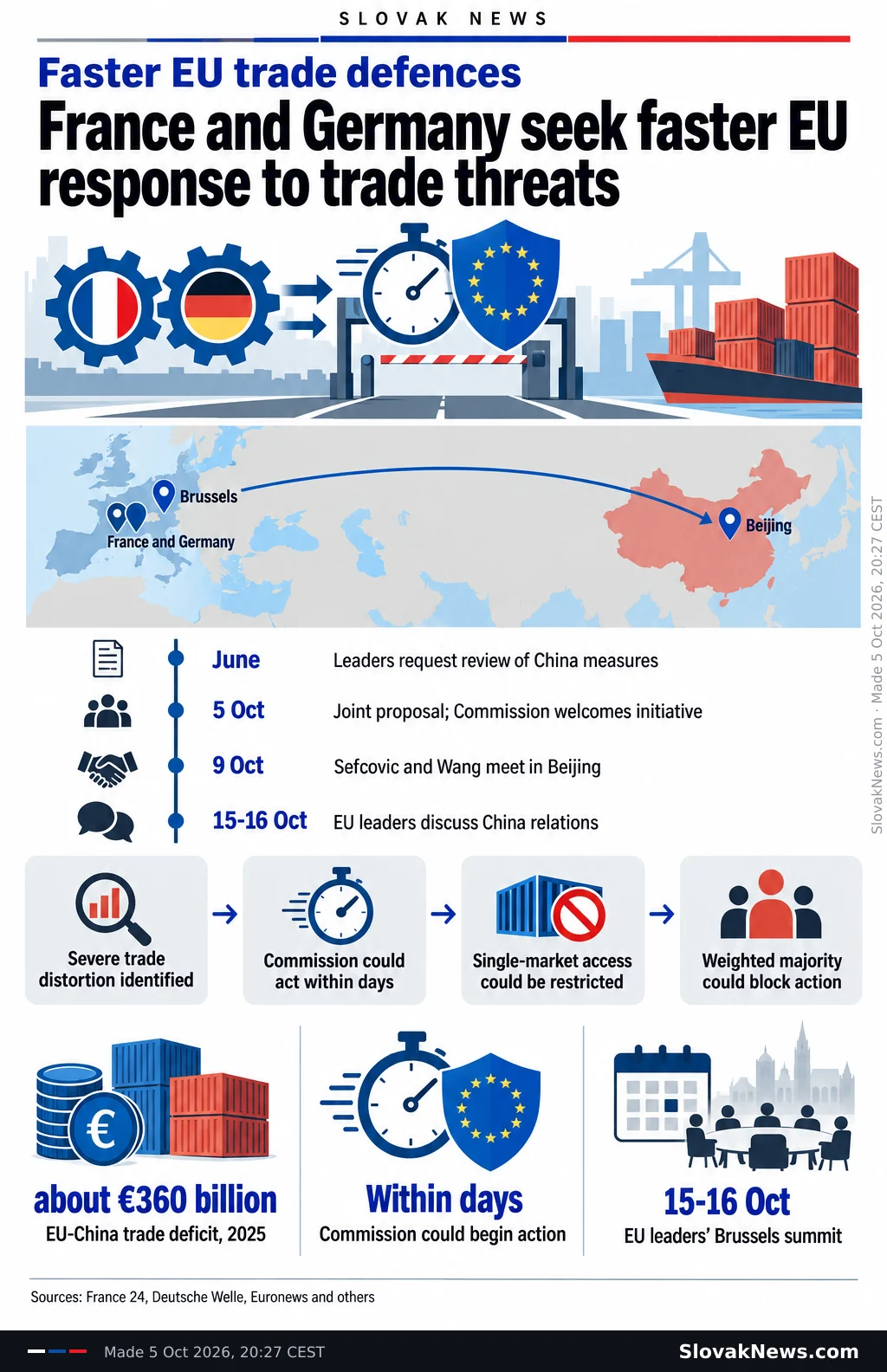
France and Germany want to give the European Commission a faster way to counter severe trade distortions, including by restricting single-market access. The plan will be discussed as the EU reviews its economic relationship with China.
- Commission action could be activated within days.
- A weighted majority of EU states could block action.
- The plan includes supply diversification and retaliation planning.
- The EU-China trade deficit was about €360 billion in 2025.
- EU leaders will discuss the issue on October 15-16.
Infographic
What's new
- Merz and Macron sent the Commission president a joint proposal. [refs: s3, s6, s8]
- The plan could let the Commission restrict single-market access within days. [refs: s1, s3, s8]
- EU leaders are due to discuss the issue on October 15-16. [refs: s1, s9]
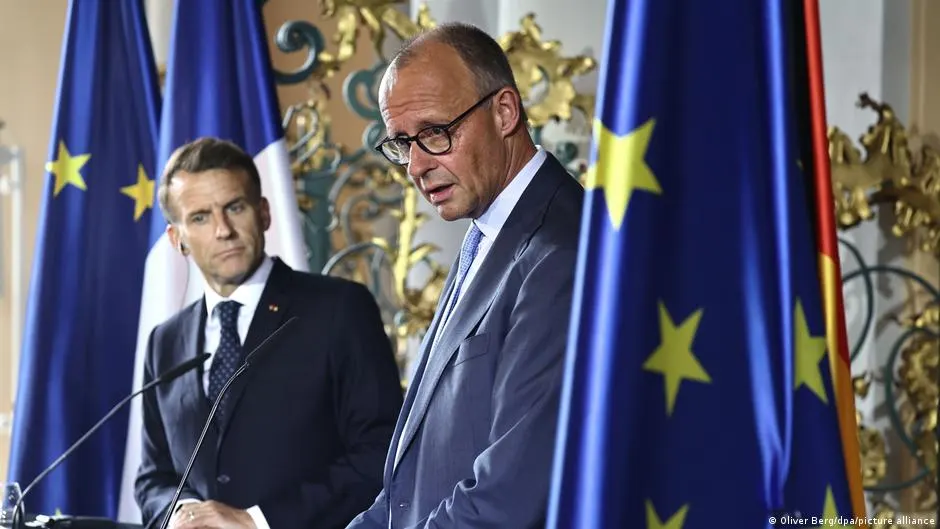
On October 5, Chancellor Friedrich Merz of Germany and President Emmanuel Macron of France urged the EU to react more rapidly to economic coercion, suggesting the Commission could limit a third country's access to the single market within days after serious market disruption. Before EU leaders were due to gather in Brussels, they outlined the proposal in correspondence addressed to Commission President Ursula von der Leyen.1368
Infographic
A faster route to market restrictions
The Franco-German proposal seeks a new legal instrument for a forceful and systematic response to economic pressure. Measures could extend to blocking some or all companies from a country from entering the single market. The plan would also cover stronger use of existing trade defences, faster action against dumping and subsidies, and tighter controls on imports that fail to comply with EU rules.3689
Under the proposed procedure, the Commission could act without first obtaining approval from every member state, while a weighted majority of governments could stop the measure. The proposal refers to activation through a reversed qualified-majority process. Deutsche Welle reported that a qualified majority requires at least 55 per cent of member states representing at least 65 per cent of the EU population.1234
The letter is an informal and nonbinding attempt to start a policy discussion, according to Deutsche Welle. The outlet reported that the current process for excluding another country from the single market requires member-state approval and can be complex and slow. Merz and Macron said the EU’s existing instruments were no longer sufficient to address unfair trade practices.2
The proposed framework would apply to countries generally rather than naming a particular target, according to France 24 and Euronews. It is intended to cover distortions ranging from individual products to whole industries, including subsidies and currency practices. A cutoff in supplies of critical raw materials was cited by France 24 as an example of conduct that could trigger a response.13
China shapes the debate
Although the appeal did not identify a specific country, according to Deutsche Welle, it comes as the EU confronts a large imbalance in commerce with China. The EU estimated that its goods-trade deficit with China was about €360 billion in 2025. European companies have said Chinese competitors undercut their prices in several industries.123
Deutsche Welle reported that the EU depends particularly heavily on China for some raw materials, including rare earths, and has become increasingly reliant on both China and the United States for high-technology imports and services. The proposed package therefore also calls for diversifying suppliers, securing access to critical materials and increasing investment.26
France and Germany also want the EU to prepare for countermeasures. Their paper calls for an inventory of possible retaliatory steps and an assessment of how those actions could affect individual member states. China has warned that it could retaliate if it considered such action necessary.236
Talks and the next political test
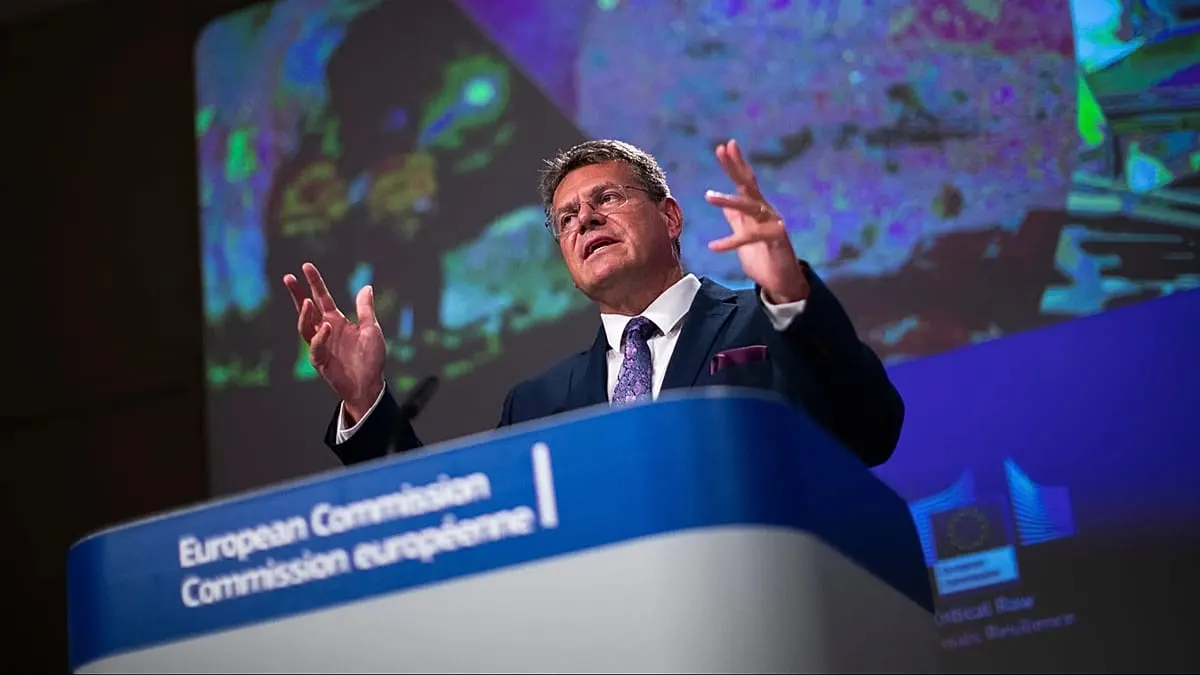
EU-China negotiations were continuing when the proposal was reported. EU trade commissioner Maros Sefcovic was scheduled to meet Chinese Commerce Minister Wang Wentao in Beijing on October 9. Sefcovic had said earlier in the year that he hoped for tangible results on trade with China by October.257
The European Commission welcomed the Franco-German initiative and said it was consistent with its work on competitiveness and relations with trading partners, including China. Merz and Macron are expected to press their case when EU leaders meet in Brussels on October 15-16, where relations with China and the bloc’s response to economic risks are due to be discussed.169
Why it matters
The plan could shorten the time required for the EU to respond when another country restricts supplies or distorts trade, while giving the Commission greater freedom to limit access to the single market. It also addresses European dependence on foreign sources of raw materials, high-technology goods and services.123
Related stories
Version history
- version 1 ·