Science & Tech · Belgium, Sweden
Francis Halzen wins 2026 physics Nobel for high-energy neutrino research
The Belgian-born scientist received the award for helping develop IceCube and for the detection of energetic neutrinos originating outside the Solar System. The prize is worth 12 million Swedish kronor.
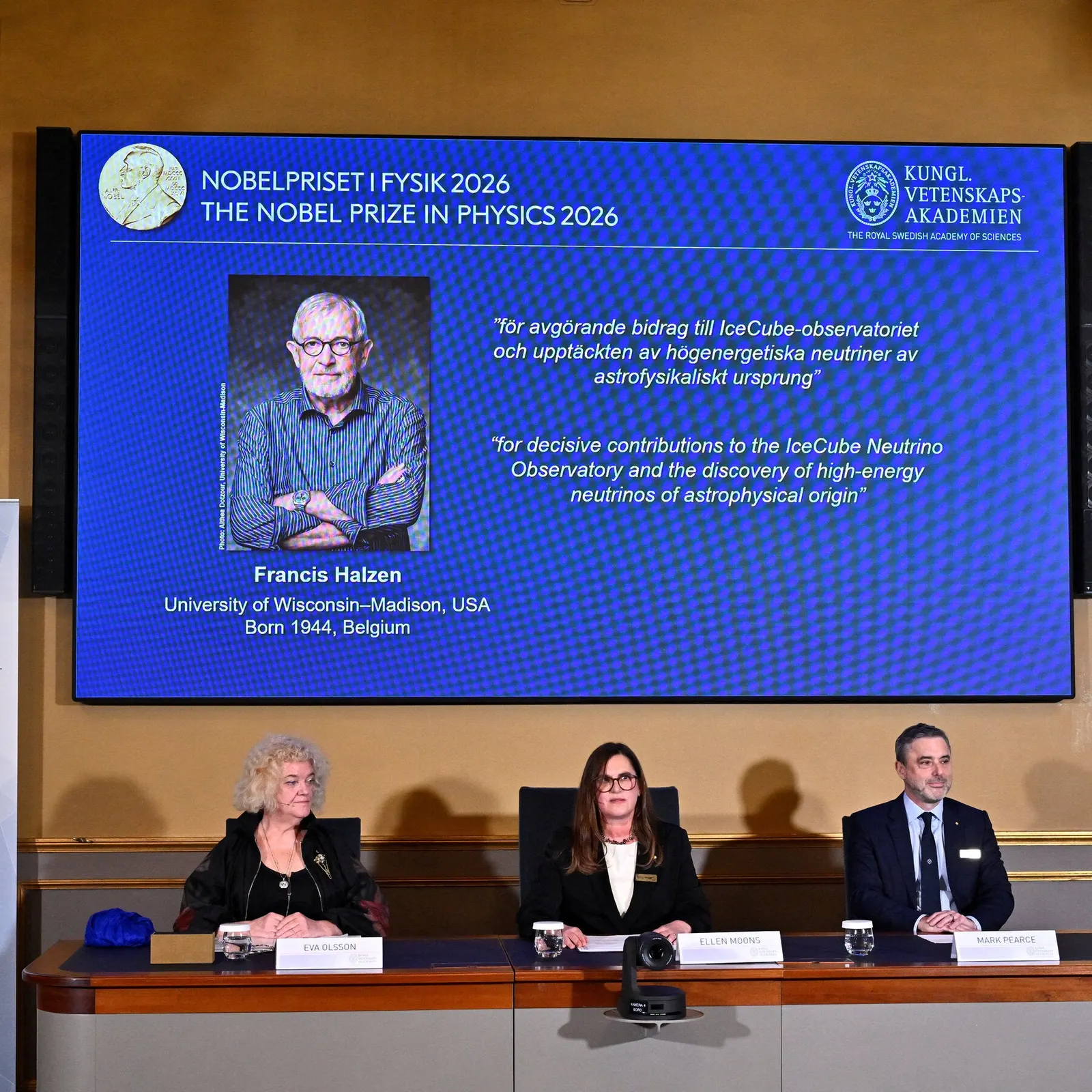
Francis Halzen received the 2026 physics Nobel for his contributions to IceCube and the discovery of high-energy astrophysical neutrinos.
- Halzen is a Belgian-born University of Wisconsin–Madison professor.
- IceCube uses a cubic kilometre of Antarctic ice.
- The South Pole concept dates to the 1980s.
- About 450 physicists participate across 14 countries.
- The prize is worth 12 million Swedish kronor.
What's new
- The Swedish academy awarded Halzen the 2026 physics prize.
- Halzen said the announcement was an unexpected pleasure.
- IceCube’s international collaboration continues analysing data and planning developments.
On 6 October, the Royal Swedish Academy of Sciences gave Francis Halzen the 2026 physics Nobel in recognition of his pivotal work on IceCube and the identification of high-energy neutrinos from astrophysical sources. Halzen, an 82-year-old physicist born in Belgium, teaches at the University of Wisconsin–Madison and focuses his research on a South Pole instrument installed within the ice.2346
An award decades in the making
Halzen’s effort to detect cosmic neutrinos at the South Pole reaches back to the 1980s. The Royal Swedish Academy says he presented his vision in 1988, before preliminary tests were conducted with sensors in the ice. IceCube was completed and became operational in 2011, according to the academy and CBC.2457
Halzen was in Italy when the Nobel committee contacted him. He described the result as unexpected and expressed hope that the recognition would also reflect on the people who joined the project in its early period. The prize carries 12 million Swedish kronor, equivalent to about $1.2 million or €1 million.2356
A telescope inside Antarctic ice
IceCube uses light sensors distributed through roughly one cubic kilometre of Antarctic ice. Corriere della Sera reported that more than 5,000 optical sensors transform that volume into a telescope, while the BBC said the pattern and timing of light produced by neutrino interactions allow researchers to estimate the particles’ direction.13711
According to the BBC, neutrinos interact only rarely with matter and have no electric charge, meaning magnetic fields do not deflect their paths. That makes their signals useful for examining regions that ordinary telescopes cannot easily observe. Their energies can provide information about processes involving exploding stars and the environments surrounding giant black holes.1
EL PAÍS reported that IceCube detected 28 neutrinos of cosmic rather than solar origin in 2013. In its Nobel citation, the academy recognised both the detection of energetic neutrinos from astrophysical sources and Halzen’s work on the observatory.2346
An international undertaking
Roughly 450 physicists at 58 institutions across 14 nations take part in the IceCube collaboration. According to the collaboration, it started with IceCube's initial 1999 proposal and brings together experienced researchers, postgraduate students, technical staff, software experts, drilling crews and engineers. It says many of the original participants remain involved.29
Although construction is complete, IceCube says the collaboration continues to analyse data, discuss results and prepare future developments. Its research also addresses questions about dark matter and the properties of neutrinos themselves.29
Mark Pearce, who heads the Nobel Committee for Physics, said Halzen guided the multinational team of scientists and engineers that built the instrument. Pearce said Halzen’s persistence and scientific vision had enabled a new form of astronomy.146
Looking beyond conventional astronomy
IceCube searches for high-energy neutrinos associated with violent processes beyond the Solar System, according to the BBC. Because the particles can carry information from regions that are difficult to study with ordinary telescopes, their detection gives researchers another way to investigate energetic cosmic events.1
The collaboration’s scope extends beyond the Nobel-cited discovery. Its members are studying the characteristics of neutrinos and questions involving dark matter, while continuing to operate the detector and assess its data.29
Why it matters
For European readers, the award connects a Belgian-born scientist with a prize conferred by Sweden’s Royal Swedish Academy and an international project spanning 58 institutions in 14 countries. IceCube says digital optical modules were produced and tested in Sweden and at DESY in Germany, as well as at the University of Wisconsin–Madison.279
Videos
Version history
- version 1 ·