Science & Tech · United States of America, Germany
Deisseroth, Hegemann and Nagel win medicine Nobel for optogenetics
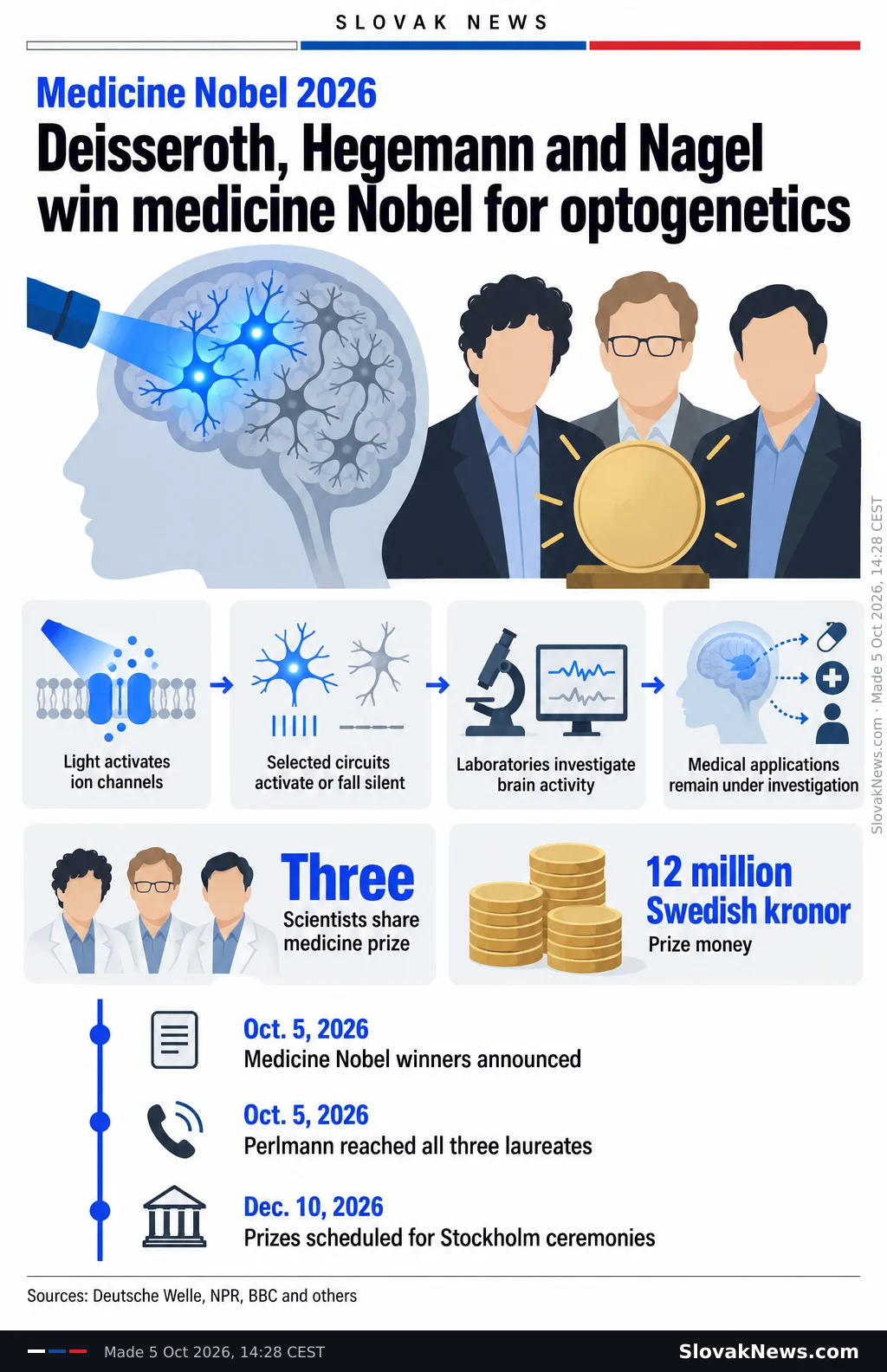
The 2026 prize recognises discoveries that gave researchers light-based control over selected nerve cells. The method is now used in laboratories worldwide to investigate brain circuits.
Listen to the story
Short version
Deisseroth, Hegemann and Nagel won the 2026 medicine Nobel for discoveries underlying optogenetics. The widely used research method controls selected nerve cells with light, but clinical applications remain experimental.
- The Nobel Assembly announced the three laureates on Oct. 5.
- Their work centres on light-gated ion channels and optogenetics.
- Researchers use light to activate or silence selected neural circuits.
- The shared prize totals 12 million Swedish kronor.
- Effective clinical treatments are not established in the dossier.
Infographic
What's new
- The three scientists were named joint medicine laureates on Oct. 5.
- The award recognises light-gated ion channels and optogenetics.
- The prize carries 12 million Swedish kronor.
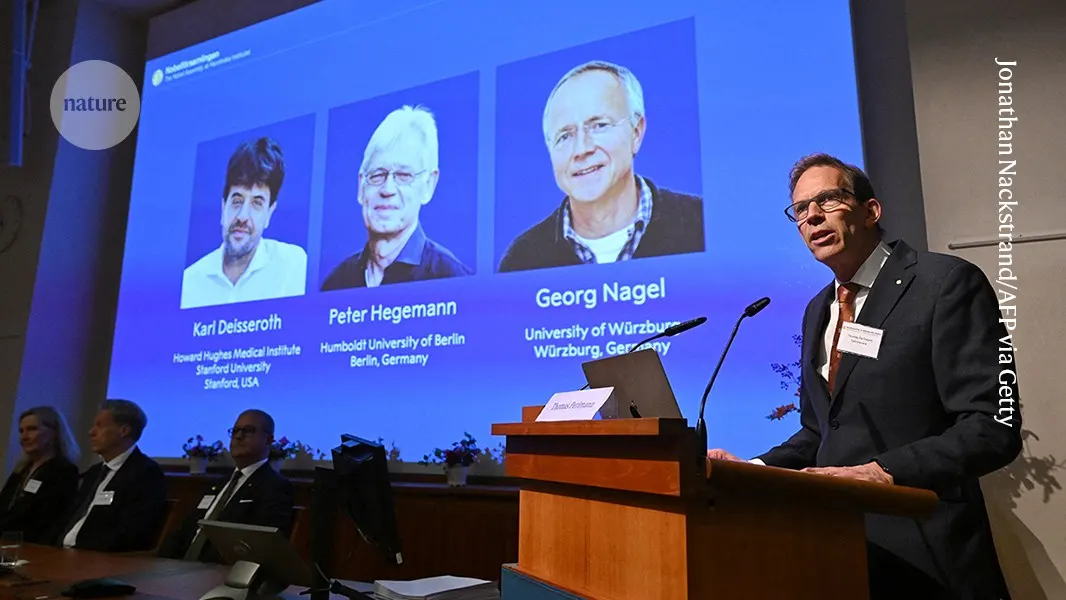
On Oct. 5, Stockholm’s Karolinska Institutet Nobel Assembly awarded the 2026 physiology or medicine prize jointly to Karl Deisseroth, Peter Hegemann and Georg Nagel. The award recognises discoveries involving light-gated ion channels and optogenetics, a method researchers use to control selected nerve cells with light and investigate how brain circuits shape memories, feelings and behaviour.1246
Infographic
A light-controlled neural switch
Optogenetics combines light with genetic modification to activate or silence selected nerve cells. Using this approach, scientists can activate or suppress specific brain pathways, helping them chart neural activity and assess what distinct neuron classes do. The Nobel committee said the technology is used in laboratories around the world.123
The work began with channelrhodopsin, a light-sensitive ion-channel protein discovered by Hegemann and Nagel in a single-celled alga in the early 2000s. According to Nature, the two scientists were working together at the Max Planck Institute for Biochemistry. The protein rapidly opens a channel when exposed to light, a property that became the basis of the new research tool.359
According to Nature, Deisseroth's team inserted the channelrhodopsin gene into rat nerve cells and showed that illumination made them send signals to neighbouring neurons. Other accounts said he developed a means of using light to control neurons in live mice. The first result from the optogenetics work was published in 2005, according to EL PAÍS.159
The resulting technique gave scientists precise control over selected populations of neurons. Researchers have used light-controlled circuits in animals to evoke memories, produce feelings and prompt behaviours, while studying the neural pathways involved. Per Svenningsson, who leads the Nobel Committee for Physiology or Medicine, said optogenetics enables forms of brain mapping that had once seemed unimaginable.349
From laboratory tool to medical research
The Nobel Assembly said optogenetics had fundamentally changed understanding of the brain. The method has helped researchers identify circuits associated with particular memories, emotions and behaviours, including circuits relevant to neurological and psychiatric disorders. It has also allowed scientists to examine the types of neurons involved in those conditions.13
Potential medical applications remain under investigation. Researchers are exploring ways to restore sight and studying possible relevance to blindness, depression, addiction, dementia, Parkinson’s disease and epilepsy. MUNDIARIO reported that widespread medical use still faces technical and safety challenges and that results from animal studies do not automatically translate to humans. The dossier does not establish that optogenetics has produced an effective clinical therapy.1912
Deisseroth works at Stanford University in California; Hegemann is at Berlin's Humboldt University; and Nagel is affiliated with Germany's University of Würzburg. Thomas Perlmann, the medicine Nobel committee's secretary, said he spoke with each of the three winners by phone on the announcement day.2
The prize totals 12 million Swedish kronor, equivalent to just over €1 million or about $1.2 million. It opened the week of Nobel announcements, with the physics, chemistry, literature and peace prizes to follow and the Nobel Memorial Prize in Economic Sciences scheduled for Oct. 12. The medicine laureates are due to receive diplomas and gold medals from Sweden’s king at a ceremony in Stockholm on Dec. 10.1212
Why it matters
Two of the three laureates work at German universities, placing European institutions at the centre of research that has become a widely used neuroscience tool. For European readers, the award also highlights a method being investigated for neurological and psychiatric conditions, although the dossier does not establish that it has produced proven treatments for patients.123
Videos
Version history
- version 2 · The update fixes the lede’s date, adds details of the Dec. 10 presentation and clarifies the technical and safety barriers facing clinical use.
- version 1 ·