World · Ukraine, Russian Federation
Russian Strikes Cut Power and Water Across Kyiv, Two Dead
Overnight missile and drone strikes on Kyiv triggered a cascading grid failure that cut water and electricity to the capital and briefly disrupted supplies in neighbouring Moldova.
Listen to the story
Short version
Russian missile and drone strikes on Kyiv killed two people and triggered a power grid failure that cut water and electricity across the city and briefly hit Moldova.
- Two killed, five injured in Sept 30 strikes on Kyiv
- Power grid cascade failure cut water and electricity citywide
- Metro passengers trapped underground for about two hours
- Outages briefly reached Chisinau, Moldova; border closed
- NATO condemned Russia's nuclear rhetoric after the attack
What's new
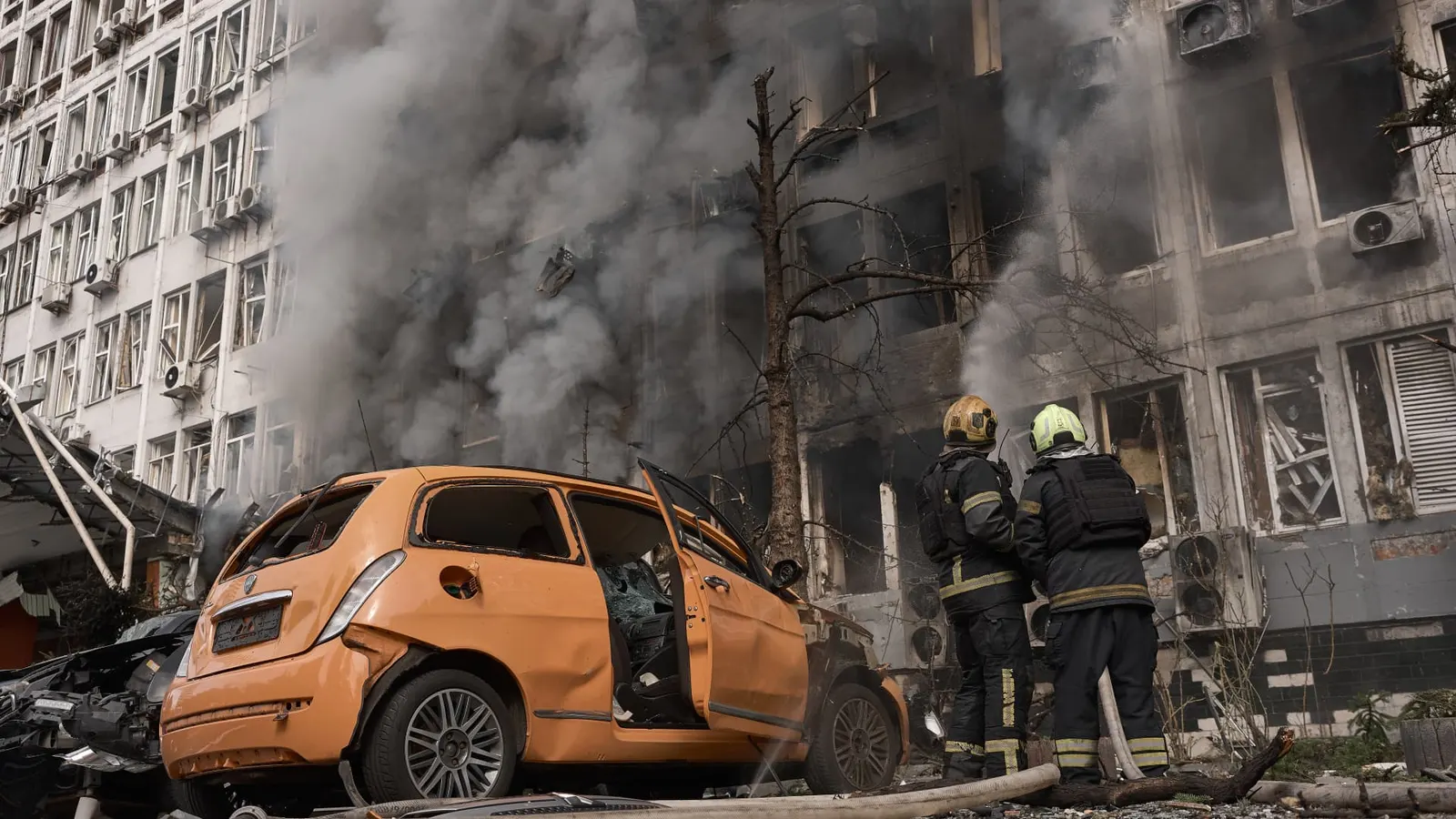
- Russian strikes hit Kyiv data centers, an energy substation and a locomotive depot overnight Sept 30
- A grid cascade failure cut power and water across Kyiv and briefly affected Chisinau, Moldova
- Two people were killed and five injured in the attack
- NATO condemned what it called Russia's irresponsible nuclear rhetoric
Russian forces struck Kyiv with ballistic missiles and drones overnight into Tuesday, Sept. 30, killing two people, injuring five, and triggering a cascading power grid failure that cut water and electricity across the Ukrainian capital and briefly disrupted supplies in neighbouring Moldova.14
Overnight strikes
Ukraine's air force warned that ballistic missiles were heading toward Kyiv before the first explosions were reported in the capital. Fires broke out in the private residential sector of the Sviatoshynskyi District and at a warehouse in the Holosiivskyi District, while drone debris fell on the Southern Bridge, prompting road traffic restrictions. Ukrainian officials said four energy infrastructure facilities in Kyiv and the surrounding region were attacked.4
According to TASS, Russia's Defense Ministry reported that its military launched a large-scale nighttime assault employing precision weapons fired from the ground alongside drones capable of striking distant targets, aiming at a communications hub and energy infrastructure in Kyiv. Russian officials described the targets as including the De Novo data center, described as a major internet traffic hub for Ukrainian military data processing, the Kievskaya power substation, the Kiev Hydroelectric Power Plant, the Tripolskaya Thermal Power Plant and an energy storage battery park, all of which Russia said supported Ukrainian defence facilities.3
CNBC reported that Russia struck several targets in Kyiv including a locomotive depot and data centers, among them the Bi-mobile facility, described as one of the capital's main internet exchange points. CNBC reported that Russia has escalated its assaults on Ukrainian internet providers and data infrastructure lately, a trend that has alarmed Ukrainian officials, with the network noting Moscow's apparent goal of interfering with the flow of information within Ukraine.2
Power and water disruption
Denys Shmyhal, Ukraine's Energy Minister, said the grid's cascading shutdown occurred after transmission lines linking Romania to Moldova, as well as lines connecting western and central Ukraine, were disrupted. Emergency blackouts were imposed across multiple regions and nuclear power plants operated at reduced capacity, with the power deficit in the system described as very high.1
The Kyiv metro was temporarily suspended, trapping passengers including 27-year-old dance teacher Kateryna Maliuha underground for roughly two hours. Maliuha said she and other passengers remained trapped underground for close to two hours before being rescued. There was no panic. Everything was quite organized," she said, adding, "But everyone is in shock, of course. There is almost no cellular network now. she said she was now trying to figure out how she would get home. Water supply was also cut across Kyiv before being restored, and the metro later resumed service on all three lines.1
According to Oleksandr Kharchenko, who heads the Energy Industry Research Center, the technical failure originated along the Moldova-Romania connection, though harm to Ukraine's own energy infrastructure made matters worse. He said Ukrenergo and distribution companies were working to restore full power supply "after these terror attacks by Russia." Officials said the cause of the mass outages was not external interference or a cyberattack but frozen lines causing automatic shutdowns, and that power was restored to pre-blackout levels across all regions by 7:30 p.m. on Jan. 31.1
Barista Maria Vykhodtseva, 25, described relying on a backup generator that freezes in severe cold. "We usually run on a generator. Fortunately, we have one. she explained that extreme cold causes the generator to freeze up, requiring her to restart it, and added that water pressure had dropped significantly before returning to normal. Approximately 2,600 residential buildings in Kyiv, about a quarter of the city's housing supply, remained without heat.1
Spillover into Moldova
Power outages hit Chisinau around 7 a.m. after voltage fell on the 400-kilovolt Isaccea-Vulcanesti-MGRES transmission line, a drop connected to issues within Ukraine's energy system. local time, Moldova's capital mayor Ion Ceban reported. Trolleybuses stopped running in many areas of the city. The Ukrainian-Moldovan border was also temporarily closed to vehicles and goods after a failure of Moldovan customs authorities' central databases.1
NATO response
A NATO spokesperson criticized Russia's rhetoric in the wake of the strikes, stating that the alliance firmly rejects threats of force, including reckless talk of nuclear weapons. The spokesperson called on Russia to end its unprovoked war in Ukraine, and added that NATO's activities pose no threat to Russia, describing the alliance as defensive in nature and characterizing Russia's use of hybrid tactics as a sign of desperation. The spokesperson said NATO's backing of Ukraine would not waver and that the alliance possesses the capability to protect every part of Allied territory and stay prepared to counter any threat. CNBC reported that Moscow has said it is ready to use its entire military arsenal if NATO tries to block Kaliningrad, and that Russia views NATO's approach to Kaliningrad as heightening the risk of direct military confrontation.2
Wider toll
The attack came as Russia's full-scale invasion of Ukraine, launched in early 2022, has continued for more than four-and-a-half years, according to CNBC. Yulia Mendel, a former press secretary to Ukrainian President Vladimir Zelensky, pointed to the broader economic cost of the conflict, saying, "A long Black Sea blockade, metallurgists say, could cost the country about $17 billion." She added, "If that industry disappears, what exactly is left to hold the state up?" and said, "And there is no strategy from the state on how to work or rebuild."32
Why it matters
The strikes show how attacks on Ukraine's power grid can spill across borders into European Union candidate Moldova, disrupting utilities and trade far from the front line. NATO's public condemnation of what it called irresponsible nuclear rhetoric, alongside Russian statements on Kaliningrad, underscores the risk that the conflict's rhetoric could escalate tensions with the alliance.21
Related stories
same actors
same actors
same actors

Version history
- version 1 ·