US and China Agree Tariff Cuts on $30bn Goods, AI Dialogue
After a three-day summit, Washington and Beijing announced reciprocal tariff reductions on non-sensitive goods and a new channel for talks on artificial intelligence, alongside a two-month extension of their trade truce.
Listen to the story
Short version
The US and China ended a summit with agreements on tariff cuts, a new AI dialogue, and an extended trade truce.
- Tariff cuts agreed on $30 billion of goods each way
- New AI dialogue launched, next round in November
- Trade truce reportedly extended two months past Nov 10 expiry
- Leaders agreed on Iran nuclear pledge and waterway tolls ban
- Trump voiced caution about deeper AI cooperation with China
What's new
- Reciprocal tariff cuts agreed on $30 billion of goods in each direction
- New US-China dialogue on artificial intelligence launched, with a November round set
- Trade truce extended by two months from its November 10 expiry, according to Scott Bessent
- Leaders agreed on Iran's nuclear commitments and on barring transit tolls on international waterways
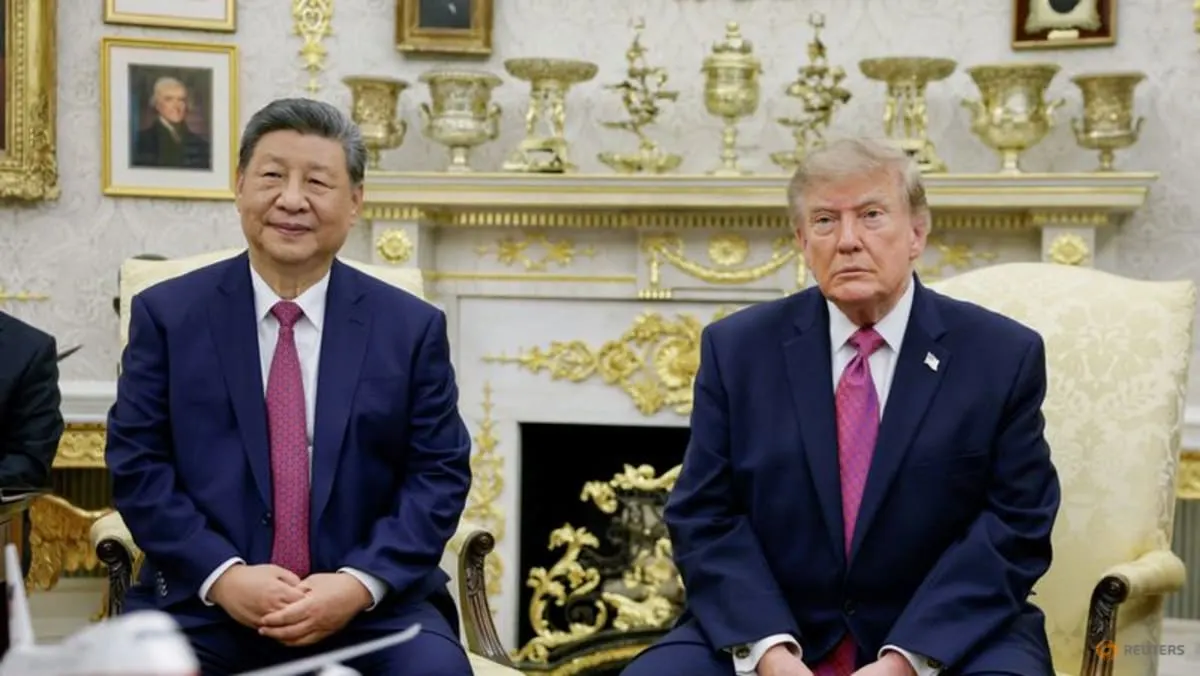
Washington and Beijing struck a deal to cut tariffs on $30 billion worth of goods flowing each way and launched a fresh channel for artificial intelligence talks, as a three-day summit between Donald Trump and Xi Jinping concluded on Friday.123
Tariff relief and a trade council
The White House said the two nations settled on proposals granting friendlier tariff terms to $30 billion worth of non-sensitive goods traded in each direction. The reductions would apply to US imports including small appliances, toys and decorations, according to ABC Australia and CNA.123
Citing a single source, The National reported that the covered goods extend to agricultural products, wood and cosmetics, with lower tariffs applying to both US-bound imports and US exports of these items.1
Both parties additionally committed to establishing a trade council and carrying forward the results reached during earlier discussions in Kuala Lumpur. US Treasury Secretary Scott Bessent said prolonging the truce gives negotiators additional room to pursue a larger agreement.123
ABC Australia said the deal came after the two countries pushed back by two months a trade truce originally set to lapse on November 10, a point CNA also noted based on the two economies' truce schedule.23
AI dialogue and a new term
Per The National and ABC Australia, both countries committed to discussing artificial intelligence's risks and benefits, with another round of talks penciled in for November. An official Chinese embassy readout separately confirmed the November 2026 timing and listed the summit's eight agreed outcomes.124
The leaders agreed to use the term "super intelligence" in place of "artificial intelligence", according to the White House. China's foreign ministry welcomed the fact that Washington adopted the new terminology, and the two governments agreed to intensify exchanges and seek common ground as AI technology continues to evolve.123
The National reported, from a single source, that the two sides agreed to include a channel for AI-related incidents; the Chinese embassy readout separately recorded agreement on such a communication channel, and ABC Australia also reported this channel.124
Speaking about the talks, Donald Trump said he had discussed AI with Xi but signalled reluctance to cooperate closely with China, according to CNA.3
Diplomacy beyond trade
All three general-audience sources reported that the leaders concurred Iran needs to uphold its pledge to forgo nuclear weapons, and that transit tolls on international waterways should not be levied by any nation or entity.123
Chinese Foreign Minister Wang Yi described the visit as historic. ABC Australia and CNA reported that each leader intends to take part in events organized by the other nation, and that both governments pledged mutual backing for Shenzhen's staging of the Asia-Pacific Economic Cooperation leaders' meeting in November. ABC Australia additionally reported an agreement to support hosting of a Group of 20 summit in Florida in December.123
Based on a single source, ABC Australia reported that both countries further agreed to formalize a memorandum aimed at bolstering crisis communication and averting military confrontations.2
Xi Jinping landed in Beijing after the summit, according to Xinhua as cited by ABC Australia and CNA. Both outlets characterised the summit as an exercise centred on personal diplomacy rather than sweeping public breakthroughs.23
Why it matters
For European readers, the reciprocal tariff cuts and the new AI dialogue signal a period of eased friction between the world's two largest economies, which can affect global trade flows and technology cooperation norms. The extension of the trade truce buys time for a larger deal, but the scope of cuts remains limited to non-sensitive goods.12
Related stories
same event
Version history
- version 1 ·