Business · United States of America, People's Republic of China
China Confirms Its Side of $30 Billion US Tariff-Cut Deal
Beijing's commerce ministry formally verified the reciprocal product lists unveiled after the Trump-Xi summit, adding coal to the goods eligible for lower tariffs and setting up new trade bodies.
China's Commerce Ministry has formally confirmed the US-China $30 billion reciprocal tariff-cut framework, which includes coal and covers about 90% of listed goods at most-favoured-nation rates.
- China confirmed the tariff-reduction framework, including coal imports
- US list: 77 entries; China list: 1,619 goods
- About 90% of listed goods to get most-favoured-nation tariff rates
- China to buy 10 million tonnes of US coal annually in 2027-28
- Trade truce extended to January; new Trade Council formed

What's new
- China's Commerce Ministry officially confirmed the reciprocal $30 billion tariff-reduction framework, resolving earlier uncertainty over Beijing's list
- Coal imports were formally confirmed as part of the framework, reinforcing China's pledge to buy 10 million tonnes of U.S. coal annually in 2027-28
- New trade data: China's exports to the U.S. totalled about $270 billion over the first eight months of 2026, versus roughly $68 billion in U.S. exports to China over seven months
- Golden Arts Gifts & Decor analyst Richard Chan noted that this season's Christmas merchandise has largely already left factories, meaning the agreement will have little immediate impact.
- The new bilateral body is referred to as a Trade Council in Chinese reporting, with its agricultural working group expected to meet by the end of 2026
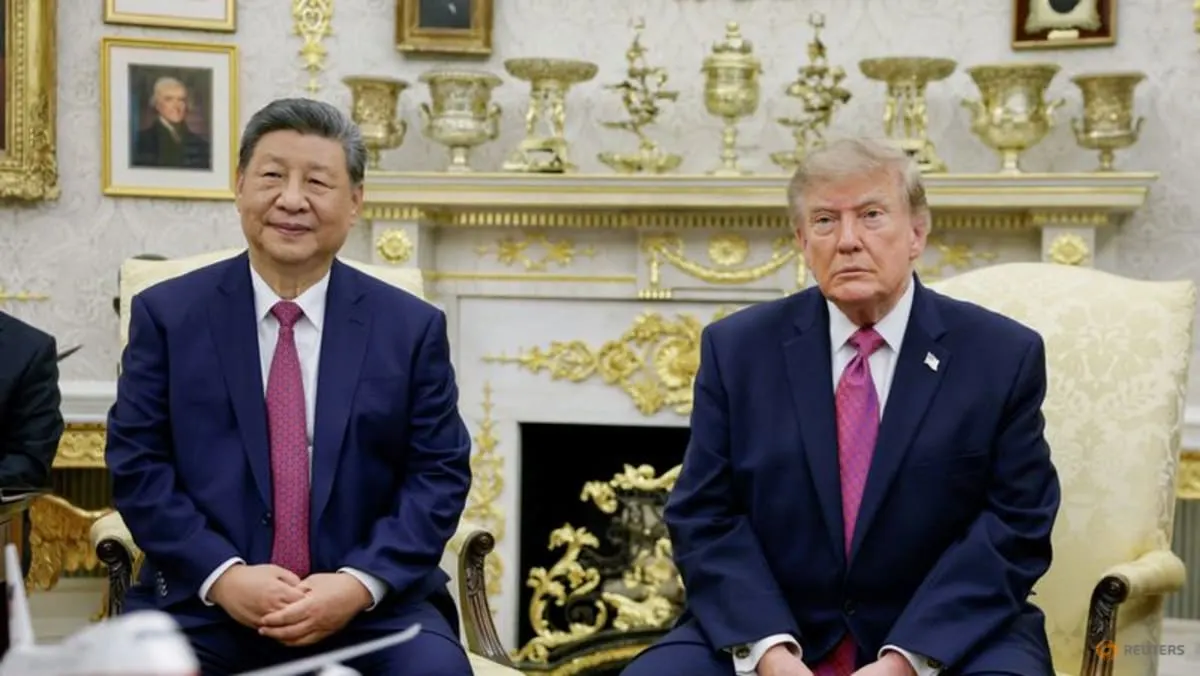
The United States and China have finalized product lists for a plan to cut tariffs on roughly $30 billion of imports from each side, with Beijing's commerce ministry now formally confirming the framework unveiled days after a Trump-Xi summit in Washington.251013
What each side listed
The U.S. list contains 77 entries covering products from China such as fireworks, household products, sports equipment and toys. China's list contains 1,619 goods from the United States, spanning categories such as beef and pork, fish and shellfish, milk products, cereals, coal, lumber and medical devices.1245
CNBC reported that agricultural goods from the U.S. dominate China's import list, and that rapidly expanding segments like hair care items and pet food packages are also included.13
Tariff mechanics and purchase commitments
Under the arrangement, about 90% of the listed products would have tariffs reduced to most-favoured-nation rates, a framework China's Commerce Ministry has now formally confirmed. Reports on the arrangement indicate China has committed to purchasing a minimum of 10 million tonnes of U.S. coal annually across 2027 and 2028, with Chinese state media confirming coal's formal inclusion in the reduction framework. Officials said the product lists may also be adjusted on an annual basis.261011
The Straits Times reported that tariff reductions would take place simultaneously after each side completes domestic legal procedures.62
Extended truce and new institutions
The two countries also agreed to extend their broader trade truce, originally due to expire on November 10, by two months to January. U.S. Treasury Secretary Scott Bessent said negotiators had agreed to the extension.371
The countries established a U.S.-China Board of Trade — referred to in Chinese state media as a Trade Council — along with an agricultural working group set to gather for the first time before 2026 concludes.12710
Trade backdrop
The product lists follow a period of elevated tension: the U.S. goods trade deficit with China exceeded $202 billion last year, and the two countries had imposed import tariffs of more than 40% and more than 30% respectively, with U.S. tariffs reaching as high as 145% at one point, according to reporting. China's trade surplus hit an all-time high of $1.2 trillion the previous year and had climbed to roughly $800 billion by August, as Chinese exports to the U.S. totalled around $270 billion over the first eight months of the year against roughly $68 billion in U.S. exports to China over the first seven months.356
The Chinese Commerce Ministry said the arrangement would help stabilise trade relations, stating: "This arrangement will help to further stabilise China-US economic and trade relations and create favourable conditions for China's exports of relevant products to the US." U.S. Trade Representative Jamieson Greer said the lists focused on "non-sensitive goods on each side that could benefit from more favorable tariff treatment."23
Market and industry reaction
Jacob Cooke, head of WPIC Marketing + Technologies in Beijing, suggested retailers stand to gain from swift implementation, stating: "If we see the tariff cuts actually implemented before the holiday season, it could provide a welcome boost to U.S. consumption and to retailers." He added that "every percentage point counts for price competitiveness and preserving margin." Ryan Zhao, meanwhile, projected second-half sales could rise 30% year-over-year if the tariff cuts go into effect.1
Analysts cited by AFP offered mixed but broadly positive assessments.36
Richard Chan, from Golden Arts Gifts & Decor, warned that since the bulk of this season's Christmas merchandise has already left for shipment ahead of peak demand, the tariff cuts are unlikely to make much difference for now.5
Why it matters
With China's commerce ministry now confirming the framework, attention shifts to implementation timing and whether the cuts arrive in time to affect this year's holiday shopping season, given warnings that much of the season's goods are already shipped.56
Videos
Related stories
follow-up

background
Version history
- version 2 · China's Commerce Ministry has now formally confirmed the $30 billion tariff-reduction framework, including coal, alongside new trade data and analyst caveats about holiday-season timing.
- version 1 ·