Science & Tech · United States of America
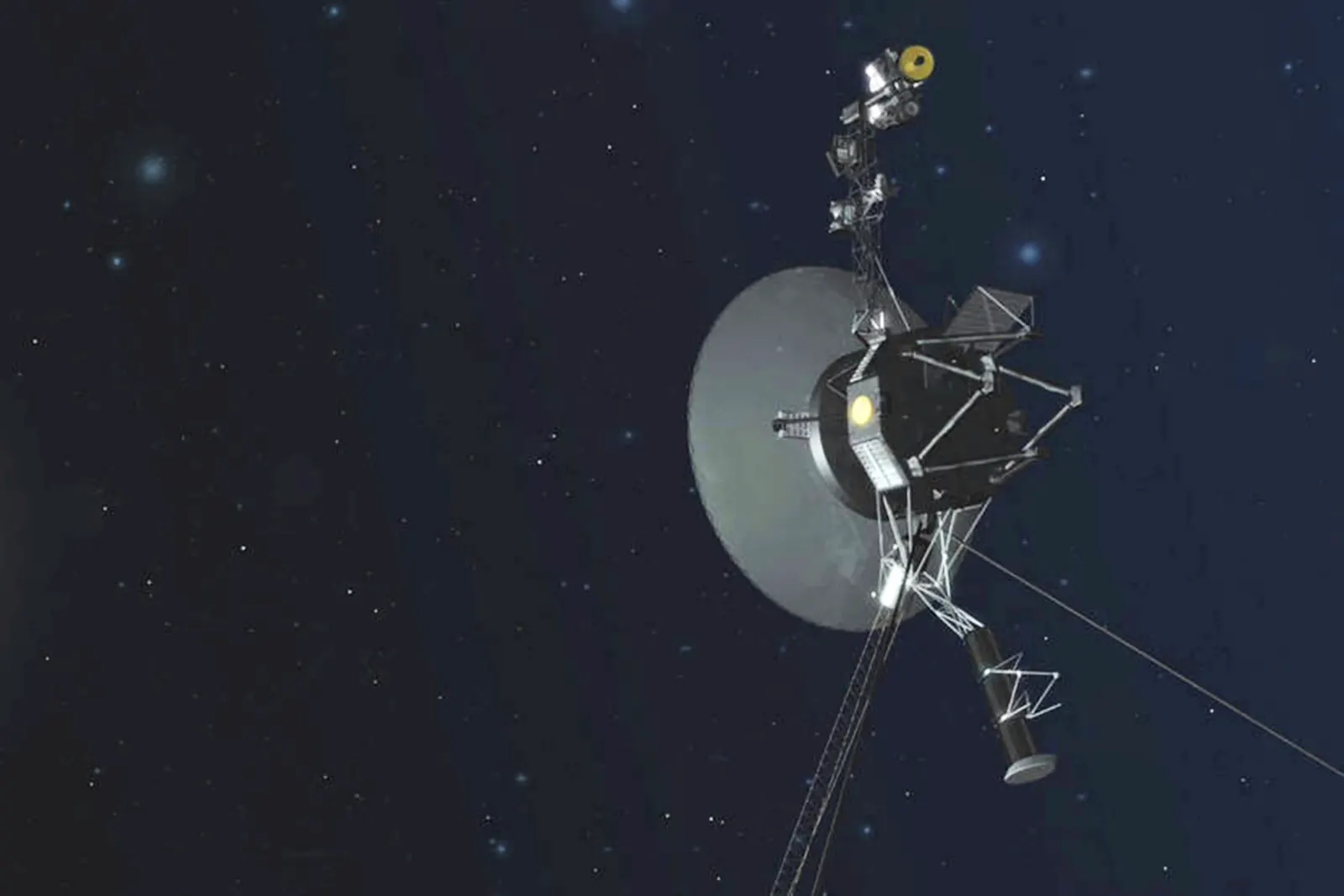
Voyager 1 reaches one light-day from Earth, Axios reports
The NASA spacecraft has crossed a distance that light takes 24 hours to travel, according to Axios. Its journey continues beyond the heliosphere with two science instruments operating, NPR reports.
Voyager 1 reached one light-day from Earth on November 18, according to Axios. NPR reports that two science instruments continue operating beyond the heliosphere.
- Axios reports the spacecraft crossed the threshold on November 18.
- A light-day exceeds 16 billion miles, according to NPR.
- NPR reports a particle experiment was shut down to conserve power.
What's new
- On November 18, Voyager 1 moved beyond the distance light travels in a day, Axios reported.
- NPR reported that NASA switched off a particle experiment to conserve power.
- Two science instruments remain in operation, according to NPR.
NASA’s Voyager 1 reached a distance of one light-day from Earth in interstellar space on November 18, according to Axios, which reported that it was the first spacecraft to cross that threshold. The milestone follows a journey that began with its launch in 1977.13
A distance measured in light
A light-day means the distance covered by light in 24 hours – more than 16 billion miles, according to NPR. The measure puts Voyager 1’s separation from Earth in terms of travel time for light rather than the decades spent travelling by the spacecraft itself.1
NPR and The Guardian had reported that Voyager 1 was expected to reach the threshold on Wednesday. NPR gave an estimated arrival time of 5:16 a.m. ET; Axios subsequently reported the crossing on November 18. The milestone concerns its distance from Earth, rather than a new planetary encounter.123
From planetary encounters to interstellar measurements
According to NPR, Voyager 1 launched on September 5, 1977. The Guardian described Voyager 1 and Voyager 2 as probes NASA sent out almost half a century ago to investigate the solar system’s outer regions. Voyager 1’s route included encounters with Jupiter and Saturn, NPR reported.12
NPR’s account traces several stages of that journey: the discovery of a faint ring around Jupiter in 1979, detailed photographs of Saturn’s rings and moons in 1980, and the overtaking of Pioneer 10 in 1998. That last event made Voyager 1 the most distant human-made object, according to NPR.1
NPR reported that the spacecraft arrived at the boundary of interstellar space in 2012. Both NPR and The Guardian describe it as having moved beyond the heliosphere. NPR says no spacecraft other than the two Voyager probes have operated beyond the protective area that surrounds the solar system.12
Science continues with less power
To reduce power use and potentially keep Voyager 1 functioning longer, NASA turned off the probe’s experiment for low-energy charged particles, NPR reported. Two scientific instruments remain active, according to the outlet: one measuring magnetic fields and another detecting plasma waves.1
Alongside its scientific equipment, Voyager 1 carries the Golden Record, a gold-plated capsule intended to communicate Earth’s story to extraterrestrials. NPR described its contents as 115 images, sounds from nature and spoken greetings in 35 languages.1
NASA also invited the public to mark the distance milestone by transmitting the spacecraft’s call sign, V-G-R, towards the sky in Morse code, according to NPR. The agency called its symbolic celebration “Shine Bright for Voyager's Light-Day”.1
Why it matters
For readers in Europe, the significance is the continuing study of space beyond the heliosphere, rather than a Europe-specific development. According to NPR, Voyager 1 still collects magnetic-field and plasma-wave measurements there, even as NASA reduces its power demands.1
Videos
Related stories
same actors

Version history
- version 1 ·