World · Brazil
Datafolha shows technical tie as Brazil election enters final stretch
Brazil votes on Sunday after a Datafolha simulated runoff put Lula ahead of Flávio Bolsonaro by 48 per cent to 45 per cent, a technical tie within the poll’s margin of error.
Listen to the story
Short version
Brazil’s election remains too close to call, with Datafolha describing its latest simulated runoff as a technical tie. Voting begins Sunday, and a runoff is expected if no candidate wins a majority.
- Datafolha’s runoff test put Lula at 48% and Bolsonaro at 45%.
- The poll’s two-point margin makes that a technical tie.
- Both frontrunners declined the latest televised debate.
- About 160 million Brazilians are registered to vote.
- A runoff is expected on October 25.
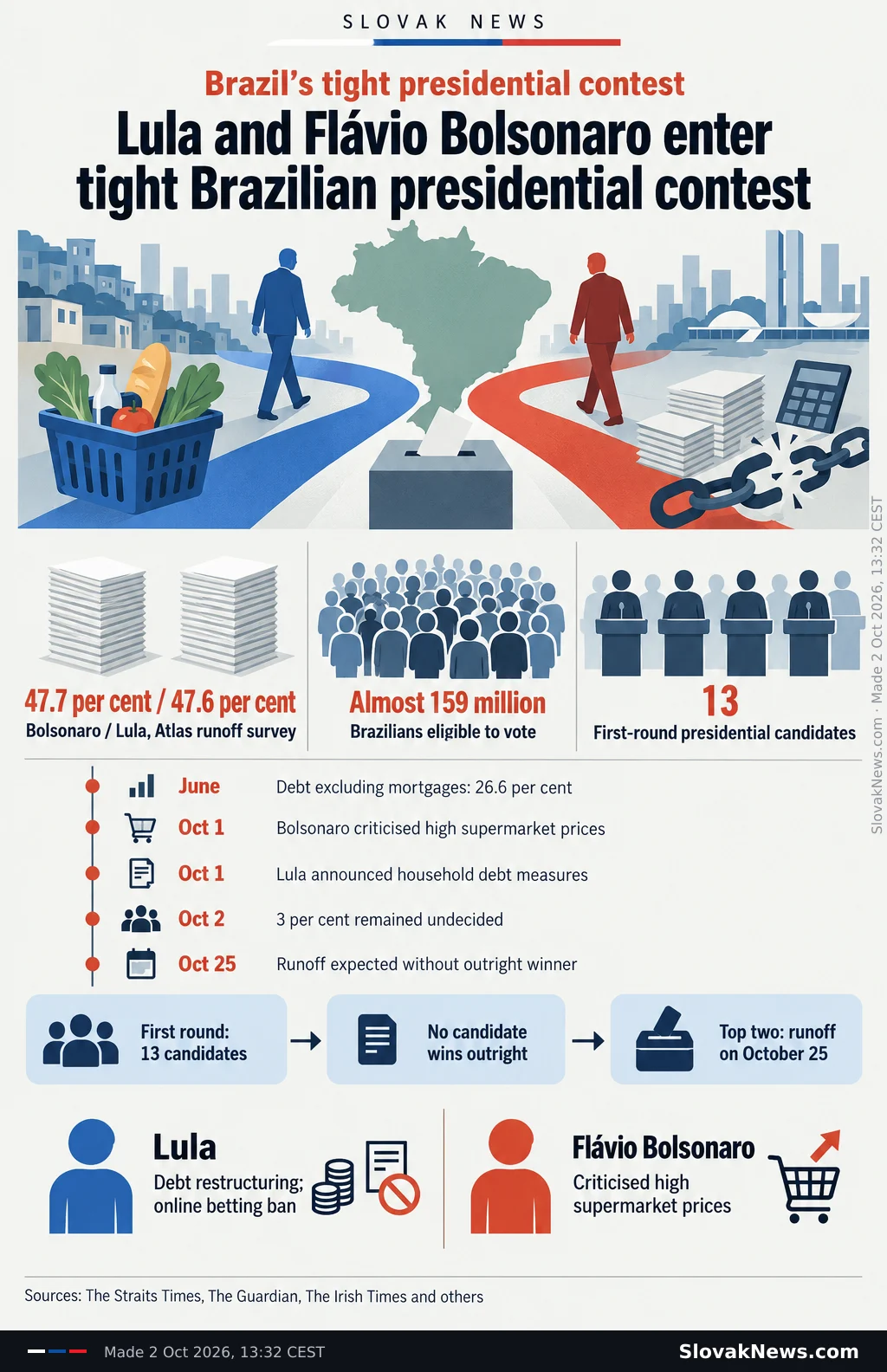
Infographic
What's new
- A Datafolha simulated runoff put Lula at 48 per cent and Flávio Bolsonaro at 45 per cent, within the poll’s two-point margin of error.
- Datafolha’s first-round scenario placed Lula first and Bolsonaro second.
- Both leading candidates declined to attend a televised debate as they intensified their final appeals and attacks.
- Brazil’s electoral court ordered the removal of posts claiming Bolsonaro planned to strip Our Lady of Aparecida of her post.
- Donald Trump said he was watching the election closely, while Lula warned him against interference.
Brazil votes on Sunday in a closely contested presidential election led by President Luiz Inácio Lula da Silva and Senator Flávio Bolsonaro. Datafolha’s latest simulated runoff put Lula at 48 per cent and Bolsonaro at 45 per cent, which the poll described as a technical tie because its margin of error is two percentage points. Neither candidate is assured of avoiding a runoff.124
Infographic
Polls point towards a runoff
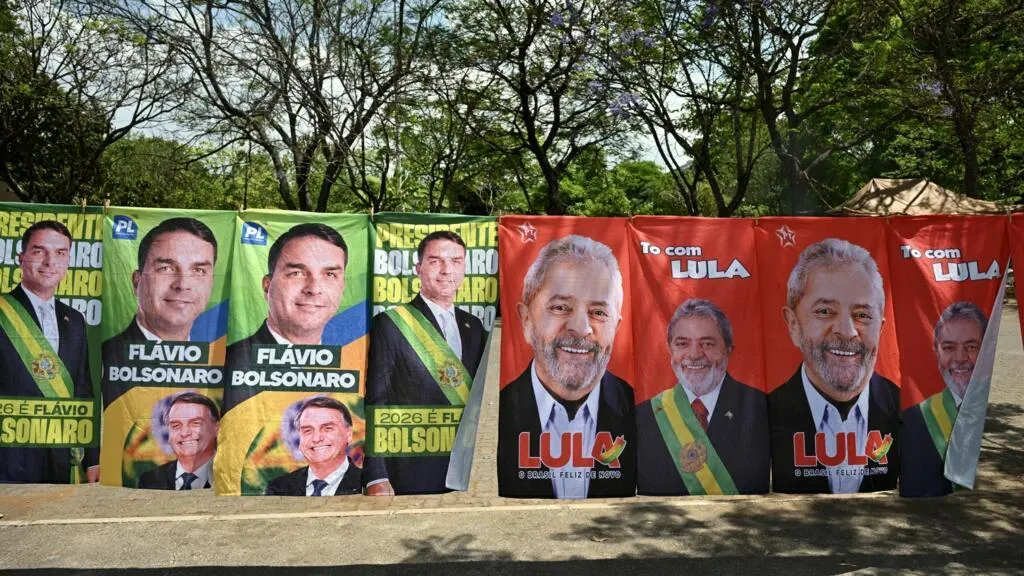
Lula, the 80-year-old leftist president seeking a fourth non-consecutive term, and Bolsonaro, a 45-year-old far-right senator, lead a field of 13. Lula is expected to narrowly lead the first round but is unlikely to win the majority needed to avoid a runoff. The Irish Times cited a separate poll giving Lula 39 per cent and Bolsonaro 34 per cent.13
Datafolha’s simulated runoff put Lula at 48 per cent and Bolsonaro at 45 per cent. The poll described that result as a technical tie because its margin of error was two percentage points. An Atlas survey separately put Bolsonaro at 47.7 per cent and Lula at 47.6 per cent. A runoff is expected on October 25 if no candidate wins more than half of valid first-round votes.111
Estimates of the undecided vote vary. The Straits Times put it at 5 per cent, while EL PAÍS cited a Quaest survey finding about 3 per cent. About 160 million Brazilians are registered to vote.1410
Household finances shape the campaign
Economic perceptions are central to the vote. Although unemployment stands at a reported historic low of 5.3 per cent and annual inflation is 4.22 per cent, only 10 per cent of Brazilians say their income rose faster than living costs during the past year. Average wages outpaced inflation during the first three years of Lula’s term, but economic growth, which accelerated after he took office, is now slowing.4567
Debt has added to the pressure. Rising household debt has added to the pressure on Lula.4567
Food prices have become campaign material. Picanha, a cut of beef associated in Brazil with prosperity, featured in a supermarket video in which Bolsonaro criticised high prices. Lula had used access to the same food as a campaign symbol four years earlier. University of São Paulo economist Laura Carvalho said voters often hold the government responsible for price rises.4567
The former president’s shadow
Flávio Bolsonaro is campaigning while his father remains in prison. According to The Guardian, a court found Jair Bolsonaro guilty of an attempted coup in September 2025; The Irish Times reported that his 27-year prison term stems from leading a bid to reverse his loss to Lula in 2022. Those accounts are single-source claims within the dossier.23
France 24 and The Straits Times reported that Flávio Bolsonaro was under investigation for corruption involving financing for Dark Horse, a planned biopic about Jair Bolsonaro. Flávio acknowledged asking Daniel Vorcaro to bankroll the film. Separately, The Straits Times said authorities were examining suspected money laundering connected to the Banco Master case, while federal police are investigating Lula’s son, Fábio Luís Lula da Silva, following claims that he traded on his influence. No outcome of either investigation is established in the dossier.14
Polarisation and international consequences
Lula and Bolsonaro used the final days before voting to discredit each other and pursue still-persuadable voters, but both declined to attend a televised debate. Lula expressed confidence that he would secure victory in the opening round. Bolsonaro vowed that Lula would be removed from the presidency and accused him of sexism after remarks about prostate and gynaecological examinations.14
Religion also became a focus of campaign misinformation. Rumours spread that Bolsonaro planned to strip Our Lady of Aparecida of her post; he denied the claim, and the electoral court ordered posts containing it removed. Lula has stronger support among Catholics, while Bolsonaro is backed by a growing Evangelical population.14
Relations with Washington have also entered the campaign. Donald Trump said he was watching Brazil’s election “very closely,” while Lula warned him not to interfere. Donald Trump called Jair Bolsonaro’s prosecution a “witch hunt.”34
Why it matters
The result may affect Europe’s planned trade relationship with South America. The Irish Times argued that Lula’s defeat could endanger the EU-Mercosur agreement, while European socialists would interpret his re-election as evidence that the region’s left remains electorally competitive.3
Videos
Related stories
Version history
- version 2 · The update adds Datafolha’s technical-tie runoff poll and the candidates’ final campaign clashes, joint debate absence, religious misinformation dispute and renewed focus on possible US interference.
- version 1 ·