World · Brazil
Lula wins Brazil runoff; Bolsonaro seeks annulment over voting extension
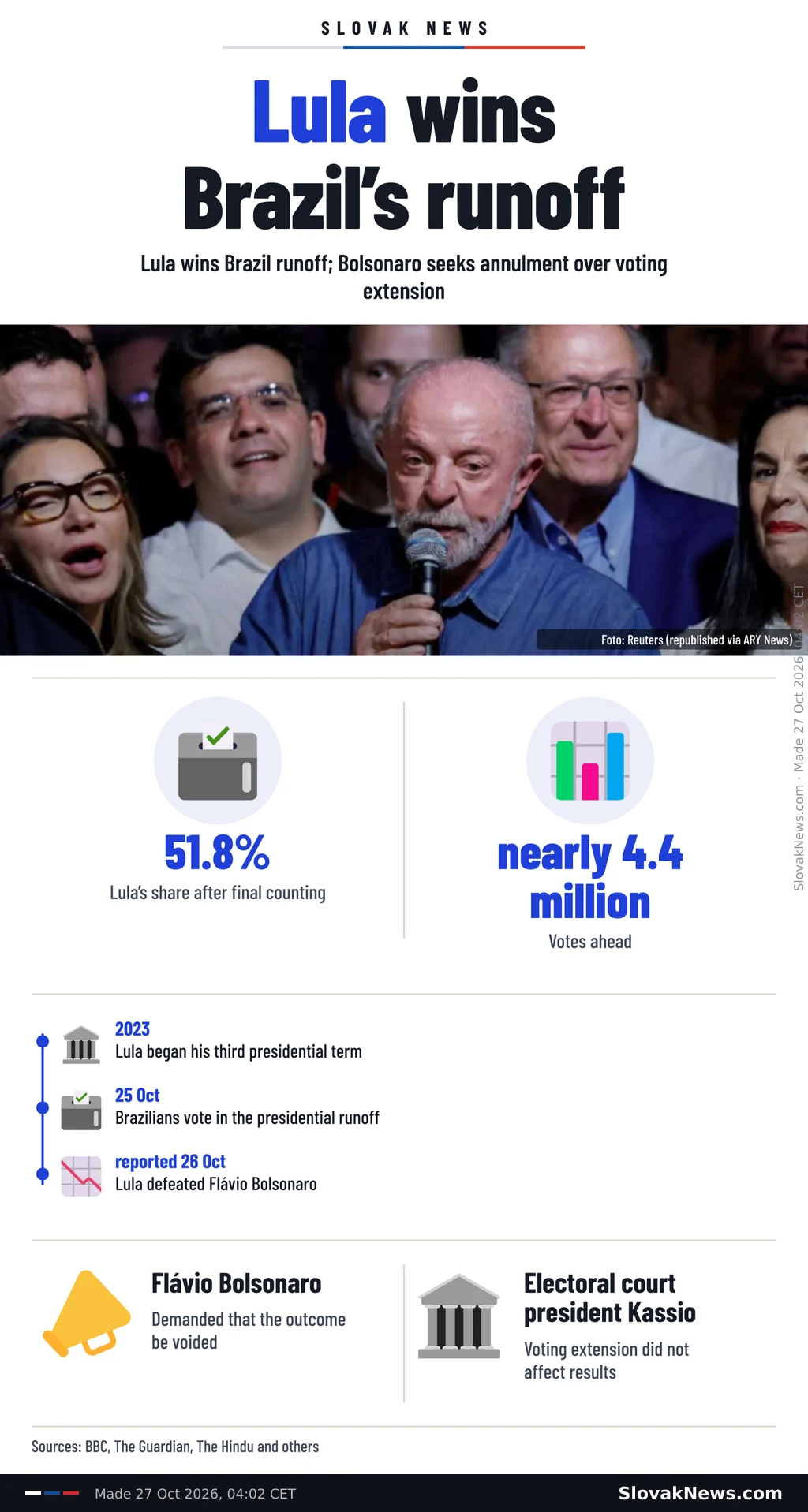
Lula received 51.8% with all votes counted, reports say. The electoral court’s president said the two-hour voting extension did not affect the result.
Listen to the story
Short version
Lula won Brazil’s runoff; Bolsonaro refused to concede and called for annulment. The electoral court’s president said extended voting did not affect the result.
- Lula received 51.8%, leading by nearly 4.4 million votes.
- Both campaigns requested extended voting hours.
- The two-hour extension also delayed vote tallying.
- Lula secured a fourth non-consecutive term.
Infographic
What's new
- Reuters, Fortune and Associated Press report that Lula won 51.8% of the vote, leading Bolsonaro by nearly 4.4 million votes with counting complete.
- Bolsonaro refused to concede and called for annulment; the dossier does not establish whether a formal court challenge has been filed.
- Electoral court president Kassio Nunes Marques said the extension did not affect the results, according to the new reports.
- Both campaigns sought longer voting hours: Bolsonaro after heavy rain in southern Brazil, and Lula after voter-transport problems in São Paulo and Salvador.
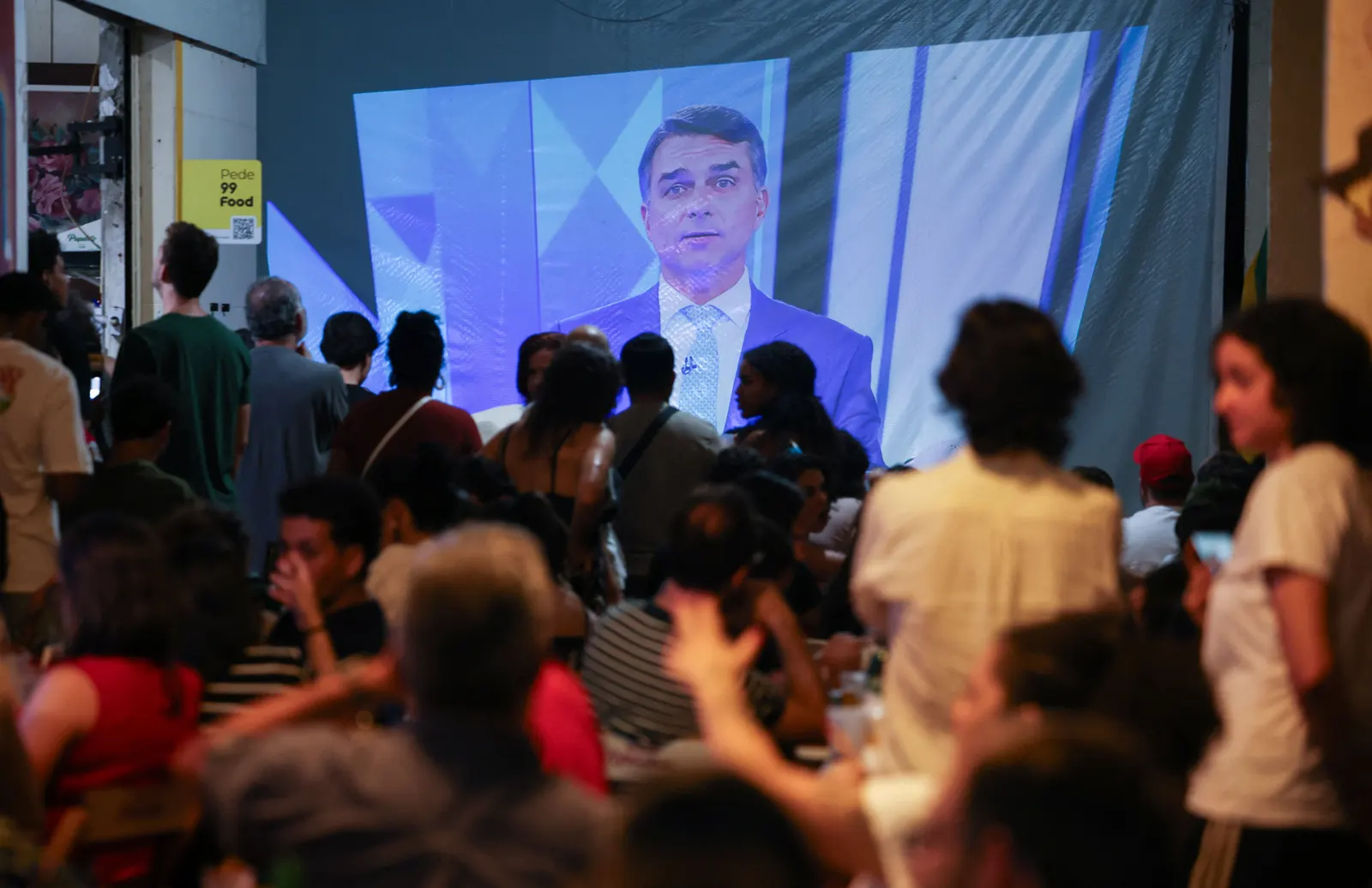
Reuters, Fortune and Associated Press said on October 26 that the completed count showed Luiz Inácio Lula da Silva had prevailed in Brazil’s presidential runoff, taking 51.8% and finishing almost 4.4 million votes ahead. Flávio Bolsonaro refused to concede and called for the results to be annulled over a two-hour voting extension. Electoral court president Kassio Nunes Marques said the extension did not affect the outcome.10611
Infographic
A changing electorate
Lula won the runoff despite finishing behind Bolsonaro in the first round, The Japan Times reports. The newspaper describes his fourth-term victory as a comeback amid voter dissatisfaction with rising prices and years of corruption scandals involving Lula and the Workers’ Party.7
Brazil’s electoral court confirmed Lula’s victory. With all votes counted, he received 51.8% and led Bolsonaro by nearly 4.4 million votes, Reuters, Fortune and Associated Press report. Middle East Eye previously reported 51.78% for Lula and 48.22% for Bolsonaro, and says his next term begins in January 2027.106119
In Osasco, a municipality in São Paulo state, the BBC reports that voters backed Lula in 2022 but favoured Bolsonaro in this month’s first round. Its account describes factories giving way to shopping centres and delivery-app businesses, alongside a workforce increasingly employed in services rather than industry.1
Gilberto Almazan, a local metalworkers’ union leader and longstanding Lula supporter, told the BBC: “The profile of the working class changed. Most now work in the service sector rather than in industry.” The BBC attributes working-class discontent to expensive goods, taxation, household debt and borrowing costs.1
Among those changing their political allegiance is Robson, a municipal employee who previously supported Lula, according to the BBC. The broadcaster also interviewed Tairine, a hot-dog seller who had abstained but now plans to support Bolsonaro, and Gisele Bonfim, a lawyer who switched from Lula to his rival.1
Competing economic offers
Bolsonaro finished ahead of Lula in the first round. The Guardian reports a lead of less than two percentage points, differing from the Durango Herald's reported 47% for Bolsonaro and 45% for Lula. According to the BBC, Bolsonaro proposes reducing public spending, the number of ministries and some taxes, while keeping some welfare programmes associated with Lula.125
The BBC reports that unemployment reached a record low during Lula's current presidency and that Brazil was taken off the United Nations Hunger Map. The Durango Herald says his administration increased Bolsa Família payments, reduced fuel taxes and forgave small-business debts.15
Support for Lula remains visible in Maré, in Rio de Janeiro. Vitoria, an 18-year-old mother earning less than £300 a month, told the BBC that his government had raised the minimum wage, provided two days off for workers and made essential medicines available without charge.1
The Hindu reports that Lula expanded welfare programmes during the campaign. It also says Amazon deforestation has fallen to its lowest level in four decades under his presidency, even as El Niño-fuelled fires have left Amazonian cities covered in smoke.3
Reaching those who stayed home
The Guardian puts the electorate at 159 million and reports that first-round abstention reached a record high, disproportionately affecting Lula's voters. According to the BBC, 33 million people abstained from the opening round.12
Before the runoff, The Guardian reported that Lula had gained ground while Bolsonaro stagnated in polls, leaving the race virtually tied. Both candidates attracted large crowds to their final campaign rallies. Lula subsequently won the runoff, according to The Straits Times and The New York Times.284
Lula’s campaign has brought supporters, especially students, onto the streets, the BBC reports. In Maré, where Lula won despite above-average abstention, resident Andreza Dionísio attributed non-participation to changed polling locations and hopelessness. Lula supporter Leila described the campaign’s task to the broadcaster: “Our fight is to make those people believe their vote changes things.”1
Lula also revamped his social-media strategy, The Hindu reports. His campaign accused Meta of manipulating algorithms to favour Bolsonaro. Meta denied that allegation but acknowledged technical errors that mistakenly deactivated some Lula campaign advertisements, according to the newspaper.3
Bolsonaro’s final push and court pledges
Bolsonaro campaigned in Belo Horizonte on the eve of voting, while supporters rallied in Barra de Tijuca, the BBC reports. He promised a tougher response to organised crime alongside tax and public-spending cuts.1
Bolsonaro has promised to pardon his father if elected, The Guardian reports. According to the newspaper, Jair Bolsonaro was placed under house arrest for a 27-year term after trying to reverse his loss to Lula in 2022 through a coup. The Hindu reports that Flávio Bolsonaro also intends to seek the impeachment of Alexandre de Moraes, the Supreme Court judge who oversaw his father's case.23
The Guardian and the Durango Herald report that authorities are investigating Flávio Bolsonaro over alleged corruption, laundering of money and evasion of taxes. The BBC reports that he denies corruption accusations.125
During the campaign, Bolsonaro vowed to change the constitution and said he wanted to re-democratise Brazil, The Guardian reported. He has now refused to concede and called for the results to be annulled, according to Reuters, Fortune and Associated Press. The dossier does not establish whether a formal legal challenge has been filed or how Donald Trump has responded to Lula’s victory.210611
Supreme Court justice Cristiano Zanin ordered a two-hour voting extension three minutes before polls were scheduled to close, also delaying vote tallying by two hours, Reuters, Fortune and Associated Press report. Both campaigns had requested extra time: Bolsonaro after heavy rain in southern Brazil, and Lula after problems with buses transporting voters in São Paulo and Salvador. Bolsonaro nevertheless alleged that the Supreme Court had improperly changed the rules in Lula’s favour, according to Middle East Eye.106119
Electoral court president Kassio Nunes Marques said the extension did not affect the results. Reuters, Fortune and Associated Press describe the extension as unusual but report little legal basis for invalidating the election without evidence that it affected voters’ free choice. They also report that Bolsonaro could seek a recount with evidence of fraud, though a recount might not alter the outcome.10611
Regional leaders welcome Lula’s victory
Leaders from Mexico, Paraguay, Bolivia, Cuba and Panama welcomed Lula’s victory, according to The Straits Times. Mexican President Claudia Sheinbaum hailed the outcome as a democratic triumph, while Uruguayan President Yamandú Orsi said he congratulated Lula during a conversation with him.8
Paraguayan President Santiago Peña emphasised the countries’ shared agenda of integration and development, while Bolivian President Rodrigo Paz highlighted their common history and challenges, The Straits Times reports. The New York Times says Lula’s victory ended a string of conservative election wins in Latin America.84
Why it matters
Lula’s victory broke a succession of conservative election wins in Latin America, The New York Times reports. According to The Guardian, Brazilians chose to give Lula another term instead of electing a rival who had vowed to amend the constitution and pardon his father, Jair Bolsonaro, now serving a prison term for a coup attempt aimed at reversing his 2022 election loss.42
Related stories
Version history
- version 6 · This update adds the completed count, corroboration of Bolsonaro’s rejection, both campaigns’ reasons for requesting extra voting time, and the electoral court president’s response.
- version 5 · This update adds reported vote shares, electoral court confirmation, Bolsonaro’s refusal to concede and planned annulment challenge, and details of the voting extension.
- version 4 · The update replaces the election-day lead with Lula’s runoff victory and fourth term, adds regional congratulations, and distinguishes pre-election concerns from unresolved post-election responses.
- version 3 · The update leads with Lula's polling gains in a virtually tied runoff, qualifies disputed first-round figures, adds Bolsonaro's constitutional and pardon pledges, and updates source references.
- version 2 · The update leads with runoff-day reporting and tight final polls, adding Bolsonaro’s court-related pledges, Lula’s environmental record and the disputed Meta advertising issue.
- version 1 ·