Business · United Kingdom
Britain weighs Chinese EV tariffs as pressure from EU grows
Ministers are considering duties on Chinese electric vehicles while seeking to protect access to European markets and attract automotive investment.
Britain is weighing tariffs on Chinese electric vehicles as the EU presses for closer alignment. Ministers must balance European market access against prices, Chinese retaliation and investment.
- No British tariff has yet been imposed.
- Reynolds is preparing possible duties on Chinese vehicles.
- Ministers could match an EU levy of about 45%.
- The EU takes most British car exports.
- Chery is discussing possible production in Sunderland.
What's new
- Britain is considering tariffs on Chinese electric vehicles.
- Jonathan Reynolds is preparing possible duties, according to reports.
- Ministers could match an EU levy of about 45%.
- No British tariffs have yet been imposed.
Britain was reported on Oct. 4 to be considering tariffs on Chinese electric vehicles entering the UK, as Business Secretary Jonathan Reynolds prepared possible measures and ministers faced pressure to align more closely with European Union trade policy. The government said no such tariffs had yet been imposed.23
Pressure from Brussels
The reports said ministers were prepared to match an EU levy of about 45% amid concerns in Britain that Chinese manufacturers were selling state-supported vehicles into the market. The government has said its response should be determined by the interests of the automotive sector and the country rather than by automatically following the EU.23
Brussels urged Prime Minister Andy Burnham in September to raise tariffs on Chinese cars and bring British trade policy closer to the EU’s approach. Burnham said he would argue for Britain to be treated as a “trusted partner” under proposed European rules intended to give priority to goods made in the bloc and reduce dependence on Chinese components.23
The Guardian reported that EU officials had warned Britain it could face barriers affecting its exports unless it imposed duties on lower-priced Chinese vehicles. The proposed Made in Europe approach has been described as limiting subsidies, tax incentives and public procurement contracts to vehicles built in the EU. The Straits Times reported that the proposals could affect British companies selling into the bloc.12
The EU introduced tariffs on Chinese electric vehicles in 2024. CnEVPost reported that additional countervailing duties of 7.8% to 35.3% were imposed for five years, producing a maximum total tariff of 45.3% when combined with the standard 10% import duty. Britain did not introduce equivalent additional duties at that time and has retained a less punitive standard tariff system, according to the South China Morning Post.45
A market-access calculation
Britain’s car industry depends more heavily on European than Chinese demand. According to The Guardian, the EU took 58% of UK car exports during the first half of 2026, while China accounted for about 4%. The newspaper reported that the close integration of British and EU automotive production meant excluding UK-made vehicles from European support or procurement arrangements could hurt businesses on both sides.1
Reynolds has also cautioned that British duties would “probably be reciprocated”, potentially reducing manufacturers’ sales in China. The Guardian reported that tariffs could increase vehicle prices for British drivers and discourage further investment by Chery, although those outcomes have not been established.1
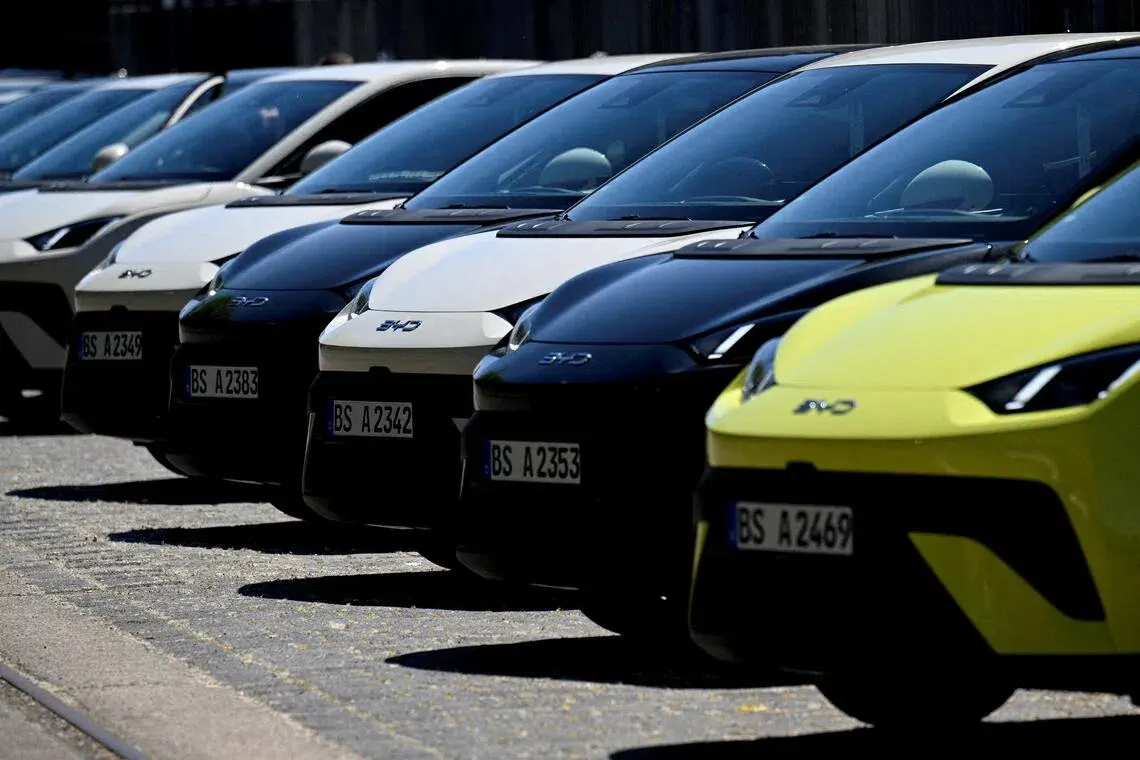
Chinese brands have expanded their position in Britain. BYD, Omoda and Jaecoo accounted for 12% of new-car sales during the first eight months of 2026, according to The Guardian. Separately, the South China Morning Post reported that Chinese-made cars represented 14% of British new-car sales in 2025, while CnEVPost put Chinese manufacturers’ combined share this year at 16%. The figures cover different periods and groupings.145
The increase came as British new-car registrations rose 12% year on year in September, the strongest annual-growth month since 2017, according to The Guardian. The newspaper also reported that EU tariffs had slowed a previously accelerating rise in Chinese electric-car sales, while imports of plug-in and battery hybrids increased sharply after those duties were introduced.1
Investment and production
The tariff decision also intersects with efforts to secure Chinese investment. Chery, which owns the Omoda and Jaecoo brands, was reported on Oct. 4 to be in talks about building cars at Nissan’s Sunderland plant. CnEVPost said Britain had sought to bring Chery production to that site, while also reporting that higher duties could complicate attempts to attract Chinese automotive capital.15
Victor Zhang of Chery said most of the company’s British sales were super-hybrids rather than vehicles targeted by the proposed tariffs, and that cars sold in Britain remained there. He said Chery would not alter its continuing UK investment because tariff policies could change.1
Industry figures have presented opposing risks. Tim Tozer said tariffs were essential to prevent further decline in British carmaking. Nissan’s European chair, Massimiliano Messina, warned that Britain could become a route for Chinese vehicles into the EU and called for tariff-policy changes. Mike Hawes said excluding British production from the EU market “would assure mutual damage”.15
Why it matters
According to The Guardian, the EU accounted for 58% of British car exports in the first six months of 2026, making access to that market crucial for UK vehicle production. Tariff alignment could help Britain avoid discriminatory treatment under proposed EU rules, but it could also raise UK prices, invite Chinese retaliation and complicate Chinese investment.12
Related stories


Version history
- version 1 ·