World · Israel
Israeli judges urge prosecutors to reconsider Netanyahu corruption cases
Judges have recommended dropping bribery charges in one case and reassessing the others. Attorney general Gali Baharav-Miara is considering their recommendations.
Listen to the story
Short version
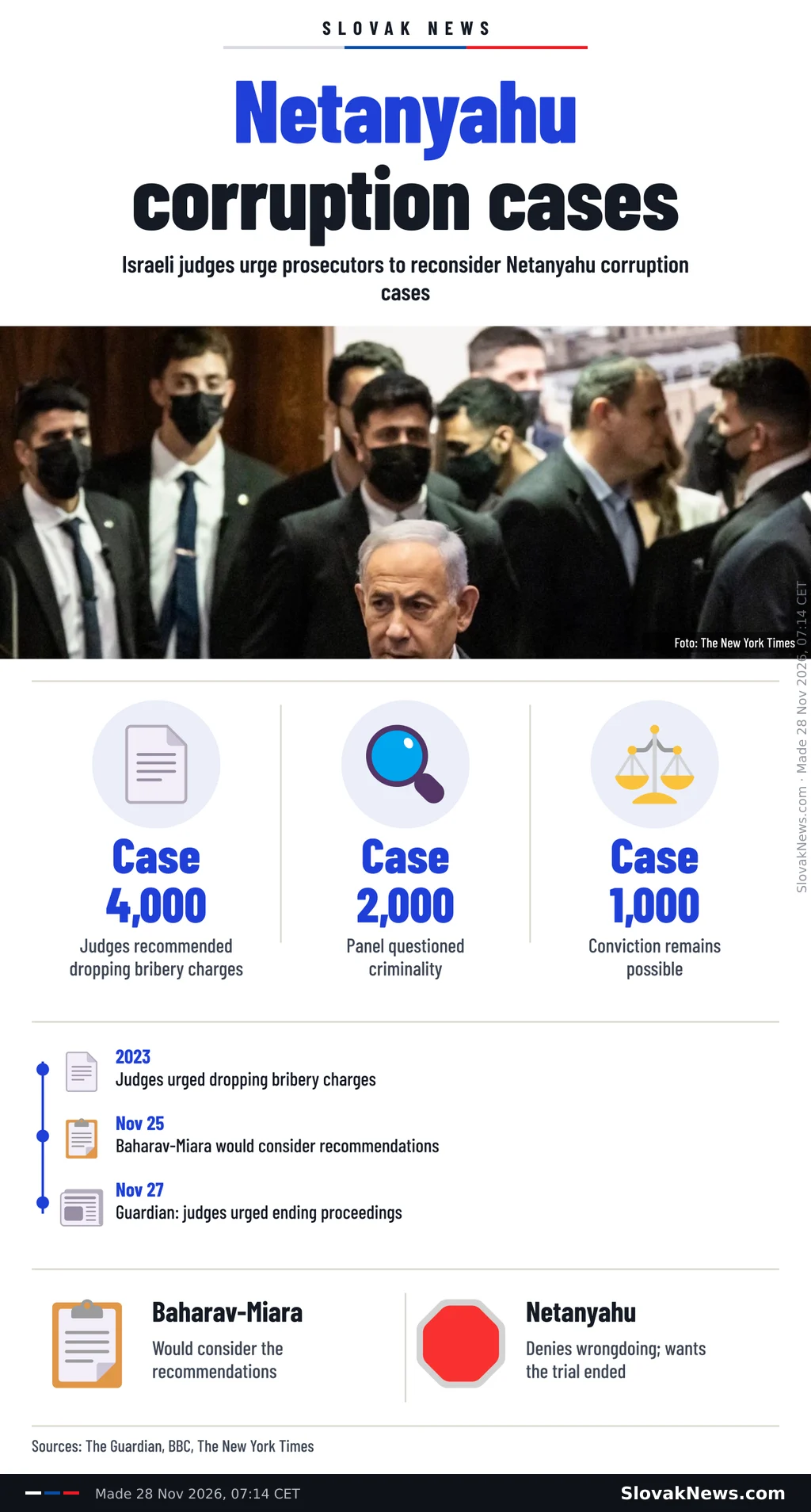
Israeli judges have recommended dropping bribery charges in one Netanyahu case and reassessing others. The attorney general is considering their recommendations.
- Judges see little prospect of conviction in Case 4,000, according to the BBC.
- The panel questioned criminality in Case 2,000.
- Conviction remains possible in Case 1,000.
- Netanyahu denies wrongdoing and wants the trial ended.
Infographic

What's new
- Judges recommended dropping bribery charges in Case 4,000, the BBC reported on November 25.
- The panel questioned whether the conduct alleged in Case 2,000 was criminal.
- Baharav-Miara said she would consider the recommendations, according to the BBC.
Israeli judges have recommended that prosecutors drop bribery charges against Benjamin Netanyahu in one of three corruption cases, the BBC reported on November 25, 2026. The panel in Jerusalem also questioned another case and raised the possibility of a plea agreement in the remaining proceedings.2
Infographic
Different recommendations for three cases
The BBC reported that the judges summoned attorney general Gali Baharav-Miara to discuss their concerns and told her that a conviction in Case 4,000 was unlikely. That case alleges Netanyahu provided government favours in return for favourable media coverage. Netanyahu denies the allegations against him.2
The panel also questioned whether Netanyahu’s alleged actions in Case 2,000 constituted a crime. In Case 1,000, however, the judges did not rule out a conviction. According to the BBC, that case concerns allegations that Netanyahu acted on behalf of an Australian billionaire after accepting cigars and champagne from him.2
Reporting on November 27, the Guardian described the panel’s intervention as a call to bring the proceedings to an end: prosecutors were urged to abandon one case, pursue a plea agreement in another and reassess the remaining charges. Baharav-Miara must decide whether to accept those recommendations, the newspaper reported.1
A trial spanning years
Netanyahu was first charged in 2019, according to the BBC. He faces accusations of bribery, fraud and breach of trust across the three cases and has pleaded not guilty, the Guardian reported. The judges had previously urged prosecutors to withdraw bribery charges in 2023, without then recommending an end to the entire trial.12
The Guardian reported that Netanyahu’s testimony ran across 98 hearings over a year and a half, while the hearing transcripts totalled more than 60,000 pages. According to the BBC, the Israel-Gaza war contributed to delays, and judges agreed to hold fewer hearings because of security concerns connected to the conflict.12
Decision rests with the attorney general
Baharav-Miara said she would consider the panel’s recommendations, the BBC reported. Netanyahu called for the trial to end and characterised the cases as fabricated. By November 27, the Guardian reported that he had welcomed the judges’ intervention as vindication, saying: “The truth has finally come to light”.12
The intervention comes amid uncertainty over Israel’s next administration. According to the BBC, Netanyahu’s parliamentary bloc secured more seats than its rival, but neither obtained an outright majority. Israel’s president gave Gadi Eisenkot the first opportunity to form a government, and he had begun coalition-building efforts by November 25.2
Why it matters
For European readers following Israeli politics, the recommendations concern a trial that has contributed to political divisions while Netanyahu has remained in office during the Gaza war, according to the BBC. They also coincide with efforts by his opponent Gadi Eisenkot to assemble a governing coalition after an inconclusive election.2
Videos
Related stories

same actors
same actors

Version history
- version 1 ·