World · Latvia
Latvia votes as Russia security concerns shape parliamentary election
Latvians are choosing a 100-member parliament after a campaign focused on drone incursions, support for Ukraine and living costs. Polls place Prime Minister Andris Kulbergs’s United List ahead, but coalition talks are expected.
Listen to the story
Short version
Latvia is choosing a new parliament in an election centred on Russia, Ukraine, drones and living costs. The United List leads, but a fragmented result could complicate coalition formation.
- The election fills all 100 Saeima seats.
- The United List leads, but polling estimates differ.
- Sovereign Power challenges continued assistance for Ukraine.
- Coalition arithmetic depends on the 5% threshold.
- Russian-speaking voters face a fragmented political field.
Infographic
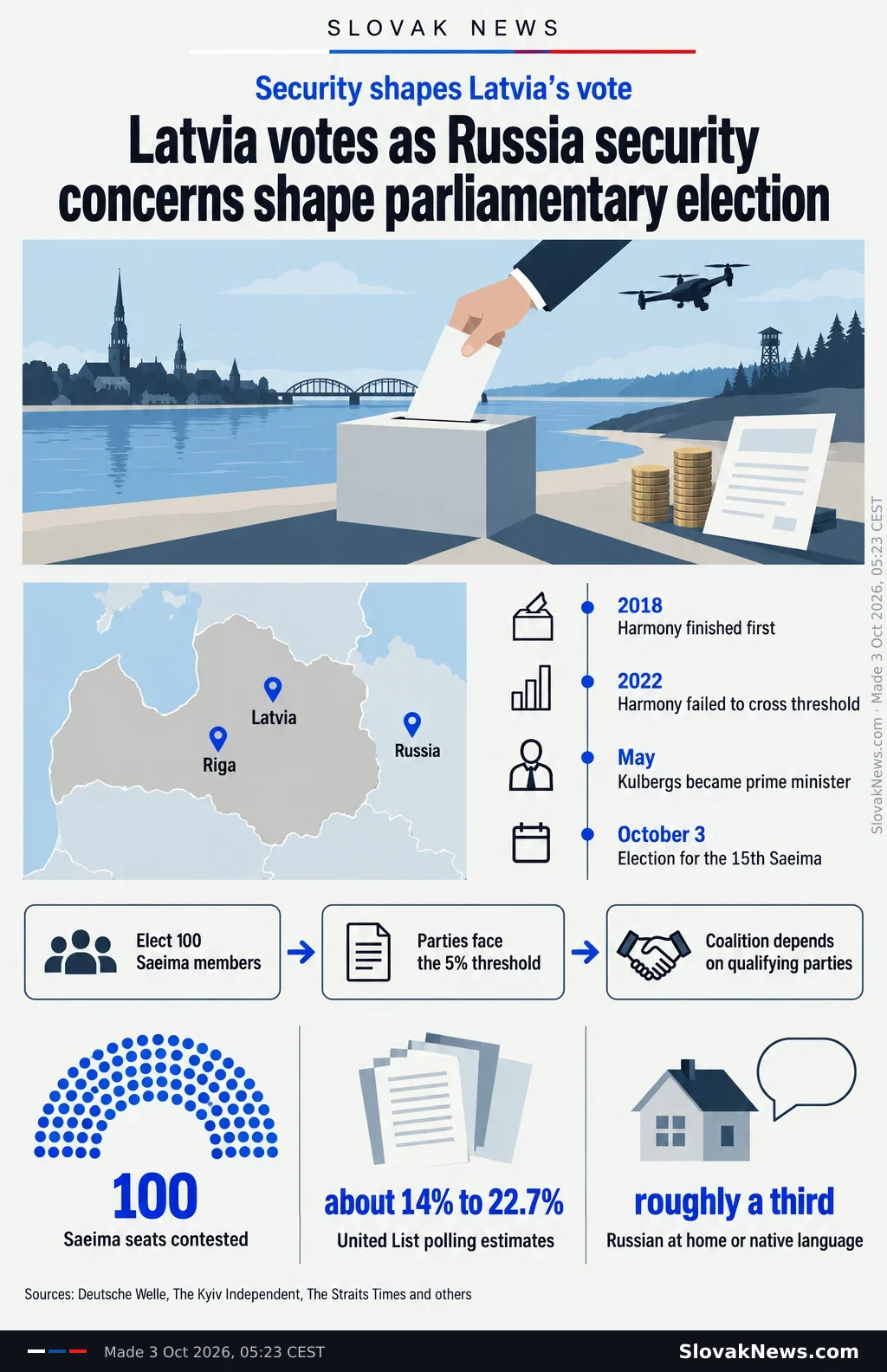
What's new
- Voting is taking place on October 3 for Latvia’s 15th Saeima. [s3, s4]
- Polls place the United List first, though estimates of its support vary. [s2, s3]
- The next government’s composition depends on which parties clear the 5% threshold. [s3]
Latvians voted on October 3, 2026, to elect all 100 members of the Saeima, the country’s parliament, after a campaign dominated by security concerns involving Russia, military drones and the cost of living. Prime Minister Andris Kulbergs’s United List entered election day ahead in opinion polls, although the fragmented field could make forming a government difficult.234
Infographic
Security at the centre of the campaign
The election is Latvia’s second since Russia began its full-scale invasion of Ukraine. Latvia borders Russia and Belarus, and roughly one-third of its 1.8 million residents speak Russian as their first language, according to The Kyiv Independent. Latvian intelligence warned in June that Moscow might be preparing hybrid operations or incursions targeting Poland and the Baltic countries, while Latvia has said it has detected no indication of an imminent conventional Russian attack.2
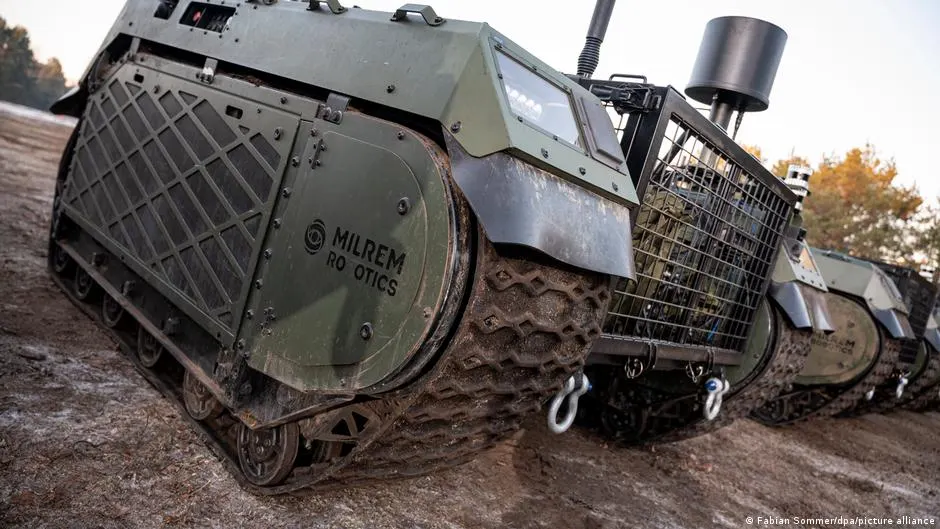
The campaign has also been shaped by military drones entering Latvian airspace. The Straits Times reported that the drones were Ukrainian and that Latvian officials blamed Russia for diverting them from their intended routes. Several stray drones have been brought down by NATO aircraft in Latvian airspace, according to The Kyiv Independent. Russia says claims that it intends to attack NATO are unfounded, while Western officials say it lacks the capability for a direct assault on the alliance.23
Kulbergs, who became prime minister in May after the previous coalition fell apart over its response to drone incidents, has campaigned for expanded anti-drone defences and military spending equal to 5% of gross domestic product. He has also promised continued assistance for Kyiv, saying: “We have to give Ukraine everything necessary right now (so) that they can have the upper hand and win”.23
A fragmented contest
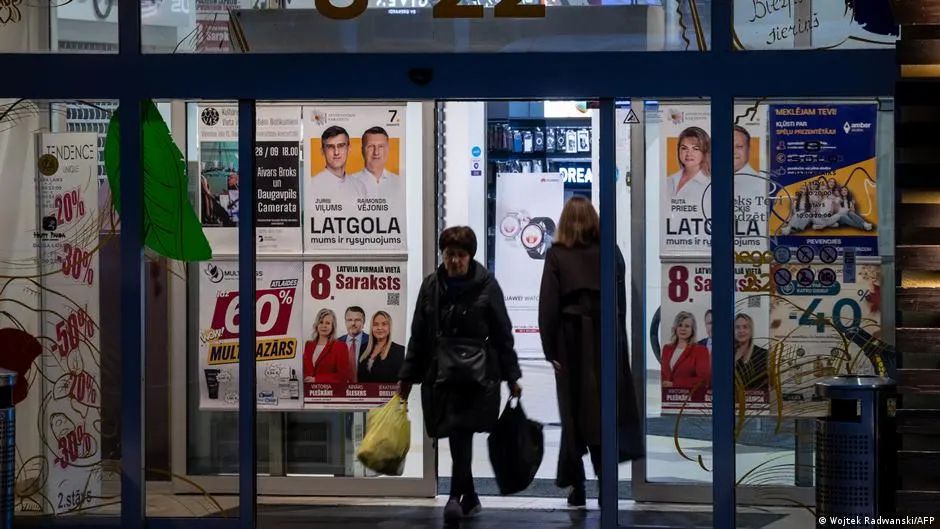
Polling consistently placed the centrist United List first, but the reported margins varied. A September SKDS/LSM survey cited by The Kyiv Independent gave the party 22.7%, while The Straits Times reported polling at about 14%. Sovereign Power/Young Latvians ranked second in both accounts, receiving 14.1% in the September survey and running close behind the United List in other polling.23
Seven of the 14 competing parties were expected to secure representation, according to The Kyiv Independent. The centre-left Progressives were polling at about 10%, while Latvia First and the Progressives were among the additional parties that The Straits Times said could enter parliament. Coalition options will depend on the distribution of votes and the number of parties surpassing the 5% threshold.23
Sovereign Power leader Julija Stepanenko has argued against completely ending economic links with Russia and Belarus. She said voters wanted peace and fewer air alerts, and maintained that Ukraine should prevail through negotiations rather than continued financing of the conflict. Kulbergs has called Sovereign Power “a threat to Latvia's security and democracy”, while The Kyiv Independent described it as the only significant political force opposing assistance to Ukraine.123
Trade and economic pressures
The cost-of-living crisis has accompanied security policy as a major election issue. Latvia First, led by former businessman Ainars Slesers, has advocated economic growth, investment and a pragmatic approach to Russia. In September, Slesers argued that goods should continue to transit between Latvia and Russia where European Union sanctions do not prohibit the trade.12
According to Deutsche Welle, Latvia’s imports from Russia and Belarus have fallen by over 90% since 2022. The outlet also cited polling indicating that 60% of Latvians want less dependence on Russia, while 20% support closer relations. The Kyiv Independent reported that Latvia briefly held up requests to remove two Russian oligarchs from the EU sanctions list before imposing its own measures once they were delisted by the bloc.12
Russian-speaking voters reassess their choices
Meduza reported that some Russian-speaking voters who support Ukraine but also want to preserve the place of the Russian language do not see a clear political choice. Harmony, once the leading party for many Russian-speaking voters, condemned Russia’s invasion on February 24, 2022, a position that split the party and alienated some Kremlin supporters. It subsequently received 4.81% in the 2022 parliamentary election and failed to enter the Saeima.4
Other organisations have since sought support from Russian-speaking voters. For Stability!, Sovereign Power/Young Latvians and Latvia First secured seats in Riga’s 2025 city council elections. In September 2026, people close to former politician Tatjana Ždanoka joined the Sovereign Power/Young Latvians slate; Latvia’s State Security Service opened an investigation in 2024 into her possible cooperation with Russian intelligence after The Insider published allegations about her contacts.4
Despite disagreement over trade, sanctions and aid to Ukraine, Deutsche Welle and The Kyiv Independent assessed that Latvia’s overall foreign-policy direction was unlikely to change substantially after the election. The immediate uncertainty is instead which parties will be able to assemble a parliamentary majority around the poll-leading United List.123
Why it matters
Latvia borders Russia and Belarus and is part of NATO’s eastern flank, making its defence policy and response to drone incursions relevant across Europe. The election will also shape Latvia’s support for Ukraine, its application of sanctions and its approach to remaining economic links with Russia.123
Videos
Related stories
background
background
Version history
- version 1 ·