Slovakia · Slovakia
Slovakia to Halve Second-Class Train Fares for One Month
The Slovak government has approved a temporary 50 percent cut in domestic second-class rail fares for October, though officials acknowledge the measure will not help residents of districts with no passenger trains.
Slovakia's government has approved a temporary 50 percent cut to domestic second-class train fares, running from 1 October to 31 October. ZSSK says the reduction changes fare prices directly, covers basic and discounted fares as well as weekly and monthly tickets, but excludes first class, international travel and several other ticket types. The operator does not plan to add trains and will monitor demand as the measure proceeds.
Officials acknowledge the discount will not help everyone: STVR reported that four districts, Námestovo, Svidník, Sobrance and Stropkov, have no railway infrastructure, and some towns such as Veľký Krtíš have unused tracks. The transport ministry is separately discussing a possible 30 to 50 percent discount for buses with regional governments, with a final government decision still pending.
Slovakia's government has approved a one-month, 50 percent cut to domestic second-class train fares from 1 October, while acknowledging it will not help districts without rail service.
- Second-class ZSSK fares halved from 1 to 31 October only
- First class, international and several ticket types excluded
- Four districts have no railway infrastructure at all
- ZSSK will not add trains, just monitor demand
- Bus fare discount of 30–50 percent under discussion
What's new
- Government approved a one-month, 50 percent cut to domestic second-class train fares from 1 October
- ZSSK confirmed the fare price itself is halved, not stacked with existing discounts
- Officials say some districts without rail lines will not benefit, and a bus-fare discount is being discussed
- Transport minister must prepare costings before a final government decision at an off-site meeting
The Slovak government approved on Wednesday 23 September a temporary halving of domestic second-class train fares, to run from 1 October to 31 October, while acknowledging that residents of several districts without passenger rail service will not benefit from the measure.234
What changes from 1 October
From 1 October, passengers will pay 50 percent less for domestic second-class fares on ZSSK trains, according to the rail operator. The reduction applies to basic and paid discounted fares, and to single and time tickets, while passengers who already travel with a 100-percent discount will see no change in their conditions.23
ZSSK spokesman Ján Baček said the change alters the fare price directly rather than adding one discount on top of another: "Nejde pritom o sčítavanie zliav. Na obdobie od 1. do 31. októbra sa mení priamo cena príslušného cestovného." He gave an example: a passenger who now pays a basic fare of ten euros for a given journey will pay five euros from 1 October, while a student paying five euros under the discounted fare will pay 2.50 euros. Final amounts will be rounded down to 0.05 euros.23
The reduction also covers weekly and monthly second-class route tickets, including relevant pupil tickets, as well as single and time network fares for persons on the Tatranské elektrické železnice and the ozubnicová železnica, where new prices will be set in ticket machines from 1 October. It does not apply to first-class fares, international fares, Maxi Klasik tickets, seat reservations, sleeper and couchette tickets, higher-category train surcharges, service fees or supplementary services.23
Adjusted fares will be available through the ZSSK app, e-shop, ticket offices, onboard trains, SMS, FAIRTIQ, Slovenská pošta and other standard sales partners, but cannot be bought in advance before 1 October. Tickets already bought at the original price remain valid and will not be repriced retrospectively.23
ZSSK said it cannot reliably predict in advance how the lower fares will affect passenger numbers. Baček said the company will monitor passenger frequency, ticket sales and occupancy of individual services from the start of the measure, and does not plan to add new trains in connection with the reduction, instead reassessing capacity according to actual demand, available vehicles, staff and infrastructure. On routes and at nodes where closures are under way, the operator said possibilities for increasing capacity are limited.235
Districts without rail service
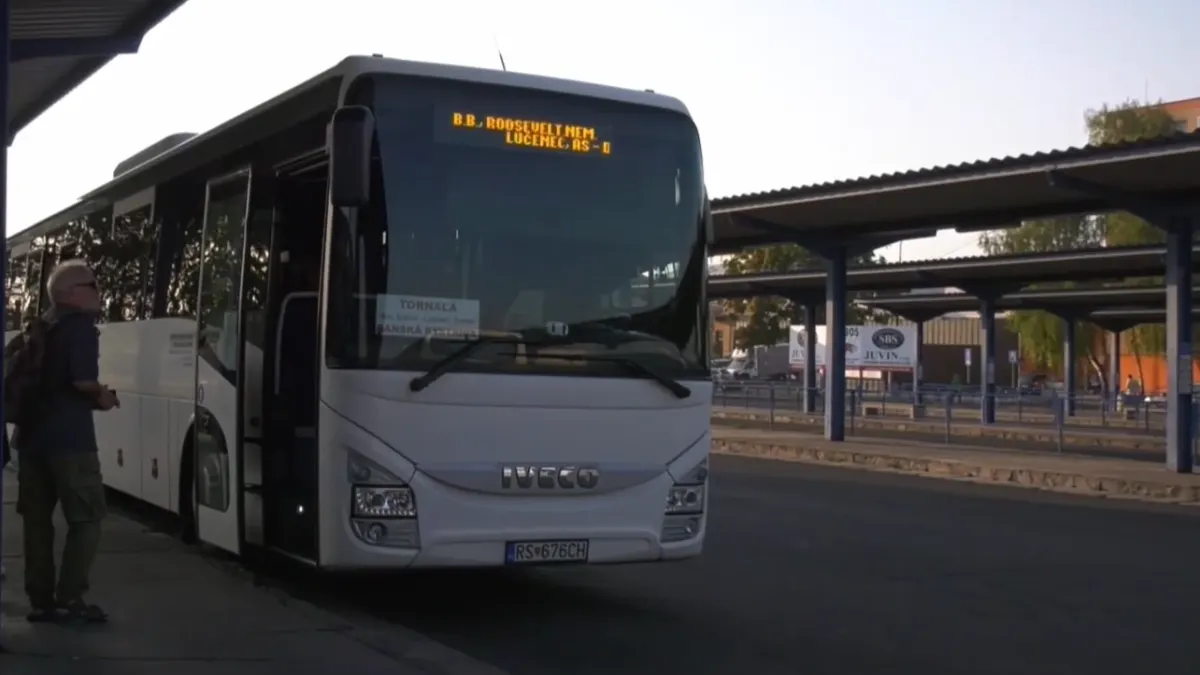
According to STVR, the discount will not help residents of some regions because no trains run there. The report named four districts without built railway infrastructure: Námestovo, Svidník, Sobrance and Stropkov, whose residents have no option other than travelling by car or bus.1
One resident contacted by STVR said they would prefer lower prices for oil or diesel, while another said buses should also be made cheaper, adding that this might reduce car use. STVR also reported that some Slovak towns have railway tracks but no passenger trains running on them; Veľký Krtíš has had unused tracks for almost 35 years. The town's mayor, Dalibor Surkoš, said the discounts "will not help citizens of the city or district at all" and that the best solution would be for the R7 expressway to be completed along its full route to the R2 and to Lučenec.1
Possible bus discounts
STVR reported that the transport ministry is preparing a separate discount for bus transport and is in intensive contact with the leadership of self-governing regions. Transport minister Jozef Ráž, a Smer-SD nominee, said the ministry's proposal envisages a 30 to 50 percent reduction for suburban buses on a monthly basis and a 50 percent reduction for city public transport. He said: "Zatiaľ to vyzerá, že sa nám riešenie darí nájsť." The government is to make a final decision at an off-site meeting, and until then the minister has been tasked with calculating the cost of the measure to the state.1
Why it matters
The measure shows a government responding to high fuel costs by subsidising rail travel, but officials themselves acknowledge it will not reach residents in areas without passenger rail lines. Its temporary, month-by-month design means the wider effect on travel patterns and public transport funding across Slovakia remains to be tested.124
How the story unfolded
The story's events over time. Click a person, place or related story.
What we know
- The government approved a temporary 50 percent cut to domestic second-class train fares for 1–31 October.
- The reduction changes the fare price directly and does not stack with other discounts.
- ZSSK will monitor passenger numbers and occupancy but does not plan to add trains.
- Several fare and ticket categories, including first class and international travel, are excluded.
- Some districts without rail infrastructure will not benefit from the measure.
- A discount for bus and city public transport is being discussed with regional authorities.
What we don't know yet
- Whether or how a bus transport discount will be implemented and at what final rate.
- Whether the train fare reduction will be extended beyond October.
- How the measure will affect residents of districts without rail infrastructure.
- The exact cost of the fare and possible bus measures to the state budget.
Timeline
- Sep 22The material on temporary rail fare adjustment was approved with a comment by government deliberation.6
- Sep 23The government approved the temporary fare adjustment; Fico announced the 50 percent cut in second-class fares for October and other fuel-price measures.45
- Sep 25STVR reported that some districts will not benefit from the discount because trains do not run there, and that a bus discount is under consideration.1
- Sep 26Pravda reported details of how ZSSK will apply the fare reduction from 1 October.2
- Sep 27ta3 reported that fares fall to half from Wednesday, for one month, in second class only.3
Quotes
Zatiaľ to vyzerá, že sa nám riešenie darí nájsť,
Nejde pritom o sčítavanie zliav.
Na obdobie od 1. do 31. októbra sa mení priamo cena príslušného cestovného.
Ak napríklad cestujúci za konkrétnu cestu dnes zaplatí základné cestovné desať eur, od 1. októbra zaplatí päť eur.
Videos
Version history
- version 1 · 27 September at 07:39