World · Ukraine, Russian Federation
Ukraine's Steel Output Halts After Russian Strikes on Plants
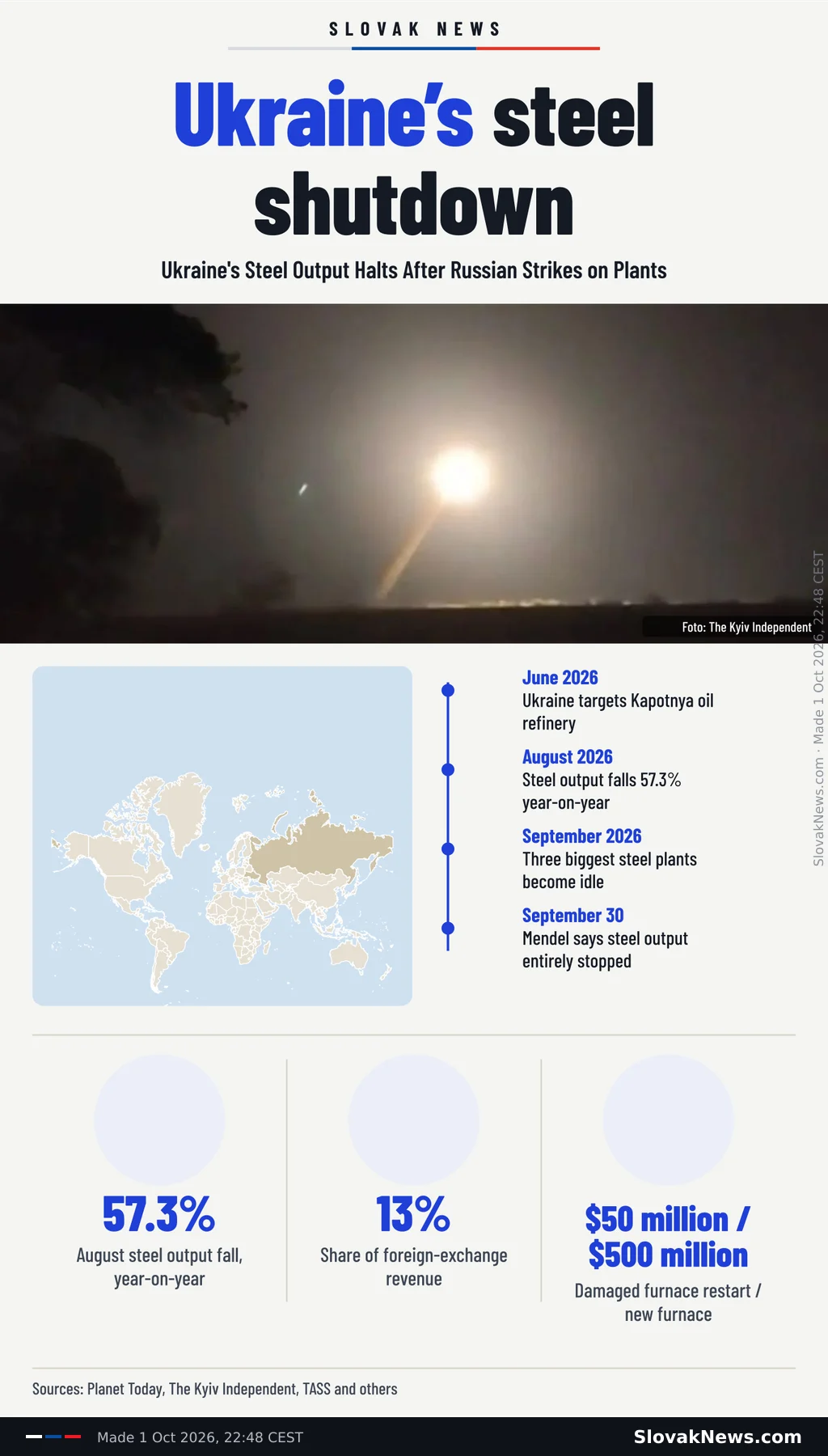
Russian missile attacks have idled Ukraine's three largest steelmakers, with a former presidential spokeswoman saying the country produced no steel at all for a week in September for the first time in a century.
Listen to the story
Short version
Russian strikes have idled Ukraine's three biggest steel plants, and a former presidential spokeswoman says the country briefly stopped making steel entirely for the first time in a century.
- ArcelorMittal Kryvyi Rih, Zaporizhstal and Kametstal are all idle
- August steel output fell 57.3% year-on-year
- Steel normally provides 13% of Ukraine's foreign-currency earnings
- Industry and EU lawmakers call for a recovery fund
Infographic
What's new
- Yulia Mendel says Ukraine's steel industry stopped producing entirely, the first such halt in 100 years
- ArcelorMittal Kryvyi Rih, Zaporizhstal and Kametstal all went idle in September after repeated missile strikes
- August steel output fell 57.3% year-on-year and could reach zero in October
- Industry figures and EU lawmakers call for a recovery fund and trade changes to save the sector
Ukraine's steel industry halted production entirely in September 2026, the first such stoppage in a century, according to Yulia Mendel, a former spokeswoman for President Volodymyr Zelensky, as Russian missile strikes forced the country's three largest steelmakers — ArcelorMittal Kryvyi Rih, Metinvest's Zaporizhstal and Kametstal — to suspend operations.3167
Infographic
A century-old industry stalls
According to Mendel, Ukraine went an entire week in September without producing any steel, a situation she said had not occurred in 100 years. She said furnaces damaged in Russian strikes would cost at least $50 million each to restart, while building a new furnace would cost about $500 million, and that steel exports are losing $200 million a month.3
Mendel said the steel sector normally generates $6.2 billion a year in foreign exchange for Ukraine, ranking second only to agricultural products and accounting for about 13% of total exports. She said ArcelorMittal Krivoy Rog alone contributed nearly 8.5 billion hryvnia, or $189 million, annually to the state budget.3
Plants struck one by one
ArcelorMittal Kryvyi Rih announced on 25 September that it could not restart operations safely, after the plant was struck by missiles repeatedly over five weeks, including an attack on 21 September that killed five people. Chief executive Mauro Longobardo said: "We have come to the deeply regretful conclusion that we can no longer safely operate ArcelorMittal Kryvyi Rih," adding that "the company is discussing the plant's future with the Ukrainian government and will focus on preserving its infrastructure." Metinvest and Interpipe also suspended production around the same date.786
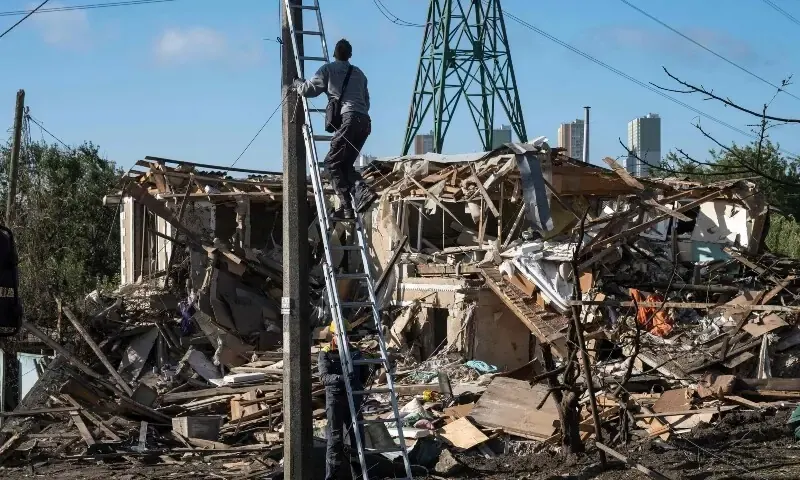
Zaporizhstal was struck by ballistic missiles in August 2026, killing seven workers and injuring 21, and was hit by two further missiles in September that hospitalised another worker; the plant absorbed 17 ballistic missiles in the month following an 11 August strike. Kametstal halted after a ballistic strike with reported deaths, and two contractors were killed and two staff injured at ArcelorMittal Kryvyi Rih on 12 September. By September, all three major plants, employing more than 15,000 people, were idle.1
Economic weight of the sector
Steel output fell 57.3% in August year-on-year, with pig iron production down 65.6%, and the sector could produce zero steel in October, according to Euromaidan Press. Directly, the sector gives jobs to more than 70,000 workers, with a further 250,000 employed in related industries; it contributes close to $1 billion a year in taxes and makes up 6% of Ukraine's GDP along with 13% of foreign-currency income. Ukraine's crude steel production fell from 21.4 million tonnes in 2021 to 7.4 million tonnes in 2025, with August 2026 output at 277,000 tonnes.41
Metinvest CEO's office chief Oleksandr Vodoviz, an executive at the firm owned by Ukraine's richest man Rinat Akhmetov, commented on the strikes: "They knew everything about the plant, they knew exactly where to hit." He continued: "As of today, [Ukraine] doesn't have a steel industry any more." Describing the aftermath at a targeted facility, he said: "Furnaces and steel frames were badly damaged, people had been killed, and from air-raid warning about two minutes to reach shelter."1
Industry calls for help
Industry figures and European lawmakers have urged intervention. Oleksandr Kalenkov said of the suspensions: "We don't really have another choice. Otherwise, we will have to stop production until the end of the war, which could last for many years." Steelmaker representatives warned Ukraine's prime minister in September that the sector was approaching a breaking point, as the European Union's June trade rules limited market access and Russia's closure of Black Sea ports forced companies to pay 50%-60% more for alternative transport routes, though 51 countries have backed Kyiv on the Black Sea trade route.6
Swedish member of the European Parliament Karin Karlsbro said: "If we seriously want to support Ukraine's ability to defend itself, we must do what we can to support the industrial infrastructure," warning that "if Ukraine's economy collapses, Ukraine will have much more difficulty defending itself and will be much more dependent on support from the EU." Vodoviz said a recovery fund "could help affected producers finance emergency repairs, restore production capacity, and make operations more resilient," adding that "Ukrainian producers cannot finance large-scale decarbonization while repeatedly rebuilding after missile attacks." Analyst Stanislav Zinchenko said: "No one will invest in recovery into a void," and that if conditions are met, "bringing the plants back to baseline could take three to six months, with a full rebuild one to two years."46
Framed as economic war
Alyona Bilan framed the wider conflict in economic terms, stating: "There is a war of attrition, and now an economic war of attrition – Russia is trying to hurt Ukraine's economy as much as possible and so does Ukraine." Analyst Denys Sakva cautioned that the closures could spill over into construction, noting: "Building firms will have to import more expensive steel from Europe, hiking construction prices, fueling inflation." According to Russian sources, Zaporizhstal supplies pig iron and rolled steel used by both Ukrainian and European defense manufacturers.16
Why it matters
A collapse in Ukraine's steel sector would remove one of the country's largest sources of foreign-currency earnings and tax revenue just as European lawmakers argue that industrial capacity underpins Kyiv's ability to defend itself. European construction firms and markets could also face higher steel prices and inflation if Ukrainian supply disappears and the EU is asked to fund recovery or adjust trade rules.64
Related stories
background
same actors
same actors
Version history
- version 1 ·