World · United States of America, Islamic Republic of Iran, Saudi Arabia
Trump Rejects Iran's Hormuz Ceasefire Offer, WSJ Reports
Iran had proposed reopening the Strait of Hormuz and resuming nuclear talks within seven days, but Donald Trump turned down the offer as Saudi-led forces intercepted Houthi projectiles aimed at Riyadh.
The Wall Street Journal reported that Donald Trump declined a conditional offer from Iran to reopen the Strait of Hormuz and resume nuclear negotiations. Iran's Foreign Minister Abbas Araghchi had offered to reopen the waterway within seven days if Washington halted alleged acts of aggression, ended a naval blockade and economic pressure, and released Iranian assets. Trump confirmed the rejection and said Iran was seeking a quick deal because it was losing badly, citing the U.S. blockade's economic toll.
The rejection came as Saudi-led coalition forces said they intercepted drones and a ballistic missile fired by Iran-backed Houthi rebels toward Riyadh and other Saudi targets. Iran said the proposal had been passed to Washington via Qatari mediators at the United Nations General Assembly, while Iranian officials insisted only diplomacy can end the conflict. Oil prices fell sharply for the week despite the rejection being reported.
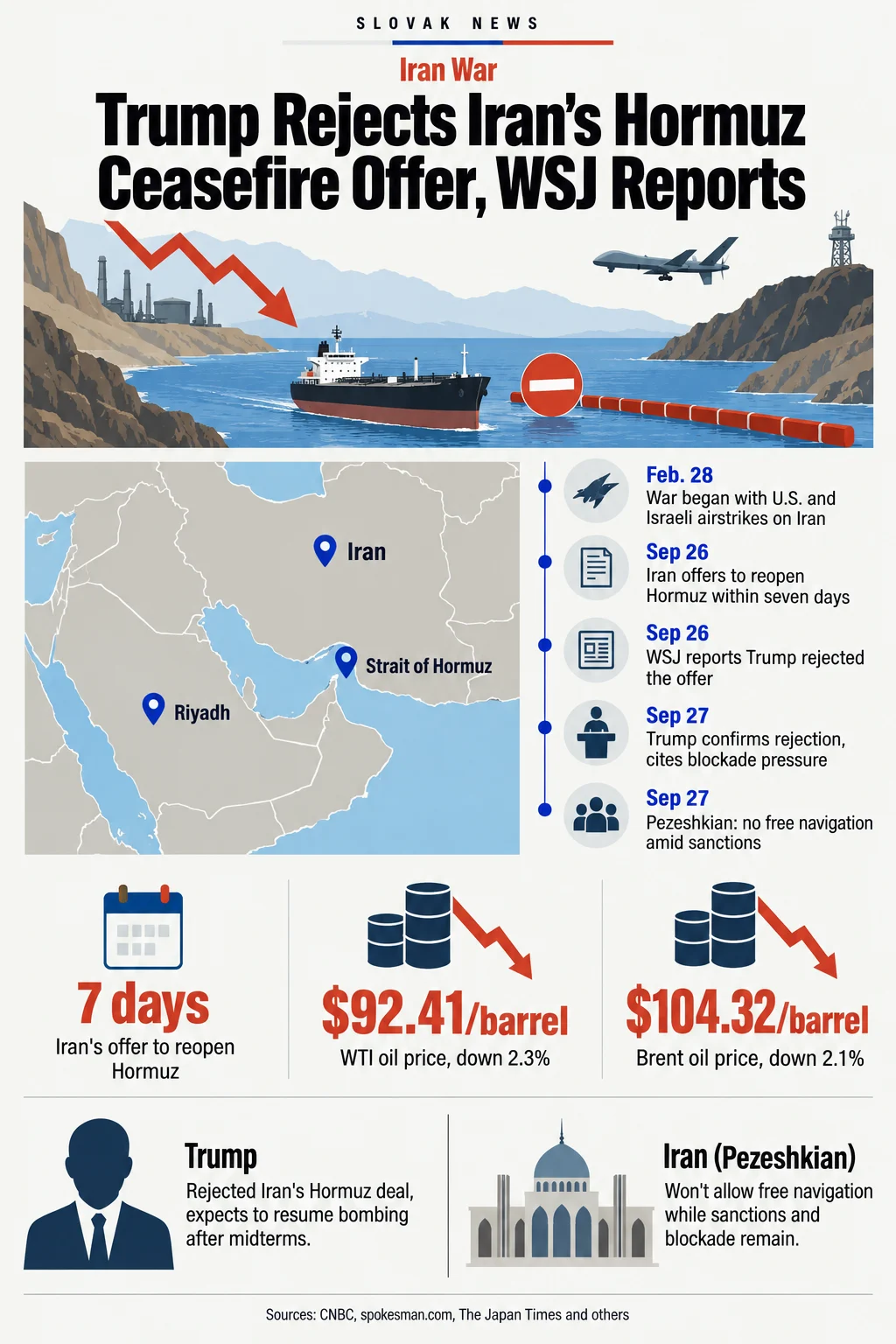
Infographic text
Trump rejected Iran's offer to reopen the Strait of Hormuz within seven days, as Saudi forces intercepted Houthi projectiles aimed at Riyadh.
- Iran offered to reopen Hormuz and resume nuclear talks within seven days
- Trump confirmed he rejected the proposal
- Saudi coalition intercepted Houthi drones and a missile near Riyadh
- Oil prices fell sharply for the week despite the rejection
- Trump reportedly expects to resume bombing after midterms
Listen to the story
Short version · read by a synthetic voice

What's new
- Trump rejected Iran's conditional plan to reopen the Strait of Hormuz, according to a Wall Street Journal report
- Saudi-led coalition forces said they intercepted two drones and a ballistic missile aimed at Saudi targets
- Iran said the proposal was passed to Washington via Qatari mediators at the U.N. General Assembly
- Oil prices fell sharply for the week even as the rejection was reported
According to a Saturday report from the Wall Street Journal, Donald Trump turned down a conditional offer from Iran to lift restrictions on the Strait of Hormuz and restart nuclear negotiations, even as Saudi-led coalition forces reported shooting down drones and a ballistic missile launched by Iran-backed Houthi rebels toward Riyadh and other Saudi sites.142
Iran's Offer
Iranian Foreign Minister Abbas Araghchi proposed reopening the strategic waterway and resuming nuclear talks with the United States within seven days if Washington accepted certain conditions, according to the Wall Street Journal's account cited by CNBC. "If certain conditions are met, the Strait of Hormuz will be open at the end of seven days, and talks will be restarted," Araghchi said. Tehran's conditions reportedly included halting U.S. acts of aggression, ending the naval blockade and economic warfare, and releasing Iranian assets.1
According to the Japan Times, Iran said it raised this initiative during the U.N. General Assembly in New York, transmitting it to American officials via Qatari mediators in an effort to end the broader Middle East conflict and reopen the waterway within seven days. Iran was reported to have engaged its Saudi rivals over the strait as it awaited an official U.S. response.3
Trump's Response
Trump confirmed, according to CNBC, that he had turned down Iran's latest offer. "They made a proposal but I rejected it," he said. He also told reporters, according to spokesman.com, that Iran was seeking an immediate deal because it was "losing so badly," adding that the U.S. naval blockade in the Strait of Hormuz was increasing economic pressure on Tehran.12
Trump reportedly told aides he expects the war to end shortly after November's midterm elections and expects oil prices to fall afterward, according to the Wall Street Journal report cited by CNBC. He was described as skeptical that Iran would meet his demands and as viewing a renewed U.S. bombing campaign against Iran as likely once the midterms have passed. Trump declined to answer directly when asked whether he would resume bombing after the elections, according to spokesman.com.12
Washington and Tehran were reported to still be negotiating through mediators, with U.S. demands aimed at preventing Iran from developing a nuclear weapon. CNBC reported that direct military clashes between U.S. and Iranian forces have significantly declined over the past several weeks. The conflict began on Feb. 28 with U.S. and Israeli airstrikes on Iran, according to the Wall Street Journal report cited by CNBC, and was seven months old, according to the Japan Times.13
Attacks on Saudi Arabia
Coalition spokesman Turki Al-Maliki said Saudi-led forces shot down two Houthi-launched drones headed for Riyadh along with two ballistic missiles targeting the Khamis Mushait area. The Houthis claimed responsibility for striking "sensitive" locations in Riyadh, a claim that followed reports of fire and smoke near the city's principal airport. Per spokesman.com, Riyadh was targeted by Houthi forces over the weekend, following an earlier incident a week prior in which air defense systems shot down incoming missiles and prompted air raid warnings for city residents.12
Saudi Arabia said its air defenses had earlier this month destroyed a Houthi drone headed for Mecca, a claim the group denied. Saudi civil defense also issued alerts of potential danger in Abha and Jazan, according to spokesman.com. CNBC noted that Houthi rebels backed by Iran, operating from Yemen, have intensified their assaults on Saudi Arabia over recent weeks.12
Oil Markets and Iran's Position
The war has severely restricted energy shipments from the Middle East and pushed oil prices higher, raising concerns about accelerating global inflation, according to CNBC. Nevertheless, oil prices declined steeply over the week while Iranian and American representatives conducted talks on the margins of the United Nations gathering. West Texas Intermediate closed down 2.3% at $92.41 per barrel, and Brent crude ended 2.1% lower at $104.32. U.S. crude ended the week down 7.9% while Brent held steady; year-to-date, WTI has gained close to 61% and Brent has climbed over 71%.1
U.S. Treasury Secretary Scott Bessent said the American-led effort to economically pressure Iran was "bearing fruit," saying, "We will continue working together as there is more to be done to prevent Tehran from carrying out its terrorist agenda," according to spokesman.com. Speaking at the United Nations General Assembly, Iranian President Masoud Pezeshkian stated that Iran would block free passage through Hormuz as long as sanctions and the U.S. blockade persisted, and that the country would not relinquish its right to pursue nuclear technology for civilian economic purposes. Iran's foreign ministry, through spokesman Esmaeil Baghaei, referred to continuing U.S. "acts of aggression." Sky News reported that Iran insisted only diplomacy can resolve its conflict with the United States and Israel.241
Why it matters
The war has severely restricted energy shipments from the Middle East and pushed oil prices higher this year, raising concerns about accelerating global inflation. Any prolonged closure of the Strait of Hormuz or renewed military escalation risks further volatility in fuel costs and inflation worldwide.1
How the story unfolded
The story's events over time. Click a person, place or related story.
What we know
- Trump rejected Iran's conditional proposal to reopen the Strait of Hormuz, according to the Wall Street Journal
- Iran's proposal was tied to a seven-day window and transmitted via Qatari mediators
- Saudi-led coalition forces reported intercepting Houthi drones and a ballistic missile aimed at Saudi Arabia
- Oil prices dropped for the week despite the rejection being reported
What we don't know yet
- Whether Trump will in fact resume bombing Iran after the midterm elections
- Whether Iran's full list of conditions will be confirmed by U.S. officials
- Whether CNBC's inability to independently confirm the WSJ report will be resolved
- Whether the Houthi attacks are directly coordinated with Iran's Hormuz proposal
Timeline
- Feb. 28The war began with U.S. and Israeli airstrikes on Iran.1
- Sep 26Saudi-led coalition forces said they intercepted two drones and two ballistic missiles aimed at Riyadh and Khamis Mushait.1
- Sep 26Abbas Araghchi proposed reopening the Strait of Hormuz and resuming nuclear talks within seven days if conditions were met.1
- Sep 26The Wall Street Journal reported that Trump had rejected Iran's proposal.31
- Sep 26Iran presented its diplomatic proposal during the U.N. General Assembly, relaying it through Qatari intermediaries.3
- Sep 26Oil prices dropped significantly over the week as U.S. and Iranian officials engaged in talks alongside the U.N. gathering.1
- Sep 27Iran said only diplomacy can resolve its conflict with the U.S. and Israel.4
- Sep 27Trump confirmed he rejected Iran's Hormuz deal and cited the naval blockade's economic pressure on Iran.2
- Sep 27Saudi-backed coalition forces reported intercepting further Houthi drones and a missile toward Riyadh and Khamis Mushait.2
- Sep 27Scott Bessent said U.S. economic pressure on Iran was bearing fruit.2
- Sep 27Masoud Pezeshkian said Iran would not allow free navigation through Hormuz while sanctions and the blockade remain.2
Quotes
They made a proposal but I rejected it.
If certain conditions are met, the Strait of Hormuz will be open at the end of seven days, and talks will be restarted,
They want to make a deal where they open the strait immediately because they’re losing so badly.
We will continue working together as there is more to be done to prevent Tehran from carrying out its terrorist agenda,
Related stories

Version history
- version 1 · 27 September at 09:31