World · United States of America
US Supreme Court Allows Trump to Resume Third-Country Deportations
The court's order lets the administration continue removing migrants to countries other than their own while a legal challenge proceeds, with three liberal justices dissenting.
Listen to the story
Short version
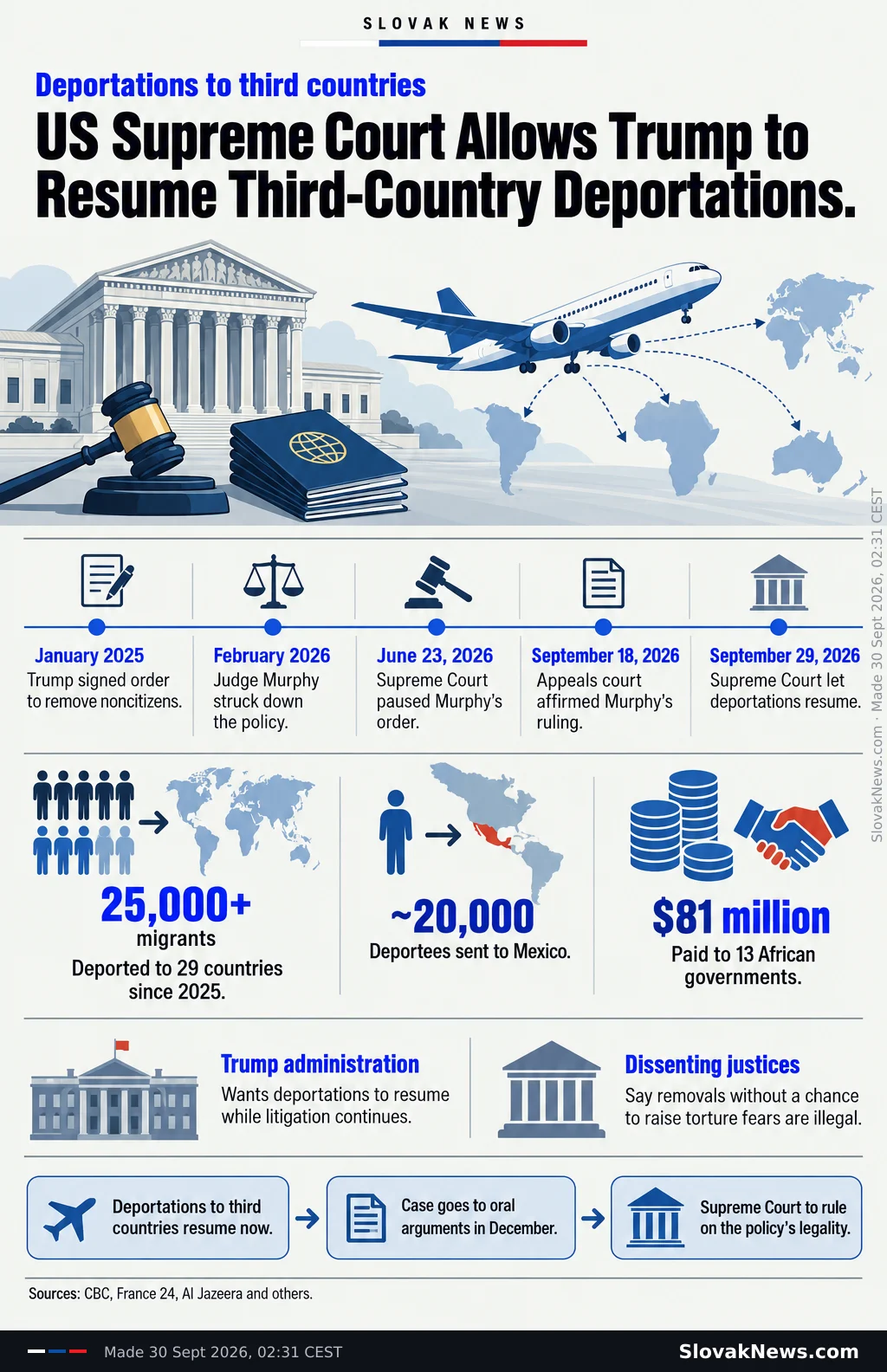
The Supreme Court let the Trump administration resume deporting migrants to third countries while litigation continues, over the dissent of three liberal justices.
- Ruling issued September 29, 2026; case to be argued in December
- More than 25,000 migrants deported to about 29 countries since 2025
- Most deportees sent to Mexico; deals also cover 13 African nations
- US paid over $81 million to governments accepting deportees
- Reports allege beatings, assault, detention and disappearance of deportees
Infographic
What's new
- Supreme Court lifted a lower-court order blocking third-country deportations
- Ruling paves way for deportations to resume while case continues
- Oral arguments on the underlying policy set for December
- Three liberal justices said they would not have granted the request
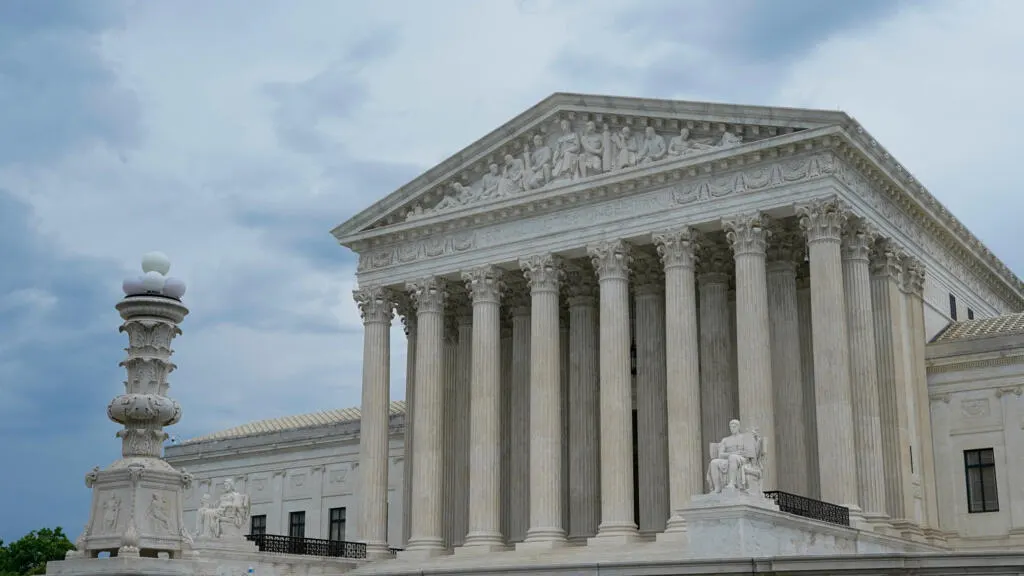
On September 29, 2026, the nation's highest court cleared the way for the Trump administration to once again send migrants to nations besides their own while the case moves forward, a decision opposed by Justices Sonia Sotomayor, Elena Kagan and Ketanji Brown Jackson, with the underlying dispute set to be argued before the justices in December.1345
Infographic
The order
The Supreme Court's order, described as apparently 6-3 in favor of the administration, lifts a lower-court requirement that migrants be given effective notice and a meaningful opportunity to argue they risk persecution before being sent to a third country. The three liberal justices dissented and said they would not have granted the administration's request.64
Solicitor General John Sauer told the court that lower-court restrictions had "created substantial logistical problems with removals." The administration argued that third-country deportation is an essential tool for removing certain aliens, including those with criminal records, and separately said allowing removals most urgent — including people convicted of murder, rape and kidnapping — would otherwise be delayed.49
Lawyers for the migrants countered that the order does not stop third-country removals altogether but requires the government to carry them out lawfully. They argued that this approach disregarded the serious damage caused when large numbers of long-term U.S. residents, most without any criminal record, are sent to countries other than their own."97
Policy by the numbers
Data gathered by France 24 shows that over 25,000 individuals have been removed to nations other than their own since Trump began his term in January 2025, with about 20,000 of those sent to Mexico. At least 5,447 people had been deported by flight to third countries as of August 31, 2026, with 28 countries on six continents having received deportees by that date.2
Thirteen African nations have signed third-country deportation agreements with the United States, and 12 of the 13 had received deportees by August 31, 2026, totalling about 450 people, according to France 24. Ghana alone has received more than 100 deportees. The Hindu similarly noted that around 25,000 individuals have been sent by the administration to upward of two dozen nations under confidential arrangements, most of them to Mexico.26
Washington has committed upward of $81 million across 13 countries tied to these removal arrangements, including over $15 million apiece to Guatemala and Honduras and more than $5 million each to six additional nations. The US also lifted five-year visa restrictions on Ghana following its deportation agreement.2
Legal history
President Trump signed an executive order in January 2025 directing the Department of Homeland Security to remove noncitizens, followed by internal DHS guidance the same month and further procedural guidance in February 2025. Four immigrants filed a federal court challenge in March 2026, and Boston-based District Judge Brian Murphy issued an order barring third-country deportations without notice and an opportunity to challenge them.7
The Supreme Court first paused Murphy's order in May 2025 after Sauer's request, granting the pause on June 23, 2026, with three justices dissenting. After Sauer sought clarification the following day about deporting eight men to South Sudan, the court issued an opinion on July 3, 2026, confirming the pause applied fully to those removals. Murphy issued a final judgment in February 2026 striking down the policy, which the 1st US Circuit Court of Appeals largely upheld on September 18, 2026, restricting but not outright banning third-country removals. The Supreme Court paused Murphy's order again on September 29, 2026, and scheduled oral arguments for December.7410
Human impact
According to the dossier, deportees have been beaten, sexually assaulted, detained or disappeared, with children, women and people with disabilities described as facing the gravest risk. Some migrants have reportedly been imprisoned in unfamiliar countries with serious safety concerns, and many deported have no criminal convictions despite facing risk of torture or persecution, according to The Hindu. Over 250 men have reportedly been confined in a maximum-security facility in El Salvador where conditions have been characterized as inhumane.4162
Rabbiatu Kuyateh, detained during a routine ICE appointment in Baltimore in July 2025, was told after four months in detention that she would be deported to Ghana. "I've known it as my home," she said of the United States. "I worked hard, I paid my taxes," she added, and asked, "Ghana? I'm not from Ghana; what am I going to do there?" Another woman, identified as Isatou, was removed to Ghana and then sent back to her country of origin, according to France 24.2
A group of over a dozen UN human rights experts issued a call for the policy to be stopped, while CBC noted instances in which third countries had unlawfully sent deportees back to the very home nations from which the US had granted them protection. South Sudan, one of the nations receiving deportees under this policy, is a place the US State Department advises citizens not to travel to because of crime, kidnapping and armed conflict.1
Why it matters
The case sets a precedent on how far a government can go in deporting people to countries with which they have no ties, and on what due-process protections apply when persecution or torture risks are alleged. For European readers, the ruling is relevant to ongoing debates over third-country return arrangements and the human-rights safeguards attached to them.21
Videos
Related stories
same actors

Version history
- version 1 ·