World · Islamic Republic of Iran, United States of America
Iran Unveils Economic Measures as US Tightens Sanctions and Blockade
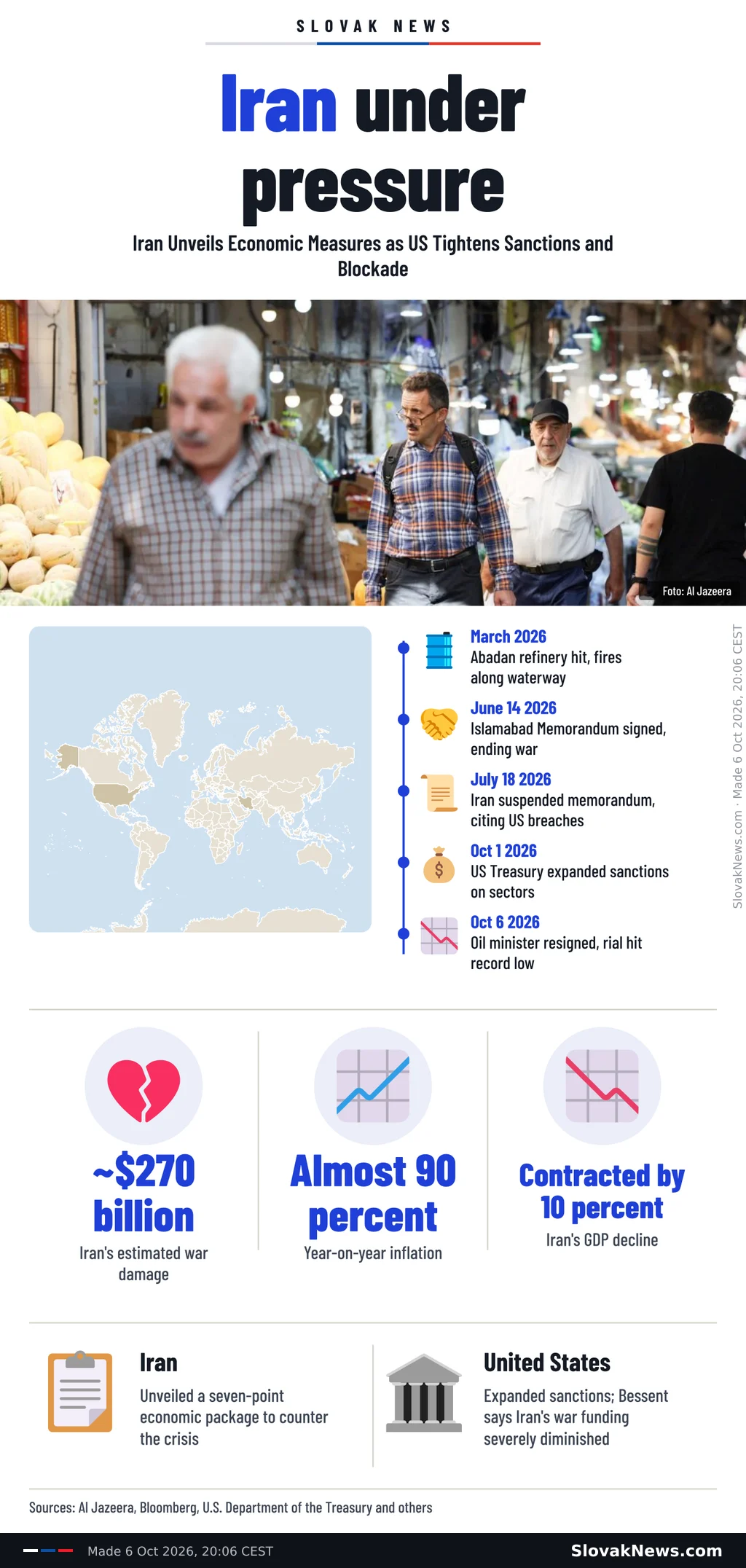
Tehran has announced a seven-point economic package and a new oversight committee as the rial hits record lows, inflation nears 90 percent and Washington expands sanctions under Operation Economic Outcast.
Listen to the story
Short version
Iran has announced new economic measures as US sanctions and a naval blockade tighten, with the rial at record lows, inflation near 90 percent, and the oil minister resigning amid an export crisis.
- Iran unveiled a seven-point economic package and new committee
- Rial hit record lows; inflation near 90 percent per one estimate
- Oil minister resigned amid export crisis, Oct 6
- US Treasury expanded sanctions on autos, rail, metals, Oct 1
- Iranian estimates put war damage at about $270 billion
Infographic
What's new
- On Oct 6, Iran's minister overseeing oil stepped down as an export-related crisis unfolded
- US Treasury sanctioned Iran's auto, rail, metals sectors and a Hong Kong-based trading network on Oct 1
- OFAC issued a fresh alert to foreign banks on Oct 5 warning of sanctions risk
- Satellite data cited by Iran put war damage at around $270 billion
Facing stricter US sanctions and a renewed naval blockade, Iran's government has rolled out a set of economic measures, even as the rial dropped to an all-time low, inflation climbed near 90 percent and the oil minister stepped down amid a crisis over exports, per Iranian and international coverage published from Oct 1 to Oct 6, 2026.156
Infographic
New measures announced
According to Middle East Eye, Iranian President Masoud Pezeshkian said officials have put in place a fresh approach for handling the present situation. He said economic pressure has intensified but that government measures have so far stopped the aims of what he described as an economic war from being realised.6
Pezeshkian said: "The enemy's plan in recent months has been to cut off the country's vital arteries with the aim of pressuring the noble people of Iran," and added that negotiations with the United States are meaningless, saying: "There is no point in negotiating with an enemy that terrorizes, sanctions, pressures, and threatens on a daily basis."6
According to Al Jazeera, Iran's Plan and Budget Organisation has presented a seven-point package intended to help the country overcome its challenges in an orderly manner, with economic policy meant to focus on helping vulnerable groups, including female-led households. Tehran's conservative mayor Alireza Zakani, central bank governor Abdolnaser Hemmati and Interior Minister Eskandar Momeni have been named to an economic committee, the outlet reported. Pezeshkian also said: "We are working to ensure that under no circumstances are electricity and energy supplies to producers and businesses cut off."1
Deepening economic strain
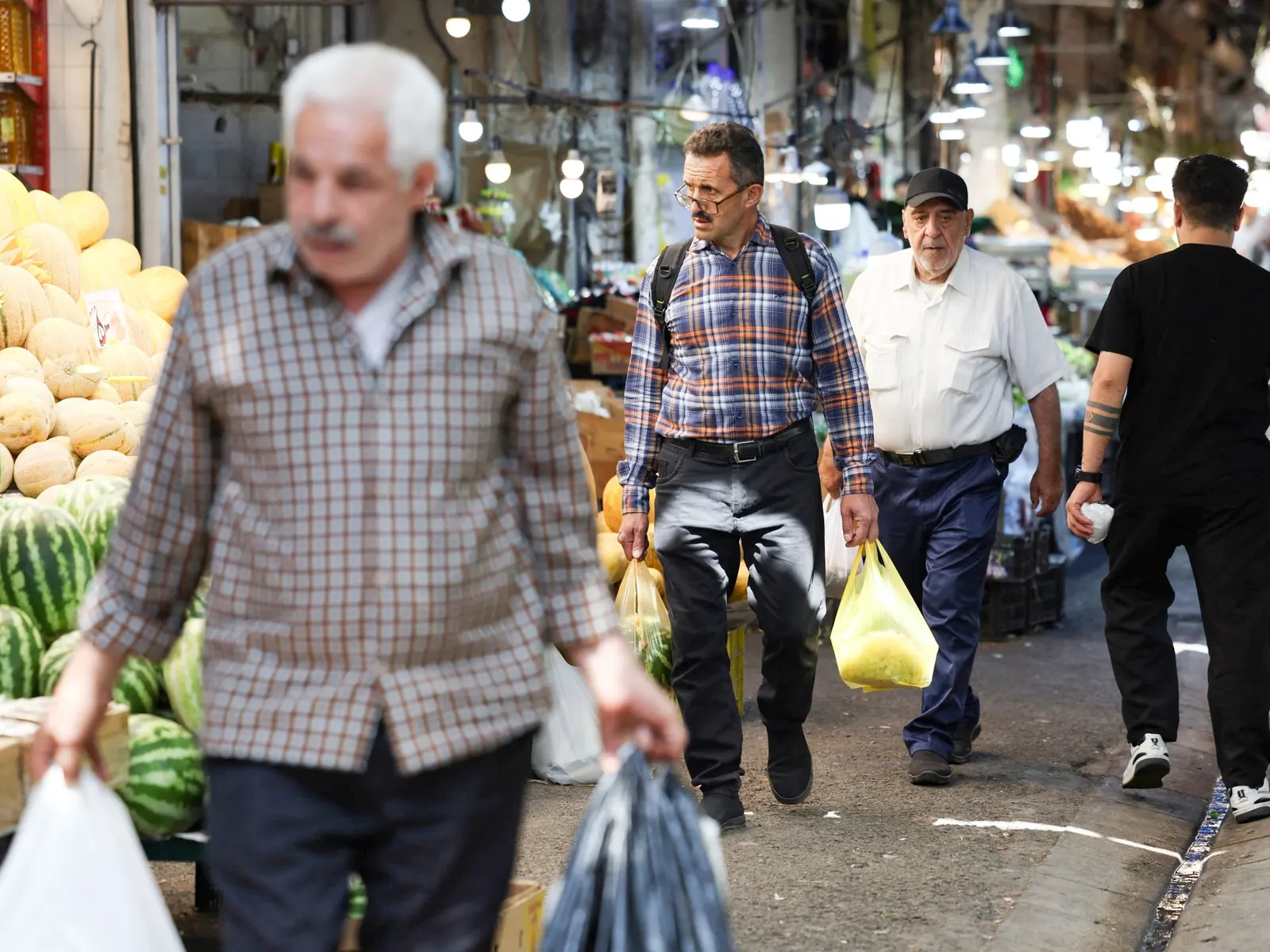
The Iranian rial has sunk to record lows, according to Al Jazeera and Iran International. Iran International reported that year-on-year inflation has reached almost 90 percent, and that US sanctions together with the naval blockade are squeezing the country's revenue. Al Jazeera reported that Iran's GDP has contracted by 10 percent, which it attributed to the collapse in energy exports caused by the blockade, and that the economic situation has deteriorated for consumers, particularly through higher food prices.15
Citing satellite analysis, Bloomberg reported that Tehran estimates the overall cost of strike damage at roughly $270 billion, a sum it noted nearly matches the IMF's full projection of Iran's 2026 GDP of $300 billion. Bloomberg reported that inflation is projected to top 70 percent and that many private businesses are shuttered or operating at only partial capacity.2
Iran International reported that the oil minister stepped down as an export crisis unfolded alongside contested claims about sanctioned oil sales.5
US sanctions expand
The US Treasury said on Oct 1 that it had launched a new wave of sanctions under Operation Economic Outcast, targeting Iran's automotive, rail, manufacturing and metals sectors, which it described as the country's remaining industrial lifelines. The Treasury said seven Iranian automotive companies, five foreign automotive parts suppliers, three Iranian rail companies, the Heavy Equipment Production Company and its China-based subsidiary, and German and UAE-based steel suppliers were designated. It also said Ramin Keshvardoust, described as a Hong Kong-based Iranian and Dominican businessman, and a network of five shell companies linked to him, along with Mehnoosh Poursaraf Hamedani, were designated for facilitating Iranian steel and oil exports worth tens of millions of dollars.3
Treasury Secretary Scott Bessent said: "The Iranian regime's ability to fund its war machine and inflict terror on the world has been severely diminished thanks to Operation Economic Outcast," adding that the action "directly targets Iran's enablers and lays the groundwork for the United States and our partners to drain the regime's revenue once and for all." The Treasury said the US military maritime blockade has taken hold and that Iran's oil revenues have fallen to zero. Separately, OFAC issued an alert on Oct 5 warning foreign financial institutions of sanctions risk for conducting business with sanctioned Iranian banks.37
Trade routes and shortages
Maryam Ashrafi, an analyst with the Bourse and Bazaar Foundation, told Al Jazeera that while standard large freighters typically haul more than 80,000 tonnes of farm goods, vessels on the substitute Caspian Sea path are capped at 7,200 tonnes, and overland trucks can move only around 20 tonnes each. Al Jazeera also reported that raw materials for Iran's pharmaceutical industry are increasingly difficult to find.1
Economist Saeed Laylaz said: "we have enough basic commodities in stock, and even if the embargo continues, we will not face a problem in securing them, because we have suitable routes, sufficient resources, and trading partners who can help us." Al Jazeera reported that the government ought to have readied itself for shrinking resources and trade interruptions once war looked likely, and that ending the blockade now ranks among Iran's top demands in its Strait of Hormuz talks with Washington.1
Infrastructure damage disputed
The National Iranian American Council said Israel destroyed 70 percent of Iran's refining throughput at peak and 70 percent of its steel production capacity, and that more than 80 energy facilities were struck region-wide. It said 27 airports were damaged, with Bushehr International destroyed outright, along with 12 bridges, two tunnels, more than 210 health centres, six hospitals, at least 1,288 schools and 32 universities. It said internet connectivity dropped to just 12 percent of pre-war levels, over a million jobs disappeared, food prices surged past 100 percent inflation, and 40 percent of Iranians were already living beneath the absolute poverty line. According to the group, the conflict's damage cut natural-gas output by roughly 95 million cubic metres daily, bringing the overall damage total to about $270 billion.4
Volker Türk, the United Nations High Commissioner for Human Rights, said: "Attacks targeting civilian objects or infrastructure indispensable to civilian populations constitute serious violations of international humanitarian law and amount to war crimes," and warned that "attacks on energy infrastructure will only compound hardship." IEA Executive Director Fatih Birol called the situation "the greatest global energy security threat in history." The National Iranian Oil Refining and Distribution Company said: "Fuel supply and distribution remained stable and uninterrupted nationwide," while a Bandar Abbas resident told IranWire that "no independent photographer was permitted near the bombed sites."4
Why it matters
Disruption to Iran's energy exports and the naval blockade touch global oil markets and shipping routes that affect prices and supply security in Europe. Continued strikes on civilian infrastructure and allegations of international humanitarian law violations raise questions the UN has flagged as having wider humanitarian and environmental consequences.24
Related stories
background
same actors
same actors
Version history
- version 1 ·