World · Islamic Republic of Iran, United States of America
Iran's Cost Of Living Soars As US Blockade Grinds On
Seven months into war with the United States, Iranians describe collapsing incomes, a plunging currency and stalled diplomacy, according to multiple accounts gathered by international outlets.
Listen to the story
Short version
Iran's economy is under severe strain from a US oil blockade and sanctions, with inflation above 80 percent and the rial at record lows, while diplomacy to end the war has stalled.
- Inflation has stayed above 80 percent for months
- Rial hit fresh record low against dollar, Sept 29
- US rejected Iran's plan to reopen Strait of Hormuz
- Oil flows through Hormuz recovered to ~80% of prewar levels
- US officials suggest bombing may resume after midterms
What's new
- Iran's rial fell to a fresh record low against the dollar, reported Sept 29
- Oil and fuel shipments moving through the Strait of Hormuz climbed back to about 80% of their prewar volume thanks to convoys accompanied by military vessels, reported Sept 29
- Diesel prices surged past $6 a gallon, reported Sept 29
- Trump rejected Iran's seven-day road map for reopening the Strait, reported Sept 27
Iranians are cutting meals, postponing marriages and losing jobs as the cost of living soars seven months into war with the United States, according to residents interviewed by The Jerusalem Post and other outlets, with the US oil blockade and renewed sanctions squeezing the economy from multiple directions.436
Households under strain
Grocery shop owner Ramin Yousefnia in Tehran said customers have significantly cut what they buy, a pattern echoed across the private sector as heavy job losses take hold, according to accounts gathered by The Jerusalem Post. Iranians who were once comfortably off now describe themselves as poor relative to their former lifestyle, and one man told reporters he paid $200 to a surgeon simply to bypass bureaucratic delays. Requests for bribes from police have also grown more frequent, and the cost of black market goods has risen.4
In interviews gathered separately, residents described similar adjustments. Solmaz, a government agency employee in Tehran, said fish has effectively disappeared from her family's diet and is now affordable only to well-off households, and she has stopped going to cafes and the gym because of transport costs. Online retailers Snapp and Digikala have expanded installment payment plans to cover groceries. Hediyeh, a woman in her 60s who lives in northern Iran and manages her household, said her pension no longer stretches far enough to cover medication, and Nazanin, a 34-year-old therapist based in Sanandaj, gave up cigarettes as a cost-cutting measure. Bijan, a 40-year-old former engineer, relocated outside Tehran after exhausting his savings and now offers tuition. "Just to survive," Ramin, an Iranian, said of his daily calculations.6
Iran's misery index reached 96 percent in June and July, and inflation has remained above 80 percent for months, according to Detroit News reporting via Reuters. Iran's currency hit over 200,000 tomans to the dollar in August before collapsing further; by late September it traded near a historic low. Mina, one resident, said price rises make it impossible to plan ahead, while Hamid said government policy has made life more expensive rather than easier.36
Oil, the blockade and the Strait of Hormuz
The United States reimposed a naval blockade in July, choking off Iran's oil exports, and in August the Trump administration launched a sanctions campaign described as its toughest yet, according to Detroit News. Iran can now move only around 250,000 barrels of oil overland by truck and train, a shortfall that is costing the government billions in lost revenue every month. During June, Iran hurried over 60 million barrels of oil out through its ports, and its stockpile sitting in tankers offshore had shrunk to roughly 30 million barrels by July, a supply it has continued drawing down at half a million barrels daily. Iran's economy was projected in July to contract by 5.4 percent over the following year.3
CNN reported that despite this, shipments of crude and fuel through the Strait of Hormuz have bounced back to close to 80 percent of their prewar pace under armed escort, even as the region's exports of refined fuel products still sit at only 58 percent of prewar volume and diesel costs have climbed above $6 per gallon. CNN assessed that Iran has lost considerable leverage in the Strait, a waterway it once used as a central point of pressure.7
US Treasury Secretary Marco Rubio said the goal of the sanctions push is to cut off all of Iran's financial ties to the rest of the world's economy. "You are preventing them from getting access to money that they will use to try and kill Americans," Rubio said. Experts warn Iran's government will not feel the full impact right away: Miad Maleki, who holds a senior fellow position at the Foundation for Defense of Democracies, noted that the naval blockade has sped up how quickly existing sanctions are taking hold, whereas Esfandyar Batmanghelidj of the Bourse & Bazaar Foundation predicted Iran might be "absorbing body blows" but would ultimately "stay on their feet, bide their time, and hit back."53
Diplomacy stalls
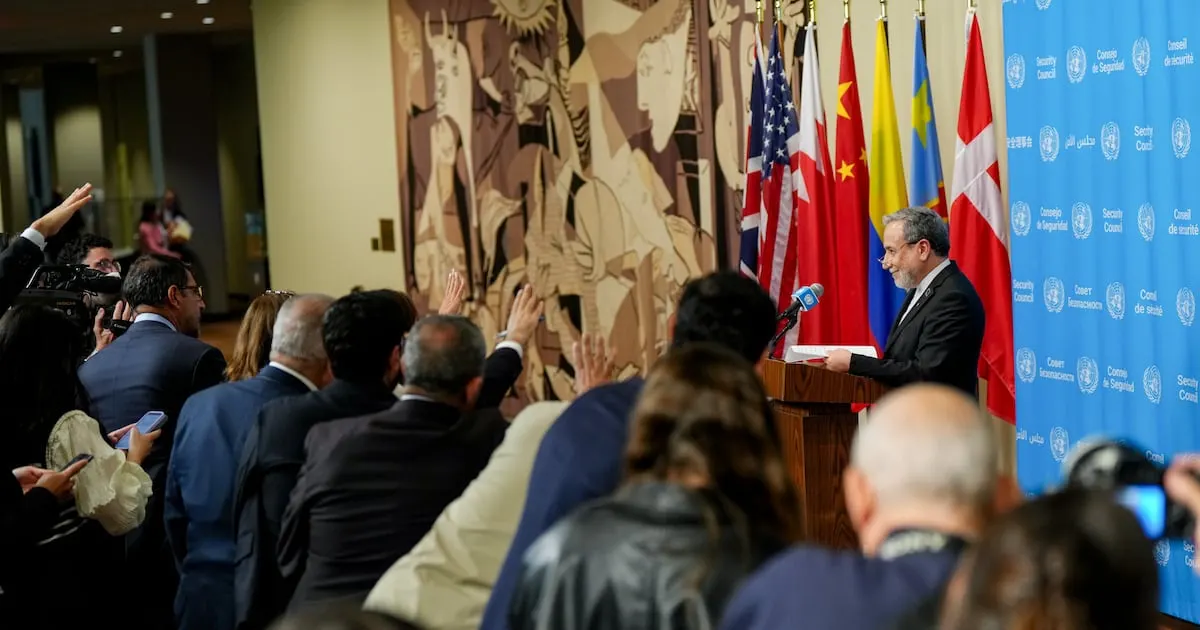
Economic strain has partly driven renewed diplomatic efforts, and Iranian officials have repeatedly expressed fears of domestic unrest, according to The Jerusalem Post; authorities killed thousands of demonstrators during nationwide protests in January that were sparked by the deteriorating economy. On the sidelines of the UN General Assembly, Iranian and US delegations held three hours of talks, according to The National. Foreign Minister Abbas Araghchi put forward a plan calling for the Strait of Hormuz to reopen within seven days in return for halting military action, easing sanctions and unfreezing Iranian assets, but Trump turned the offer down outright.42
President Masoud Pezeshkian said the combined effect of sanctions and the naval blockade has shrunk Iran's trade—both exports and imports—by close to 35 percent. Mohsen Rezaei, who serves as Secretary of Iran's Supreme National Security Council, gave the US a window of just four or five days to satisfy Tehran's demands, warning, "If they do not fulfil the conditions, we will neither open the Strait of Hormuz nor is there any negotiation on the table." Analyst Ali Vaez suggested the two governments have simply been failing to understand each other, and former US official Robert Malley contended that mounting economic and military pressure has weakened Iran's bargaining position since June. US officials speaking anonymously to the Wall Street Journal indicated that Trump anticipates restarting airstrikes on Iran once the midterm elections have passed. The two sides continued communicating through intermediaries, including Qatar, despite the absence of a formal negotiating round.2
Why it matters
Stalled diplomacy and reports that Washington may resume military action after the midterms raise the risk of renewed escalation in a region already under strain.27
Videos
Related stories
same actors
same actors
same actors
Version history
- version 1 ·