Climate · Fiji, Tuvalu
Pacific leaders press climate demands as Fiji pre-COP talks begin
The Nadi gathering is focused on the 1.5C warming limit, climate finance and ocean health before COP31 in Turkey. A smaller group of leaders will also visit low-lying Tuvalu.
Pacific leaders are using pre-COP31 talks in Fiji and Tuvalu to demand action on the 1.5C limit, climate finance, oceans and fossil fuels.
- The Nadi summit began on Oct. 5.
- Fiji prioritises 1.5C, finance access and ocean health.
- Fourteen national leaders were expected to visit Tuvalu.
- About 4,000 people attended the preparatory meeting.
- COP31 is scheduled to take place in Turkey.
What's new
- The pre-COP31 summit began in Nadi on Oct. 5.
- About 4,000 people joined the preparatory gathering, The Guardian reported.
- Fourteen national leaders were expected to travel to Tuvalu.
- Fiji set priorities covering the 1.5C limit, finance and oceans.
Pacific leaders joined ministers, officials and climate negotiators in Nadi, Fiji, on Oct. 5 for preparatory talks ahead of COP31, pressing governments to preserve the 1.5C warming limit, improve access to climate finance and give greater attention to ocean health. Deutsche Welle reported that representatives from about 60 countries were attending, while COP31 is scheduled to take place in Turkey.124
Pacific priorities
Fiji has set three broad goals for the talks and the COP31 negotiations: keeping the 1.5C global-heating threshold within reach, making climate finance faster and fairer for developing countries, and placing ocean health more firmly within climate policy. Small island and least-developed states are also seeking cooperation to help vulnerable countries adapt and strengthen their resilience.123
Those demands come as the temperature target appears increasingly difficult to meet. Deutsche Welle reported that a UN assessment published in September put warming at no less than 1.8C above pre-industrial levels even under its most favourable scenario. Separately, The Guardian reported that the UN Environment Programme expected the world to exceed the Paris agreement’s 1.5C goal and warned that every additional increment of warming would worsen extreme weather, glacier loss, damage to ecosystems and coastal inundation.12
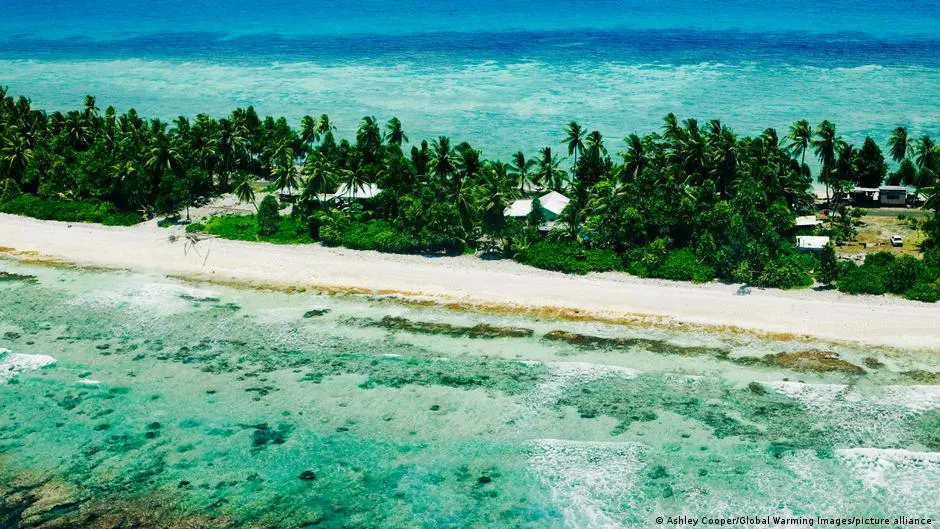
The effects of higher seas are already making some land uninhabitable. Deutsche Welle reported that Tuvalu lies, on average, only two metres above sea level and has experienced more frequent and severe flooding. France 24 reported that rising water had largely covered two of the country’s nine coral atolls, while a team including Rajneel Singh reported extensive coral deaths around Tuvalu.23
Tuvalu puts risk at centre of talks
Leaders attending the gathering were due to travel first to Tuvalu, where senior delegates planned a one-day retreat that would include discussion of possible population relocation. Fourteen national leaders were expected to make the journey, only two of them from outside the Pacific. The delegation was also set to include the EU climate commissioner, the UN climate chief, the incoming COP president, two institutional leaders and journalists.123
Tuvalu’s Prime Minister Feleti Teo has sought to frame sea-level rise as an immediate problem rather than a distant forecast. “Sea-level rise is not a future threat, it is a present reality,” he said. Anne Rasmussen, who heads climate negotiations for the Association of Small Island States, said that low tides reveal house footings and ancestral graves.23
Fiji’s Prime Minister Sitiveni Rabuka said the Pacific Ocean covers roughly a third of the planet and plays a central role in global weather. He urged other governments to treat Pacific countries as an early indication of challenges that could spread elsewhere, and warned that a developing El Niño could cause disruption in every country.1
Finance and fossil fuels
Climate finance remains another dividing line. Deutsche Welle reported that poorer countries have long pressed wealthier, higher-emitting states for more funding to prepare for climate impacts. Pacific and other vulnerable governments are seeking practical support for adaptation as well as stronger international commitments.12
Countries agreed in 2023 to begin moving towards an energy system that does not depend on coal, oil and gas, but Deutsche Welle reported that little progress had followed. Scientists say stopping the burning of polluting energy sources is the only way to bring temperatures back within internationally agreed limits. Australian Climate and Energy Minister Chris Bowen, who is president of the COP31 negotiations, advocated expanding renewable power and electrification to reduce the need for fossil fuels.12
Australia’s role is under scrutiny as it prepares to chair COP31 in partnership with Pacific countries. The Guardian reported that Australia has been criticised for approving large coal and gas projects, while France 24 said Greenpeace had urged Canberra to do more to end dependence on fossil fuels. Australia, for its part, said it was rapidly increasing renewable-energy supply.13
Attendance and political stakes
The Guardian reported that about 4,000 people attended the Nadi meeting. Anthony Albanese arrived for what the newspaper described as his first UN climate summit since becoming Australian prime minister more than four years earlier. Albanese said the meeting was important preparation for COP31 and that climate change threatened the existence of some participating Pacific nations.1
The relatively small number of leaders travelling to Tuvalu has also drawn political attention. The Guardian attributed the limited participation to the journey’s distance, geopolitical divisions and competing climate meetings in Antalya. Australian opposition politician Dan Tehan said the turnout showed that the Fiji conference was wasteful and described it as a “farce”; Albanese defended the gathering as necessary preparation for COP31.1
Why it matters
The planned Tuvalu delegation includes the EU climate commissioner, placing European representation directly inside discussions led by countries confronting higher seas. The talks also concern international commitments on fossil fuels, adaptation funding and the 1.5C target that governments will take into COP31 in Turkey.124
Related stories
Version history
- version 1 ·