Business · Russian Federation
Russia Submits Budget Plan With 16 Trillion Ruble Deficits
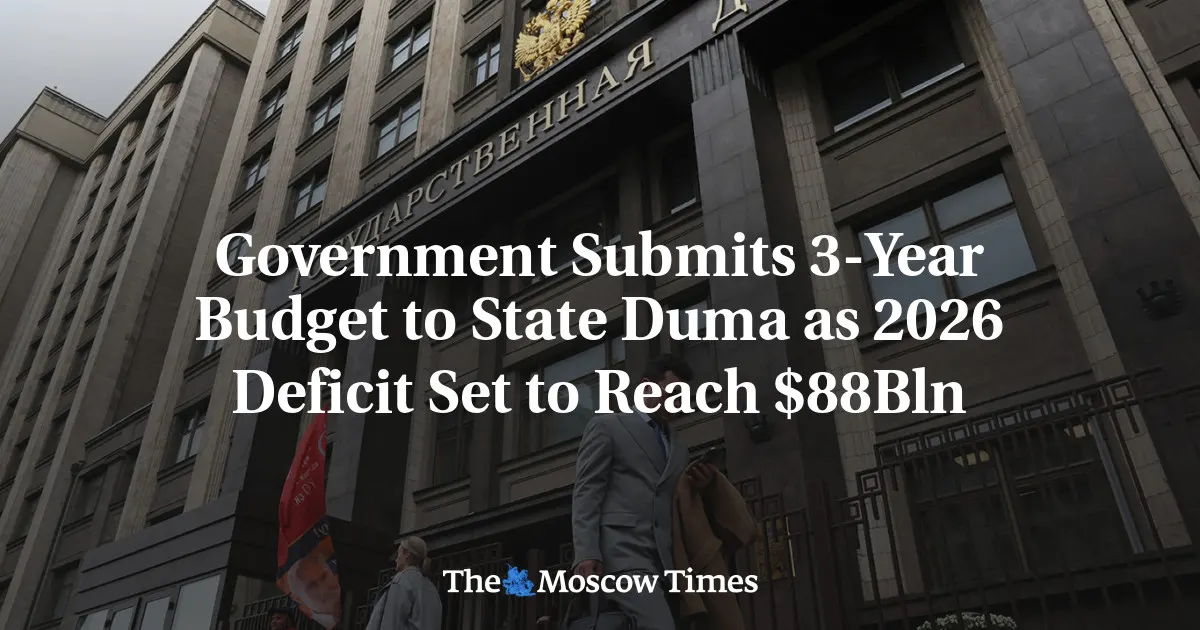
The three-year spending plan Moscow handed to the State Duma forecasts a combined budget gap of almost 16 trillion rubles, even as military outlays reach new highs.
Listen to the story
Short version
Russia's government submitted a 2027-2029 draft budget projecting nearly 16 trillion rubles in combined deficits and record defense spending.
- Combined 2027-2029 deficits projected near 16 trillion rubles
- 2026 deficit forecast raised to 7.345 trillion rubles
- 2027 defense spending set to exceed 17.1 trillion rubles
- Zero structural deficit target delayed to 2029
- Putin says deficit poses no critical risk to economy
What's new
- Government submitted the draft three-year federal budget to the State Duma
- 2026 deficit forecast raised to 7.345 trillion rubles
- 2027 budget earmarks record defense spending of over 17 trillion rubles
- Finance Ministry pushed the target for a zero structural deficit back to 2029
Russian officials delivered a three-year spending blueprint covering 2027 through 2029 to the State Duma, with shortfalls expected to total close to 16 trillion rubles across the period, Meduza and The Moscow Times reported. Prime Minister Mikhail Mishustin approved the budget order on September 30, and it appeared in the Duma's electronic system the following day, according to TASS.521
A wider gap for 2026
The Finance Ministry raised its estimate for the 2026 budget deficit to 7.345 trillion rubles, up from a previous forecast of 3.785 trillion rubles, according to The Moscow Times and Interfax. The government described the draft as balanced, stating, "The draft budget is balanced, which is an important condition for maintaining macroeconomic stability and reducing inflation."23
Interfax put the anticipated shortfalls at 5.5 trillion rubles for 2027, 5.1 trillion for 2028 and 5.3 trillion for 2029, with Meduza citing the same 2027 figure. The Moscow Times, however, put the 2027 figure at 5.443 trillion rubles. Finance Minister Anton Siluanov said the government had pushed back its fiscal consolidation timeline, stating that "the federal budget will now provide for reaching a zero structural deficit only by 2029." Mishustin told a government meeting that "the deficit averages about 2% of GDP annually over the three-year period," a figure bne IntelliNews said also applied to the 2027 plan, which it said was 72% larger than what had been planned a year earlier.3523
Defense spending and secrecy
The 2027 budget allocates more than 17.1 trillion rubles to national defense, according to TASS, Meduza and The Moscow Times, though TASS cited a more precise figure of 17.147 trillion rubles. According to The Moscow Times, that marks a 27% jump from current levels and accounts for over a third of all federal outlays, yet only 2.3 trillion rubles of it appears in public records, leaving 34.9% of the entire 2027 budget undisclosed.152
According to The New York Times, the 2027 spending plan calls for additional borrowing, steeper taxation and reduced social payments, and both warring nations are struggling more to fund the war. Meduza, however, noted that the government's official statement said nothing about reducing social outlays.45
Where the money goes
Beyond defense, the draft budget sets aside approximately 1.78 trillion rubles for education in 2027 and 12.9 trillion rubles for insurance pension payments through the Social Fund, according to TASS. Family mortgage subsidies for 2027 total 785.8 billion rubles. The budget also allocates over 337.646 billion rubles for space activities, over 1.069 billion rubles to replace decommissioned vessels, and over 26.7 billion rubles for construction of the Leader project icebreaker.1
Regional and infrastructure allocations for 2027-2029 include more than 100 billion rubles for development of the Greater Northern Sea Route, more than 269 billion rubles for Crimea and Sevastopol, and more than 865 billion rubles for restoration of Donbass and Novorossiya, TASS reported.1
Debt, taxes and the fiscal rule
Per TASS, overall government debt is projected to hit 53.9 trillion rubles by year-end 2027, with domestic debt's portion climbing to 89.1% that year, then 89.9% in 2028 and 91.3% in 2029. The Finance Ministry plans to issue 7.72 trillion rubles in ruble-denominated bonds in 2027. Interfax reported a base oil price of $50 per barrel for the fiscal rule in 2027-2030, projected GDP of 248.323 trillion rubles in 2027, 263.724 trillion in 2028 and 281.674 trillion in 2029, and inflation projected at up to 4% across all three years. Interfax further noted the National Wealth Fund won't be tapped to cover shortfalls over 2027-2029, and TASS said the fund is expected to grow by 1.082 trillion rubles in 2027, a year when oil and gas income is projected at 7 trillion rubles.13
TASS put the 2026 federal deficit at 3.2% of GDP, and VAT revenues for 2027 were cited by TASS at 20 trillion rubles, a figure not confirmed by Interfax. Meduza reported that the Finance Ministry had proposed a 22% value-added tax on cross-border e-commerce goods. President Vladimir Putin said "the size of the budget deficit poses no critical risk for the Russian economy, and that it will be managed," a view The Moscow Times said was echoed by analysts who consider a deficit of 4-5% of GDP manageable.12
Why it matters
The budget plan shows Moscow committing record sums to defense while running deficits for a fourth consecutive year, a pattern The Moscow Times said reflects a budget situation that has deteriorated over four and a half years. For European readers, the scale of military allocation and the share of spending kept classified bear on assessments of Russia's capacity to sustain the war in Ukraine.24
Related stories
background
same actors
same actors
Version history
- version 1 ·