Business · Islamic Republic of Iran
Hormuz Oil Flows Near Pre-War Levels, Prices Stay High
Multiple estimates in late September and early October show oil shipments through the Strait of Hormuz approaching pre-conflict volumes, even as crude prices remain near $100 a barrel and analysts dispute the exact pace of recovery.
Listen to the story
Short version
Crude volumes passing through the Strait of Hormuz have climbed close to where they stood before the war, yet prices remain near $100 a barrel as fears of renewed fighting persist.
- Recovery estimates range from 77% to 98% of pre-war Hormuz flows
- Brent crude trades back above $100 a barrel
- China suspends some October fuel exports, including PetroChina cargoes
- Saudi Arabia restores East-West Pipeline and Yanbu exports
- Iran's oil inventories reportedly nearing depletion under US blockade
Infographic
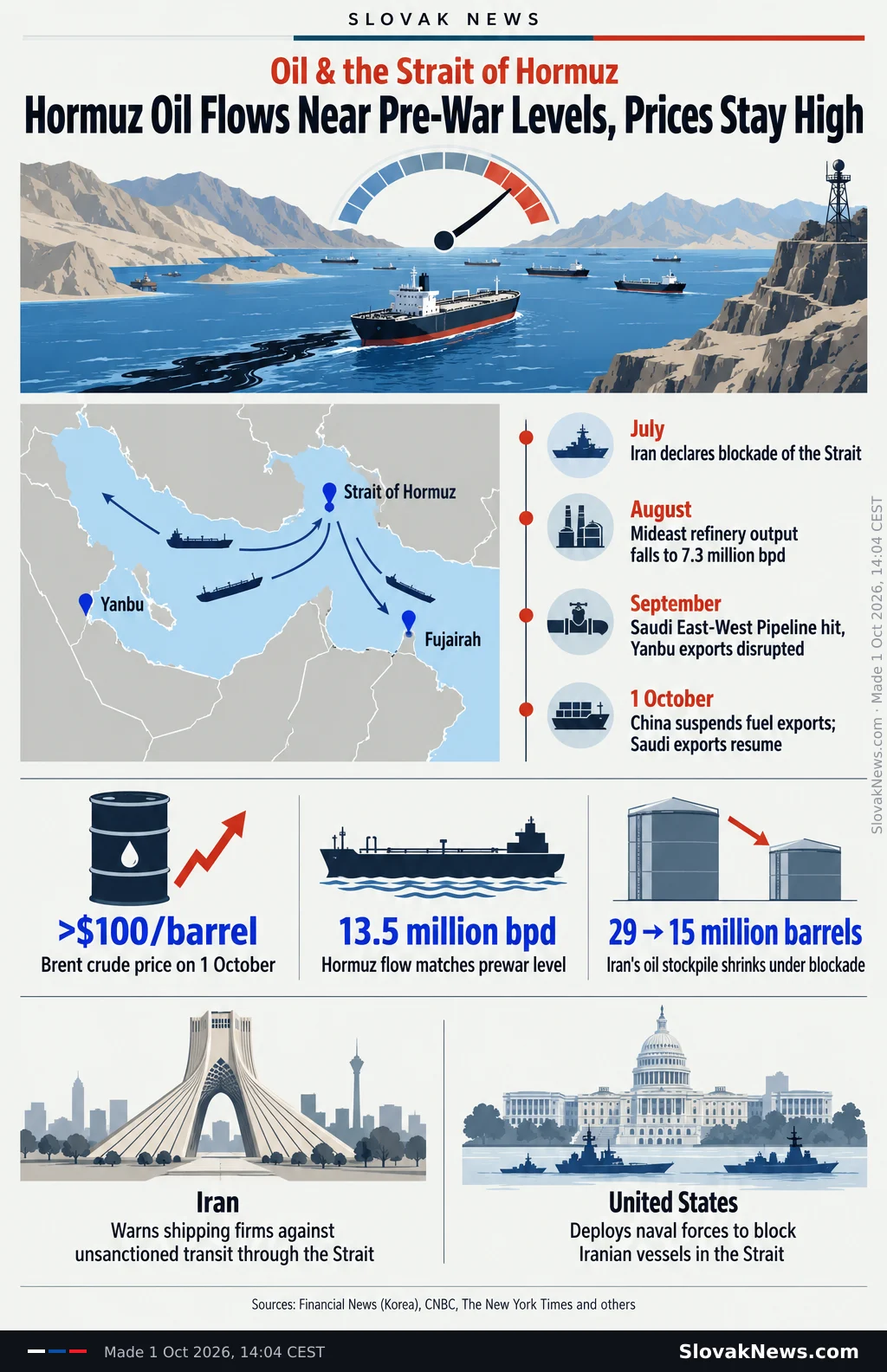

What's new
- Estimates of Hormuz recovery range from 77% to 98% of pre-war levels, with dossier sources disputing the figures
- Chinese refiners, including PetroChina, suspended October fuel exports, pushing oil prices higher
- Saudi Arabia restarted its East-West Pipeline and resumed tanker loadings from Yanbu
- US and Iranian officials held indirect talks on October 1, after which Rubio ordered Iran's delegation to leave the US
Crude volumes moving through the Strait of Hormuz have climbed to nearly where they stood before the conflict began, a range of industry and government assessments released between September 27 and October 1 indicate, even as oil prices remain near $100 a barrel and observers disagree on just how far the rebound has gone.1345
Infographic
Diverging estimates of recovery
Assessments published in late September and early October point to a rebound in flows through the Strait of Hormuz but differ on scale. Financial News estimated transport had recovered to approximately 80% of pre-war levels, with September's average daily crude volume at 9.36 million barrels per day, slightly below that threshold [s1]. Middle East Eye calculated the recovery at about 77% of pre-war levels, based on a weekly shipment average of 13.2 million barrels per day, but Iran International challenged that figure, noting that shipments on a single day topped 20 million barrels, surpassing pre-conflict totals [s6][s7]. TASS reported Middle East oil shipments had rebounded to 98% of pre-war volumes, with crude flows through the Strait matching late-June levels [s4]. According to ibtimes.co.uk, the amount of crude passing through Hormuz hit a weekly average of 13.5 million barrels per day by Monday, equal to the level seen before the war [s5].1456
Prices remain high
Despite the recovery in flows, The New York Times reported crude oil costs remained close to $100 a barrel, with traders worried hostilities could resume and concern that the world is drawing down emergency stockpiles [s3]. ibtimes.co.uk noted that Brent crude prices have lately fluctuated between the upper $90s and slightly over $100 a barrel [s5]. CNBC reported oil prices rose on October 1 after Reuters reported Chinese refiners had suspended October fuel exports, with PetroChina canceling gasoline and jet fuel shipments for the month to safeguard domestic supplies [s2]. Fuel supplies, particularly gasoline, were lagging behind the recovery in crude, according to CNBC [s2].235
Pipelines and alternative routes
Saudi Arabia resumed exports via its East-West Pipeline, previously attacked by the Houthi movement, and tanker loadings resumed from the Red Sea port of Yanbu, according to TASS and CNBC [s4][s2]. Trade Nation's top market analyst, David Morrison, remarked that the pipeline has shouldered much of the burden of exporting Gulf crude while Iran keeps the Strait of Hormuz blocked, noting that experts believe the pipeline is still operating well under its maximum capacity. Still, he said, simply having it operational offers a degree of relief [s2]. ibtimes.co.uk found that roughly 40% of regional crude exports now bypass Hormuz entirely, up sharply from 17% prior to the war, and that during August, over 70% of the oil that did transit the strait was transferred between tankers near Fujairah or Sohar [s5]. Shipments of refined products through the strait fell to a seven-day average of just 677,000 barrels per day, far short of the prewar figure of 3.6 million, and Kpler calculated that regional refineries were processing about 7.3 million barrels daily in August, a drop from 9.9 million in February [s5]. ibtimes.co.uk projected that volumes would not fully recover to prewar levels until at least the second quarter of 2027 [s5].245
Iran under pressure
Tehran imposed a blockade on the Strait of Hormuz in July, prompting Washington to relaunch major strikes against Iran on July 8 over alleged violations of a prior waterway agreement, in the wake of military action the US and Israel had initiated on February 28 [s4]. Financial News reported that the United States mobilized naval forces at the end of September to block Iranian vessels, that Iranian crude inventory held on tankers outside the US blockade declined from 29 million to 15 million barrels over September, and that Iranian attacks on vessels near the Strait had remained subdued for several days [s1]. US Treasury Secretary Scott Bessent said: "They will probably make their last oil delivery to China within the next two weeks, and after that there will be nothing left" [s1]. According to Kpler's projections, Iran's crude stockpile is on track to run out sometime between early and mid-October [s1]. Sanam Vakil, director of the Middle East programme at Chatham House, said: "Iran's strategy regarding the Strait of Hormuz is becoming increasingly ineffective," and warned: "To escape this predicament, Iran may have to provoke an incident itself or pull the trigger on a larger conflict, potentially leading to a more explosive phase" [s1]. Iran International noted that Tehran kept issuing cautions to shipping firms about unsanctioned transit despite the rebound in flows, even as US Navy escorts had by then helped guide over 2,000 commercial vessels through the area [s7]. Middle East Eye reported Iranian claims of intensified strikes against ships attempting to pass through the waterway, alongside ongoing negotiations over an Iranian proposal to restore full passage through the Strait within seven days [s6]. CNBC reported that US and Iranian officials held separate indirect talks with mediators on October 1, after which Secretary of State Marco Rubio ordered the Iranian delegation to leave the United States, and that a lasting resolution to the conflict may be delayed [s2].1246
Why it matters
Roughly a quarter of global oil trade and a fifth of LNG shipments pre-war passed through the Strait of Hormuz, according to TASS. Continued high prices near $100 a barrel, despite rising physical supply, signal that markets still price in the risk of renewed conflict, which could affect fuel costs and inflation across European economies.24
Videos
Related stories
background

background

background

Version history
- version 1 ·